Bid Assembly Automation: Compile Tender Documents in Hours Instead of Days
Your estimators and proposal writers are drowning in copy-paste from old Word docs. Company details get mistyped, past project sheets go stale, and every tender pack still takes days to assemble by hand.
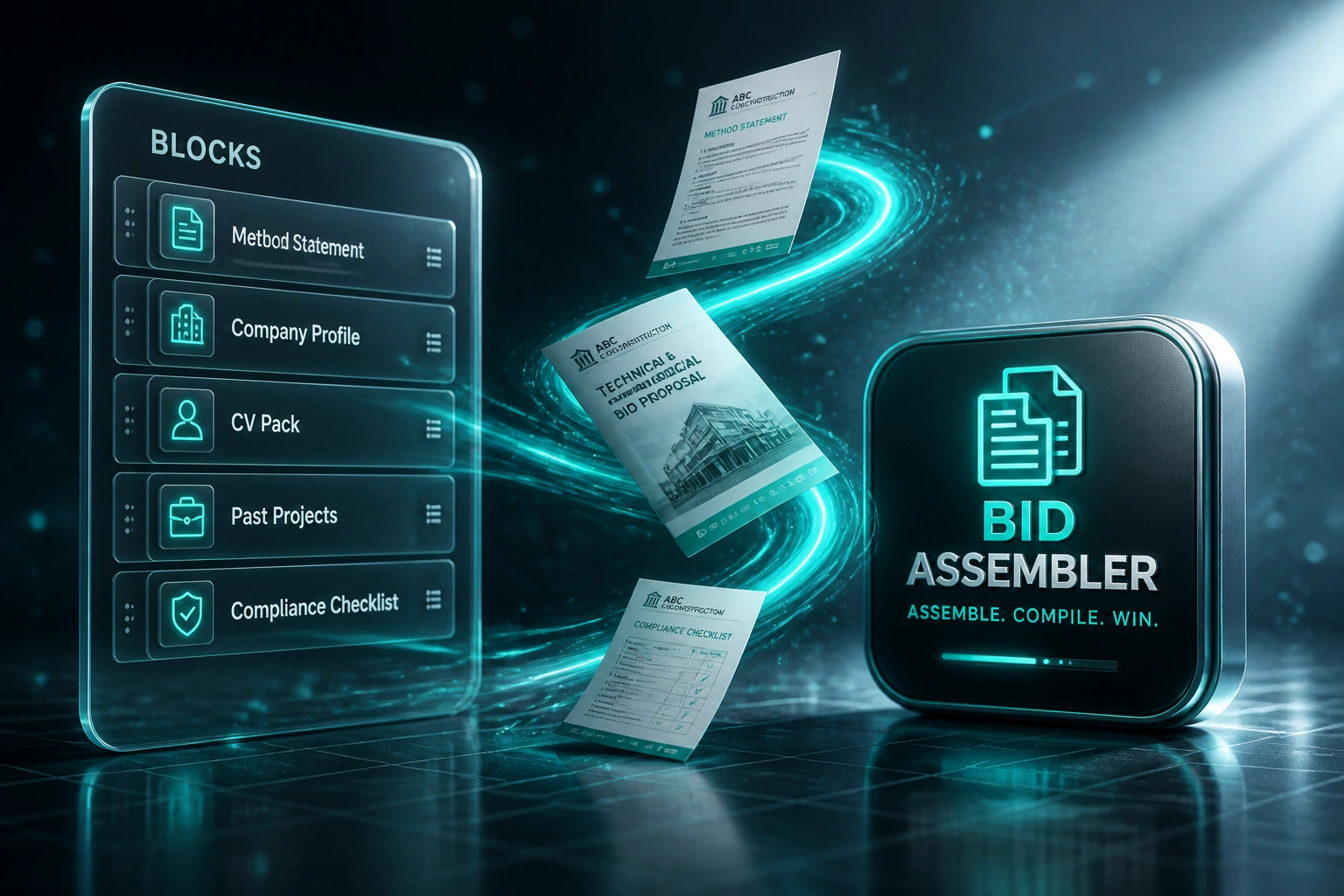
We build the content assembly engine that compiles a complete bid document set from reusable blocks.
Sound Familiar?
These are the exact issues our clients faced before bid assembly automation:
- Every tender starts from last year's Word dump, so estimators and proposal writers spend days hunting paragraphs instead of refining the offer
- Company particulars, tax numbers, and CIDB grades get retyped into cover sheets and get mistyped under deadline pressure
- CVs, past project sheets, and method statements go stale on shared drives while the live bid still ships yesterday's facts
- Compliance checklists are rebuilt by hand for each returnable schedule, so mandatory items slip until the night before close
- Bid assembly alone burns most of a mid-market RFP cycle, leaving almost no time for strategy, pricing, or a proper review
Public-sector and municipal tenders still reject packs for outdated company particulars and incomplete returnables. When every bid starts from last year's Word dump, those defects are almost inevitable under a hard portal close.
What Tender Document Compilation Actually Does
Select the tender shape → pull approved blocks → auto-fill company and staff → compile the pack for review.
Choose Pack Template
Bid manager picks the tender type: works, services, or goods, with the required returnable structure
Pull Content Blocks
Method statements, company profile, CVs, past projects, and boilerplate drop in from the approved library
Auto-Fill Master Data
Company particulars, CIDB, tax, and staff fields populate cover sheets and forms from one source
Compile Full Bid Pack
Narrative plus compliance checklist compile into a review-ready document set in hours, not days
Everything You Need for Reliable Bid Management Content
Reusable Content Blocks
Approved narratives for company profile, methodology, HSE, quality, and past performance live as tagged blocks. Writers assemble, not rewrite from scratch.
Auto-Populated Company Details
Legal name, registration, VAT, CSD number, CIDB grade, B-BBEE status, and addresses fill cover sheets and forms from one master record.
Method Statements & Narratives
Pull the right technical approach for the works category, then customise scope and programme without rebuilding the whole document.
CV & Past Project Sheets
Keyed staff CVs and reference project sheets stay current. Select the team and projects for this bid; the pack updates in one pass.
Compliance Checklist Compile
Returnable schedules, compulsory forms, and evidence lists compile alongside the narrative so the pack is complete before lock.
One-Click Bid Pack Output
Compile a structured document set ready for review: cover, technical schedules, CVs, past projects, and checklist in hours, not days.
Systems We've Connected for Bid Assembly
From 4 Days of Copy-Paste to Under 6 Hours
How a Gauteng civil contractor stopped rebuilding every tender pack from old Word dumps and recovered serious bid labour in year one.
The Manual Process
- Proposal lead opened three previous bids and hunted paragraphs for company profile and methodology
- Estimators retyped registration, VAT, CIDB, and CSD numbers into cover sheets under deadline pressure
- CVs and past project sheets were pasted from personal folders, often months out of date
- Compliance checklists rebuilt in Excel for each returnable schedule
- Full pack assembly routinely took 4–5 working days before technical review even started
The Automated Process
- Bid manager selects the works template and pulls approved content blocks in one pass
- Company particulars and staff fields auto-populate cover sheets and forms from the master record
- Current CV pack and past project sheets drop in by role and project type
- Compliance checklist compiles with the narrative so gaps show before lock
- Writers spend their hours customising scope and pricing, not hunting last year's Word file
Before vs After Bid Assembly Automation
How It Works
From first conversation to live bid compilation in 3–5 weeks.
Audit Your Pack Library
Which Word dumps you reuse, which company fields always change, and which CVs, projects, and method statements win work.
Free Scoping Call
30-minute call to design content blocks, master company fields, checklist templates, and how compilers hand off to review.
Build & Pilot
We seed the block library, wire auto-population, and compile a live tender in parallel with your current Word process.
Go Live & Coach
Proposal writers and estimators assemble from blocks. We monitor hours per pack, reuse rate, and copy-paste defects.
Frequently Asked Questions
How is bid document assembly different from tender management or portal submission?
Tender management tracks owners, deadlines, and pipeline. Portal systems chase SA compliance packs and upload status. Bid document assembly is the content engine in the middle: reusable narrative blocks, auto-populated company details, method statements, CVs, past project sheets, and checklists that compile a full bid pack in hours instead of days.
Will our proposal writers still control the wording?
Yes. Subject-matter experts own and approve each block. The system pulls the current approved version, fills company and staff fields, and compiles the structure. Writers customise the tender-specific sections; they stop retyping boilerplate and stale facts under deadline pressure.
Can it handle SA returnables like company particulars, CVs, and compliance schedules?
That is the core use case. Master company fields feed cover sheets and forms. CV packs and past project sheets select by role and works type. Compliance checklists compile beside the narrative so missing returnables surface before the pack is locked, not at portal close.
Where do the content blocks live, and how do we keep them current?
Blocks typically sit in SharePoint, Google Drive, or a governed library with owners and review dates. When B-BBEE status, CIDB grade, or a key CV changes, you update once. The next compile uses the current version instead of last year's Word attachment.
How long does a bid assembly system take to set up?
A focused build with a seeded block library, company auto-fill, and pack compile is typically live in 3–5 weeks. Multi-entity packs, CRM opportunity hooks, and deep checklist libraries usually sit closer to 5–7 weeks from scoping to go-live.
How much does bid document assembly automation cost?
Focused assembly builds with reusable blocks and auto-populated company details typically start from around R35,000. Multi-entity libraries, CRM hooks, and richer checklist compile usually sit in the R45,000–R80,000 range. Teams assembling several substantive packs a month often recover the build cost within 2–3 months from recovered bid labour alone.
Stop Rebuilding Every Bid From Old Word Docs
If your proposal team is still copy-pasting company details, CVs, and method statements for every tender, you are paying days of labour for a problem that reusable blocks already solve.
Tell us how many packs you assemble a month, where the Word dumps live today, and which returnables cause the most rework. We will show you exactly how automated document compilation would work for your bid desk.