Bidirectional Sync Conflicts: Repairing Two-Way Data Synchronisation Issues
Your HubSpot↔Xero or CRM↔ERP two-way sync keeps overwriting the "correct" value from both sides. Sales ops fixes a contact; finance ops fixes the same record; the next sync resolution ping-pongs the overwrite and data divergence spreads.
We implement field-level conflict policies, repair already-diverged state, and leave you with a stable two-way contract.
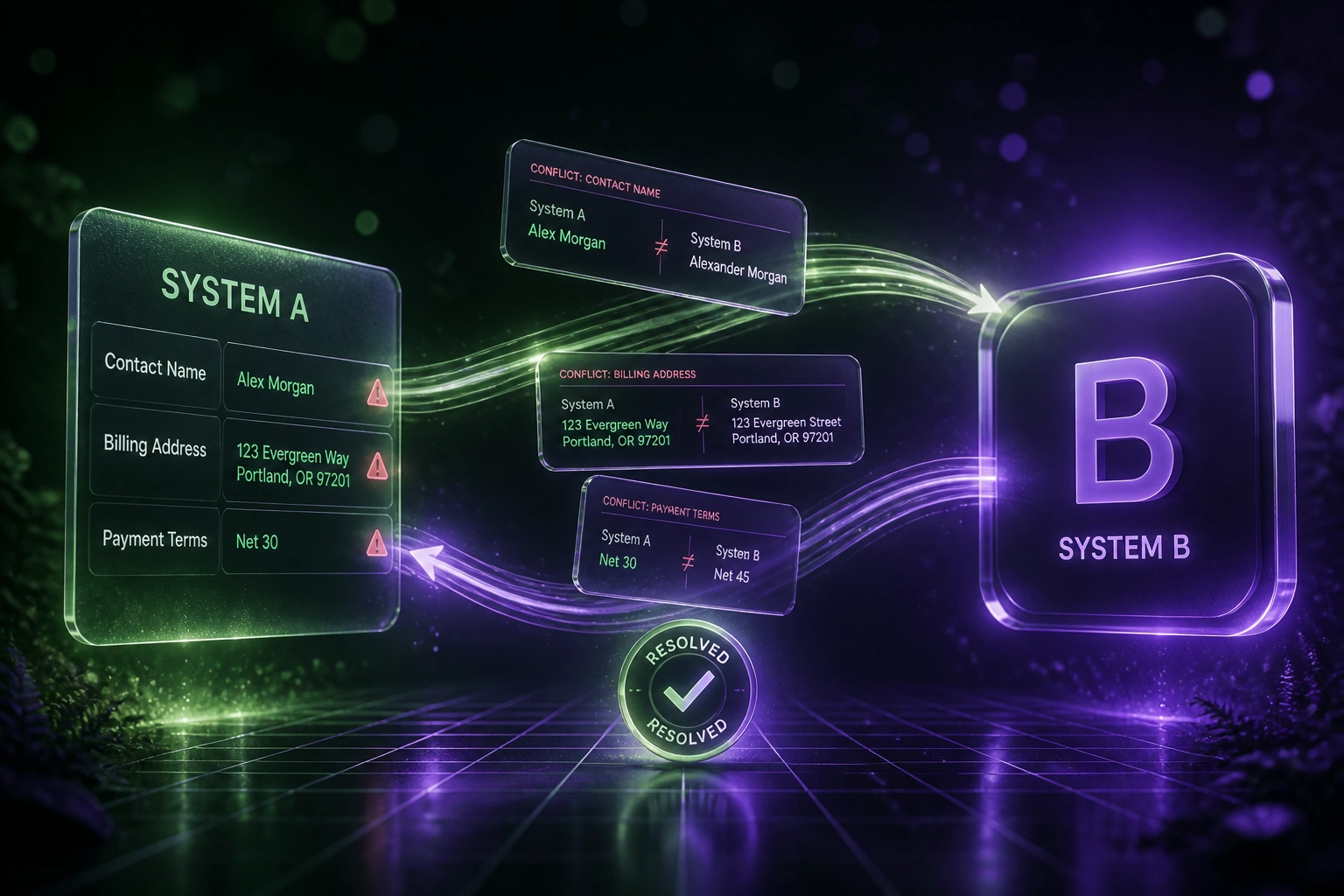
Sound Familiar?
These are the exact bidirectional sync conflicts our sales ops and finance ops clients faced before named field policies:
- Sales updates a contact in HubSpot while finance edits the same record in Xero or the ERP, and the next two-way sync overwrites the "correct" value on both sides in a ping-pong loop
- Native connectors default to last-write-wins on every field, so a workflow timestamp quietly beats a human-verified billing address or invoice amount
- Custom fields drop or map one-way only, so the two-way contract looks healthy while critical properties never sync back
- Ops spends hours each week untangling contacts and invoices that already diverged, with no field-level policy saying which system owns what
- Nobody trusts either system of record, so month-end and collections become forensic archaeology instead of a controlled close
Native two-way connectors still default many fields to "most recently updated wins." After Xero retired its native HubSpot integration in March 2026, teams rushing onto Data Sync or marketplace connectors often inherit last-write-wins with no field ownership, while custom properties quietly drop or sync one direction only.
What Bidirectional Sync Resolution Actually Does
Both sides edit → conflict detected per field → owner, timestamp, or queue → both systems written to the same approved truth.
Both Systems Edit
CRM and ledger or ERP update the same linked record between sync cycles
Field Conflict Detected
Integration compares each field against the last synced state, not a whole-record overwrite
Policy Applied
Owner wins, selective timestamp wins, or the pair lands in the manual review queue
Both Sides Agree
Approved values write back both ways, with an audit trail and no ping-pong loop
Everything You Need for Reliable Two-Way Conflict Resolution
Field-Level Ownership Map
You name the source of truth per field: CRM owns engagement contacts, accounting owns payment terms and VAT status, ERP owns stock codes. Two-way sync never guesses.
Conflict Policies, Not Blind Overwrite
When both systems edit the same record between cycles, we apply owner-wins, timestamp-wins only where you mark it safe, or a manual review queue for high-stakes fields.
Ping-Pong Loop Prevention
Loop detection stops System A overwriting System B, which then overwrites System A again. Shared fields get explicit merge rules instead of infinite bounce.
Historical Divergence Repair
We do not only fix the next sync. Already-diverged bidirectional state is compared field by field, repaired under your policies, and written back so both sides agree.
Manual Queue for Ambiguous Conflicts
Clock-skew and same-second dual updates land in a short queue with both values side by side. Sales ops or finance decides before anything bills or emails.
Stable Two-Way Contract
Every overwrite, quarantine, and resolution is audited. Conflict rate and queue depth are monitored so silent corruption cannot accumulate for weeks.
Platforms We've Hardened for Two-Way Sync
From 12 Hours/Week of Ping-Pong Overwrites to a 90-Minute Queue
How a Johannesburg professional services firm stopped HubSpot and Xero from fighting over the same contacts and invoices, repaired months of diverged fields, and gave sales ops and finance ops a stable two-way contract.
Blind Bidirectional Sync
- Native-style two-way sync treated every field as last-write-wins, including billing address and payment terms
- A HubSpot workflow and a Xero edit on the same afternoon ping-ponged the "correct" value overnight
- Custom fields mapped one way or dropped entirely, so finance thought the sync was healthy while critical properties never returned
- Roughly 55 field conflicts a month surfaced only after a bounced statement or a wrong invoice
- Sales ops and finance ops spent about 12 hours a week comparing screens and rebuilding records by hand
Field Policies and a Repair Pass
- CRM owns engagement contacts; accounting owns payment terms, VAT status, and legal name; shared notes use selective timestamp wins
- Historical divergence repaired field by field, then written back so both systems matched before go-live
- Ambiguous dual updates land in a short queue with both values side by side
- Silent ping-pong overwrites dropped from 55+ a month to near zero on owned fields
- Ops clears the queue in about 90 minutes a week, with a full audit trail
Before vs After Bidirectional Sync Resolution
How It Works
From first conversation to a stable two-way contract in 3 to 6 weeks.
Map the Two-Way Contract
Which systems both write, which fields already diverge, and which ping-pong overwrites burn the most hours for sales and finance ops.
Free Scoping Call
30-minute call to design field-level policies: owner per field, timestamp-wins where safe, and what must hit the manual queue.
Repair, Rules & Parallel Run
We repair historical divergence, wire conflict resolution, and run parallel against live dual updates before go-live.
Go Live & Monitor
Blind last-write-wins stops. Your team only clears the queue. Alerts fire when conflict rate or queue depth spikes.
Frequently Asked Questions
How is bidirectional conflict resolution different from one-way API sync repair?
One-way repair fixes races, failed writes, and retries when a single system is the master. Bidirectional sync means both systems legitimately edit the same record. We implement field-level conflict policies (source of truth per field, selective timestamp wins, manual queue) and repair already-diverged two-way state, not just failed pushes in one direction.
What is wrong with last-write-wins on a two-way connector?
Last-write-wins treats every field the same and silently prefers whoever saved last, even when that write was a workflow, enrichment job, or clock-skewed API call. Billing address, payment terms, VAT status, and legal name need named ownership. We reserve timestamp precedence for fields you explicitly mark safe and quarantine the rest.
Can you repair data that has already diverged?
Yes. We compare linked records field by field, apply your ownership map, queue ambiguous conflicts, and write the approved values back to both systems so the bidirectional contract is stable going forward. Changing sync direction alone does not retroactively fix history.
Which platforms do you cover for two-way sync resolution?
We routinely repair and harden HubSpot↔Xero, HubSpot↔Salesforce, Salesforce↔ERP, Pipedrive↔Xero/Sage, and custom CRM↔ERP pairs. If both systems expose the same entities via API, we can enforce field-level policies and a review queue.
Will this stop sales and finance from editing records while we roll out?
No. We run conflict detection in parallel first so you see what would have been overwritten without changing live invoices or contacts. Only after you approve the field map and queue behaviour do we switch off blind last-write-wins.
How much does bidirectional sync conflict resolution cost?
Field-level policies with a review queue and historical divergence repair typically start from around R35,000. Broader HubSpot↔Xero or CRM↔ERP programmes with many shared fields usually land between R45,000 and R85,000. Most mid-size ops teams recover the investment within 2 to 4 months from rework hours and avoided overwrite corrections alone.
Stop Letting Two-Way Sync Overwrite Your Correct Data
If sales ops and finance ops are still untangling HubSpot↔Xero or CRM↔ERP overwrites by hand, you are paying for a conflict problem that field-level policies already solve.
Tell us which systems both write, which fields keep diverging, and how much time the overwrite chase costs each week. We will show you the ownership map, repair pass, and queue that would stabilise your bidirectional sync.