Bulk Email List Verification: Clean Before You Send
Your bounce rate is climbing and the ESP is already talking about throttling. Sending to unverified lists burns budget, invites blacklisting, and poisons inbox placement for everyone still on the list.
We build the pipeline that cleans CRM and ESP lists in bulk before every campaign.
Sound Familiar?
These are the exact issues marketing leads bring us when bounce rates start climbing:
- Hard bounce rates sit near or above 2%, and the ESP is warning about throttling or account review
- Campaigns burn budget sending to addresses that no longer exist, while open rates keep falling
- Disposable, role-based, and catch-all addresses quietly poison sender reputation across the whole domain
- Lists age in the CRM and ESP with no hygiene cadence, even though B2B emails go invalid at roughly 22–30% a year
- A blacklist scare means weeks of remediation while legitimate mail to engaged subscribers also stops landing
Bulk email validation before every campaign is cheaper than recovering from a blacklist. Verifying 1,000 addresses costs roughly R50–R130. One blocklist event routinely costs R82,000–R245,000 in remediation and lost pipeline, while inbox placement for valid subscribers collapses for weeks.
What Bulk Email Validation Actually Does
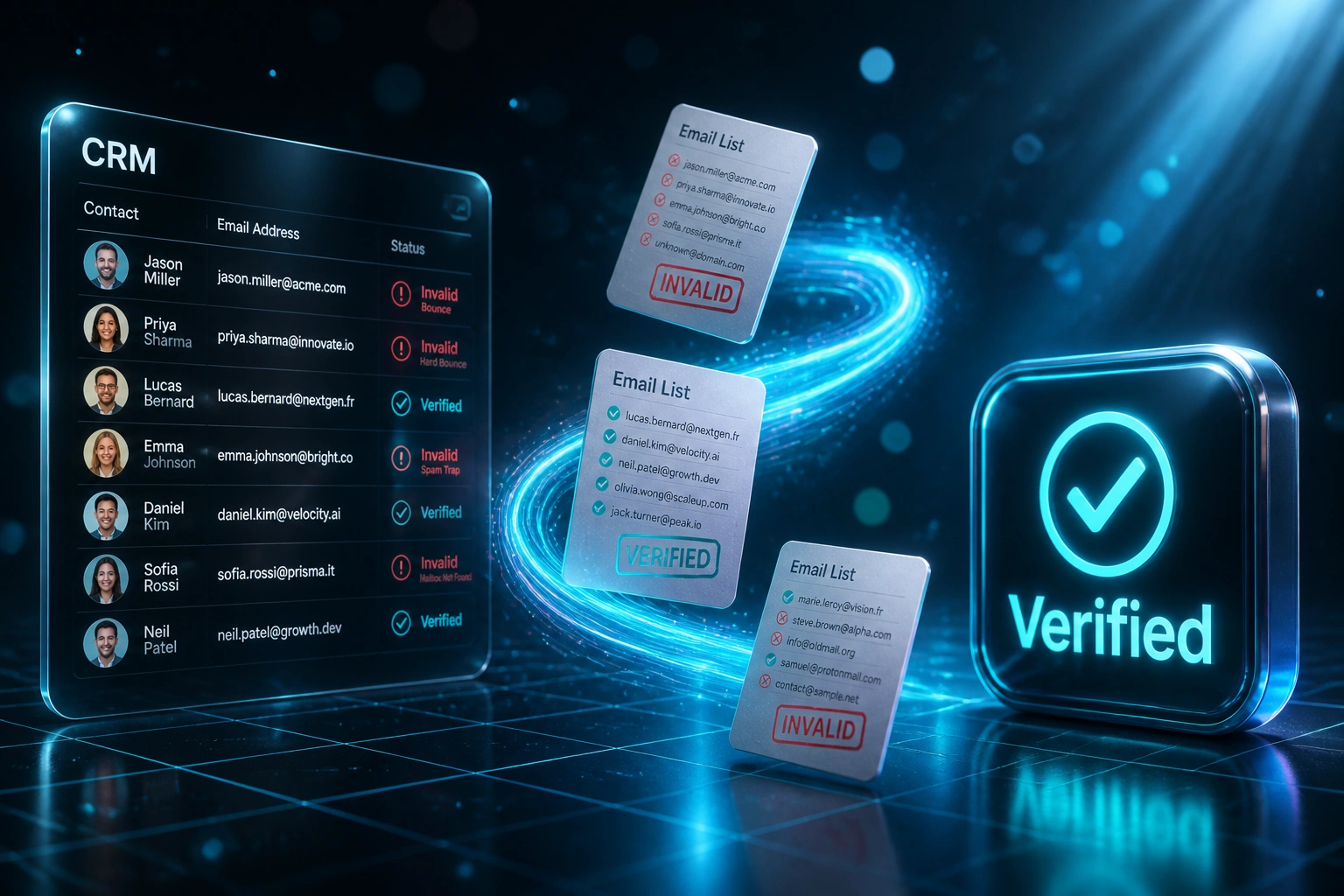
Export the list → verify at scale → suppress risk → send only what is safe. No more gambling deliverability on aged CRM exports.
Pull the List
CRM or ESP segment exports (or a scheduled sync) feed the verification queue
Verify in Bulk
NeverBounce, ZeroBounce, or equivalent classify valid, invalid, disposable, catch-all, and risky
Write Statuses Back
CRM fields and ESP segments update so campaigns exclude anything unsafe
Send Clean
Hard bounces collapse, ESP warnings ease, and sender reputation holds
Everything You Need for Reliable Email List Cleaning
Bulk CRM and ESP Export Cleaning
Pull existing HubSpot, Mailchimp, Klaviyo, or CSV lists in bulk, run them through NeverBounce, ZeroBounce, or equivalent, and return only send-safe addresses.
Invalid and Disposable Removal
Hard-invalid, disposable, and toxic addresses are suppressed before the next campaign, so bounce signals never hit the mailbox providers.
Catch-All and Role Flagging
info@, sales@, and catch-all domains are flagged for review or exclusion instead of auto-sending, protecting deliverability without deleting every grey result.
Status Write-Back to CRM and ESP
Verified, invalid, catch-all, and risky statuses sync into CRM fields and ESP segments your campaigns already filter on.
Pre-Campaign Verification Gate
Every major send runs through a clean list gate first. Marketing stops gambling deliverability on aged exports.
Scheduled Re-Verification
Active segments re-verify on a cadence, because lists lose about 2% of valid contacts every month and last quarter's clean file is already stale.
Platforms We've Wired for List Cleaning
From 4.6% Hard Bounces to 0.3%
How a marketing team with 72,000 ESP contacts stopped an ESP throttle warning and protected the sending domain before the next product launch.
The Unverified Process
- Lifecycle and promo segments exported from HubSpot into Klaviyo with no verification gate
- Hard bounce rate sat at 4.6%, inside the ESP warning band and climbing toward critical
- Roughly one in five contacts on aged segments were invalid, disposable, or role-based
- Marketing paid ESP fees on dead addresses and burned domain reputation every send
- A Spamhaus scare on a prior brand had already cost weeks of remediation attention
The Cleaned Process
- Full 72,000-contact export ran through bulk verification before launch week
- 15,800 invalid, disposable, and high-risk addresses suppressed; catch-alls queued for review
- Statuses wrote back to HubSpot and Klaviyo so every campaign filtered on verified only
- Hard bounces fell to 0.3% on the next three sends, well under the 2% ceiling
- Scheduled re-verification keeps active segments fresh as lists decay ~2% a month
Before vs After Email List Cleaning
How It Works
From first conversation to verified campaign sends in 2–4 weeks.
Tell Us Your Lists
Which CRM and ESP you use, list sizes, current bounce rates, and which segments matter most before the next campaign.
Free Scoping Call
30-minute call to map the clean → suppress → sync flow, pick risk thresholds, and size the first bulk verification run.
Build & Pilot
We wire the verifier, clean a pilot segment, write statuses back, and compare bounce rates against your baseline.
Go Live & Monitor
Campaigns only send verified addresses. Scheduled re-verification and bounce feedback keep reputation protected.
Frequently Asked Questions
What is bulk email list verification?
It is email list cleaning at scale: existing CRM and ESP contact lists are checked before a campaign so invalid, disposable, role-based, and catch-all addresses are removed or flagged. Unlike lead finding, this protects deliverability on lists you already own.
How is this different from email finding and verification for outbound?
Finding tools discover new work emails for named prospects. Bulk email list verification cleans the lists already sitting in your CRM or ESP before you press send. Marketing teams use it to cut hard bounces, avoid ESP throttling, and reduce blacklist risk on lifecycle and newsletter campaigns.
What bounce rate should we aim for?
Industry guidance treats total bounce rates under 2% as the healthy ceiling most ESPs and mailbox providers expect. Hard bounces ideally stay under 0.5%. Rates above 5% are critical and commonly trigger throttling, spam-folder placement, or blacklisting. Verification before every major send is how teams stay inside that band.
Which tools do you connect for email list cleaning?
We commonly wire NeverBounce, ZeroBounce, or Hunter verification against HubSpot, Salesforce, Pipedrive, Mailchimp, Klaviyo, Brevo, or flat CSV exports. Statuses write back as CRM fields and ESP segments so campaigns only include verified contacts.
How long does setup take?
A focused one-way bulk clean with status write-back is typically live in 2–4 weeks, including a measured pilot. Scheduled re-verification, catch-all review queues, and ESP bounce feedback usually take 4–6 weeks.
How much does bulk email list verification cost?
Focused cleaning pipelines that verify lists and write statuses back start from around R15,000. Full setups with pre-campaign gates, catch-all handling, and scheduled re-verification typically range from R25,000 to R60,000, plus verifier usage (roughly R50–R130 per 1,000 emails depending on volume). Most teams paying ESP fees on dead contacts, and facing a blacklist remediation bill of R82,000–R245,000, see payback within one to two campaigns.
Stop Sending to Unverified Lists
If bounce rates are climbing and the ESP is already warning you, bulk email list verification is cheaper than rebuilding sender reputation after a blacklist.
Tell us which CRM and ESP you use, how large the lists are, and what your current bounce rates look like. We'll show you exactly how a clean-before-send pipeline would work for your campaigns.