Change Data Capture for System Sync: Move Only What Changed
Your overnight full-table job still runs for hours, burns cloud transfer budget, and leaves CRM, ERP, and the warehouse hours out of date. Database change tracking already knows which rows moved. You should not be re-copying the rest.
We build CDC sync that cuts transfer volume dramatically and keeps systems in near-real-time alignment.
Sound Familiar?
These are the exact issues CTOs and ops leads bring us when nightly full-table sync stops scaling:
- Nightly full-table extracts run for hours and still leave CRM, ERP, and the warehouse a day out of date
- You re-transfer millions of unchanged rows every night, burning cloud egress and warehouse compute
- Hard deletes never appear downstream, so closed accounts and cancelled orders linger in reporting
- Peak-season batch windows overrun into business hours and slow the live transactional database
- Ops teams babysit fragile overnight jobs while dashboards and inventory stay hours behind reality
Full refresh reprocesses every row whether it changed or not. On large tables that waste compute, miss hard deletes, and lock you into overnight latency. As tables grow, the batch window only gets longer, and cloud egress at roughly R1.50 per GB keeps charging for data that never moved.
What CDC Sync Actually Does
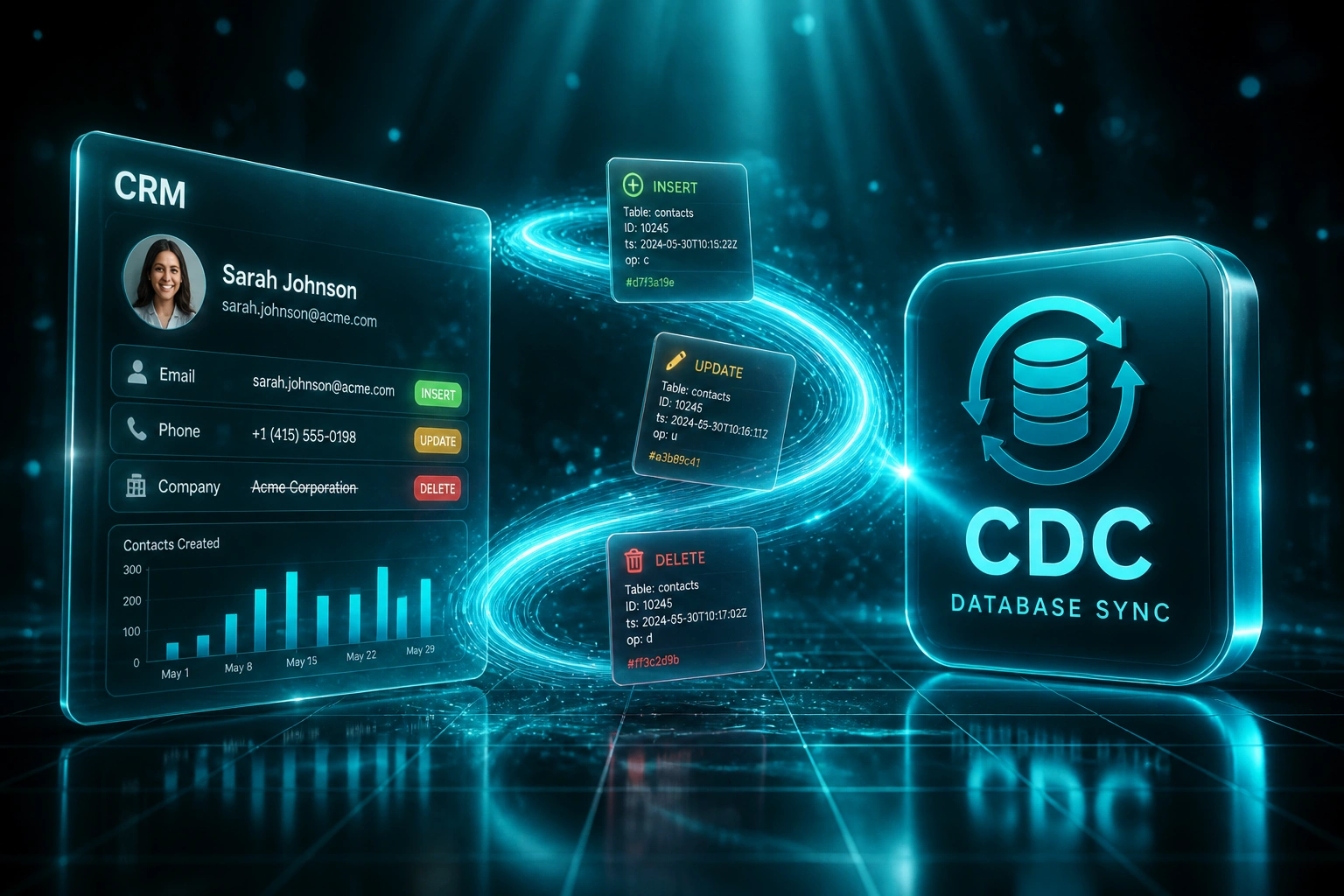
Row changes → capture → apply downstream. No nightly full-table haul between systems.
Change Happens
A customer, order, or stock row inserts, updates, or deletes in the source system
CDC Captures the Delta
Change Data Capture records only that row event from the log or change feed
Targets Update
CRM, ERP, or warehouse applies the delta with mapped fields and delete rules
Near-Real-Time Alignment
Ops sees current state in minutes, without waiting for the overnight batch window
Everything You Need for Reliable CDC Sync
Change-Only Capture
We stream only the rows that inserted, updated, or deleted since the last sync. Transfer volume typically drops 90% or more versus full-table extracts.
Near-Real-Time Alignment
CRM, ERP, and warehouse stay minutes apart, not overnight. Ops and finance act on current stock, orders, and customer status instead of yesterday's snapshot.
Delete and Soft-Delete Handling
Hard deletes and cancellations travel with the change stream so downstream systems stop treating removed records as live.
Source-Light Extraction
Log-based or change-tracking capture avoids nightly full-table scans that spike OLTP load during the batch window.
CRM, ERP, and Warehouse Targets
Changed customer, product, order, and inventory rows land in the systems that need them, with field mapping and conflict rules you can audit.
Monitoring and Freshness Alerts
Lag, failed events, and stalled pipelines surface before the morning standup, not after a board pack goes out wrong.
Sources and Targets We've Wired for CDC Sync
From 4.5 Hours Overnight to Under 4 Minutes
How a national distributor stopped hauling unchanged rows and brought CRM, ERP, and warehouse into near-real-time alignment.
The Full-Table Nightly Job
- Operations re-extracted millions of customer and order rows every night, even when under 1% had changed
- Job routinely ran 4–4.5 hours; warehouse and reporting stayed on yesterday until mid-morning
- Peak weeks pushed the batch into business hours and slowed the live ERP database
- Hard deletes rarely landed downstream, so cancelled orders still polluted stock and credit views
- Cloud transfer and warehouse compute kept paying for unchanged data night after night
The CDC Sync
- Change Data Capture streams only inserts, updates, and deletes into CRM, ERP, and warehouse targets
- Typical lag dropped from overnight to under 4 minutes for priority tables
- Data moved each night fell by about 94%, cutting egress and load time
- Deletes and cancellations clear correctly so ops stops chasing ghost stock
- Nightly babysitting ended; freshness alerts replace the 02:00 war room
Full-Table Extract vs Change Data Capture
How It Works
From first conversation to live CDC sync in 3–6 weeks, depending on source count and volume.
Map Your Sync Pain
Which tables blow up overnight, how stale is "fresh", and where lag costs cash or trust.
Free Architecture Call
30-minute call to score full-table vs CDC per source, estimate volume savings, and price the build.
Build and Parallel Run
We wire change capture, map fields, and run CDC beside your nightly job until accuracy and lag are proven.
Cut Over and Monitor
Retire the full extract. Freshness dashboards and alerts keep CRM, ERP, and warehouse in near-real-time alignment.
Frequently Asked Questions
What is Change Data Capture, in plain terms?
Change Data Capture (CDC) watches your database for inserts, updates, and deletes, then moves only those changed rows to the systems that need them. Instead of re-copying an entire customer or order table every night, CDC sync keeps CRM, ERP, and warehouse tables aligned with far less data transfer and far less lag.
How much can CDC cut transfer volume versus full-table sync?
Industry patterns commonly show 90% or more reduction when only a small share of rows change each day, and some CDC designs report 10–100× less bandwidth and processing than full extracts. On a table of millions of rows where a few thousand change, you stop hauling the unchanged majority every night.
How fresh will our data be after CDC sync?
Log-based CDC can deliver sub-ten-second freshness on supported databases. Most business syncs we deploy land in the seconds-to-minutes range, versus the 12–24 hour lag of overnight batch jobs. Exact latency depends on source platform, network, and how you apply events downstream.
Will CDC slow down our production database?
Done properly, no. Log-based capture reads the transaction log rather than scanning live tables every night, which is why teams often see roughly 30–60% lower compute on the pipeline and a sharp drop in overnight OLTP pressure. We design capture so peak shopping or month-end load stays on the transactional path, not the extract job.
Which systems can you apply CDC sync to?
We work with PostgreSQL, MySQL, SQL Server, and Oracle change streams, plus SaaS change feeds such as Salesforce and Dynamics where available, feeding CRM, ERP, ecommerce, and warehouse targets. If your source exposes a reliable change log or change API, we can usually design a CDC path.
How much does a CDC sync project cost?
Focused change-capture on a handful of high-volume tables typically starts around R25,000. Broader multi-system CDC with mapping, delete handling, and monitoring usually sits between R40,000 and R90,000. Most clients recover that within a few months by cutting overnight labour, cloud transfer and compute waste, and decisions made on stale data.
Stop Paying to Re-Copy Unchanged Rows
If your CRM, ERP, and warehouse still wait on a nightly full-table extract, you are funding latency and cloud waste that Change Data Capture already solves.
Tell us which databases and SaaS tools you sync, how long the batch window runs today, and where stale data hurts ops or cash. We will show you what CDC sync would change for your stack.