Clock In and Clock Out System: Accurate Attendance, Cleaner Payroll
If your team still relies on paper timesheets or a shared PIN time clock, you already know the cost: buddy punching, inflated hours, payroll disputes, and nothing clean to show a labour inspector. HR managers, payroll leads, and ops directors feel it as payroll leakage and BCEA risk, not an IT inconvenience.
We build the digital clock-in system that captures start and finish, stops buddy punching, and feeds payroll.
Sound Familiar?
These are the exact issues our clients faced before a digital clock-in system:
- Paper timesheets and shared PIN clocks let colleagues clock in for absent mates (buddy punching)
- Payroll spends half a day every cycle chasing missing cards, illegible starts, and disputed finish times
- Early punch-ins and late punch-outs quietly inflate gross payroll without anyone noticing until month-end
- Labour inspectors ask for time-worked records and you produce three conflicting spreadsheets
- Attendance mistakes land as payroll errors that cost thousands of rand each to investigate and reissue
Under BCEA Section 31, every employer must keep accurate records of time worked for three years, and no person may make a false entry. Paper timesheets and buddy punching leave you unable to prove attendance when payroll, CCMA, or a labour inspector asks. Time and attendance errors are also the most common payroll error category, costing organisations roughly R4.1 million per 1,000 employees a year.
What a Digital Clock In System Actually Does
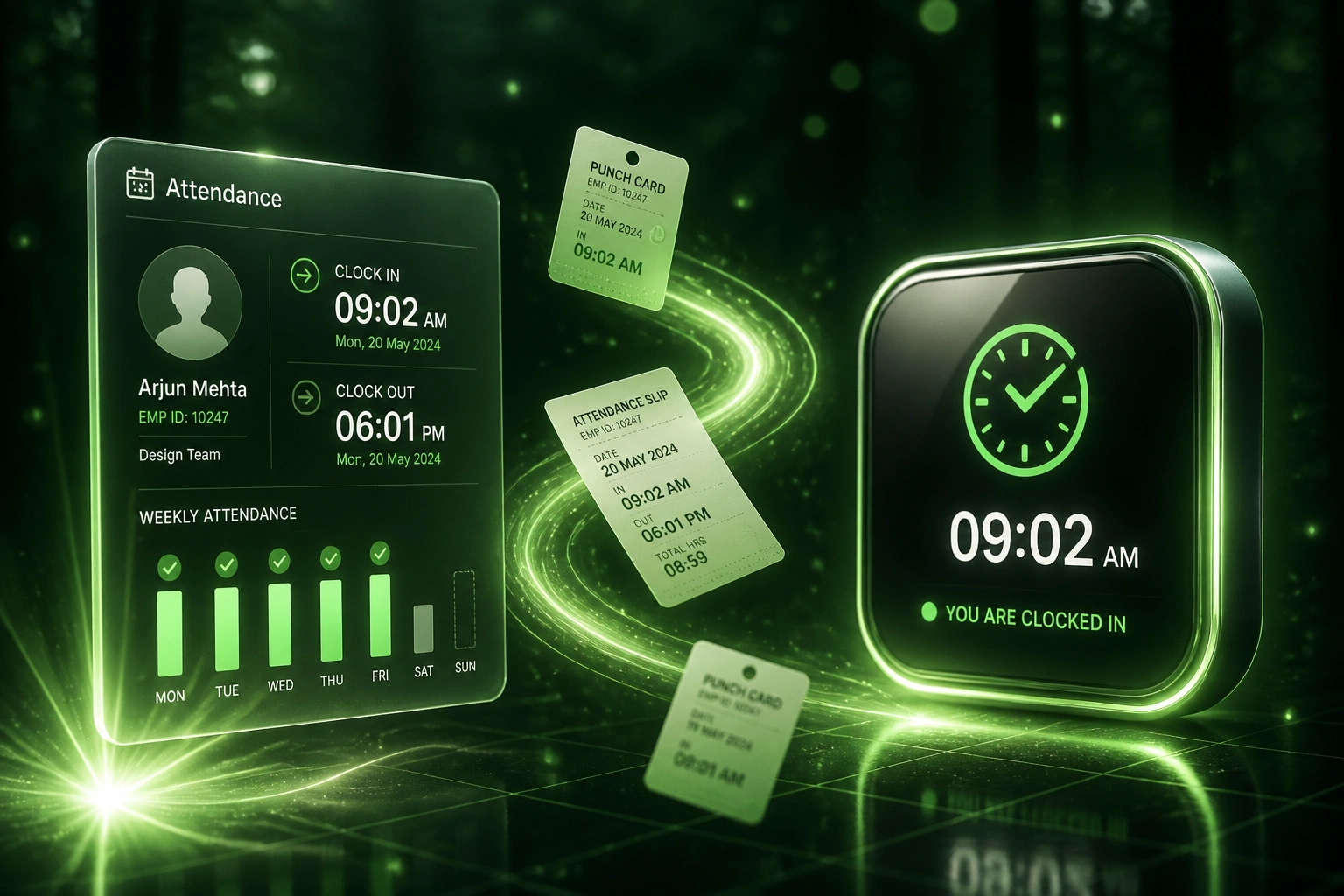
Employee clocks in → hours accumulate → exceptions reviewed → payroll updated. Payroll reviews exceptions, not handwriting.
Clock In at the Door
Biometric, PIN, kiosk, or app captures the verified start time for the right person
Clock Out at Finish
End-of-shift punch closes the day. No paper card, no buddy punch for an absent colleague
Review Exceptions
Missed punches and odd start/finish pairs surface for manager approval before cut-off
Write Back to Payroll
Approved attendance hours post into SimplePay, Sage, or PaySpace ready for the pay run
Everything You Need for Reliable Employee Attendance Tracking
Digital Clock In and Clock Out
Biometric, PIN, kiosk, or mobile app capture of start and finish times at the door or on site. Every punch is timestamped, attributable, and ready for payroll.
Buddy Punching Prevention
Fingerprint, face, or one-person PIN rules stop employees clocking for absent colleagues. Shared badge drawers and honour-system cards become obsolete.
Payroll-Ready Attendance
Approved hours write into SimplePay, Sage Payroll, PaySpace, or your HRIS so the attendance record and the payslip never diverge.
BCEA Attendance Ledger
Every employee's time worked is stored with name, occupation, and remuneration linkage for the three-year retention period Section 31 requires.
Exception and Dispute Packs
Missed punches, early outs, and late starts surface as exceptions. When someone queries a day, payroll opens the punch trail in seconds.
Multi-Site Time Clock Rollout
One attendance ruleset across plants, warehouses, and branches. Site-level clocks feed a single attendance system for employee attendance tracking.
Platforms We've Connected for Attendance Clocking
From Shared PIN Chaos to Verified Punches
How a Gauteng manufacturer stopped buddy punching, cut payroll reconciliation time, and walked into a labour inspection with a clean attendance ledger.
The Manual Process
- 120 plant and warehouse staff used a shared PIN time clock plus paper cards for late shifts
- Supervisors routinely punched for late or absent colleagues at shift change
- Payroll spent 5–6 hours every cycle chasing missing cards and disputed finish times
- Roughly 2% of gross wages looked inflated versus actual headcount on the floor
- No single attendance record when the Department of Employment and Labour asked for time worked
The Automated Process
- Biometric kiosk at the main gate plus mobile app for remote supervisors
- Buddy punching stopped: only the person present can clock in or out
- Exception queue surfaces missed punches before cut-off for manager approval
- Approved hours write into SimplePay with a three-year BCEA attendance export
- Payroll reviews exceptions in under an hour instead of reconstructing paper cards
Before vs After a Digital Time Clock
How It Works
From first conversation to live attendance clocking in 2–4 weeks.
Tell Us Your Setup
How you capture start and finish today, which payroll you run, and where buddy punching or missing cards hurt most.
Free Scoping Call
30-minute call to map clock methods → attendance rules → exceptions → payroll write-back for your sites.
Build & Test
We deploy the clock-in system, map employees, and run parallel against your paper or shared-PIN process for two pay cycles.
Go Live & Monitor
Switch off manual timesheets. Monitoring flags missed punches and exception spikes before cut-off.
Frequently Asked Questions
How long does a clock-in clock-out system take to set up?
A standard digital attendance rollout with payroll write-back takes 2–4 weeks from scoping to go-live. Single-site builds with clean employee master data can be live in about two weeks. Multi-site builds with biometric hardware, mobile clocking, and custom exception rules typically take 4–6 weeks.
Which clocking methods and payroll tools can you connect?
We have connected biometric kiosks, PIN terminals, and mobile app clocks into SimplePay, Sage Payroll, PaySpace, Sage 300 People, and custom HRIS platforms. If attendance still lives on paper cards or a standalone time clock export, we start there and harden the feed into payroll.
How does a digital time clock stop buddy punching?
Buddy punching needs a shared credential. Biometric verification (fingerprint or face) or enforced one-person PIN and app rules mean only the employee who is present can clock. That removes the honour-system loophole that Nucleus Research links to roughly 2.2% of gross payroll leakage on traditional clocks.
What does the BCEA require for attendance records?
Section 31 of the Basic Conditions of Employment Act requires every employer to keep a record of each employee's name and occupation, the time worked, and remuneration paid, retained for three years from the last entry. No person may make a false entry. A digital clock-in system produces that ledger automatically instead of reconstructing it from paper.
Will managers still approve attendance exceptions?
Yes. The system captures start and finish times and flags exceptions. Managers and payroll still approve missed punches, early outs, and adjustments. Automation removes the paper chase and buddy-punching risk, not the judgement call on whether an exception is valid.
How much does a clock-in clock-out system cost?
A focused digital attendance build with payroll write-back starts from around R25,000. Multi-site builds with biometric hardware integration, mobile clocking, and exception workflows typically range from R40,000 to R70,000. Most clients recovering buddy-punching leakage and payroll admin time see ROI within two to three months.
Stop Paying for Hours Nobody Worked
If your payroll still runs on paper timesheets or a shared PIN time clock, you are funding buddy punching and rebuilding attendance by hand every cycle.
Tell us how employees clock today, which payroll you use, and where disputes or missing cards hurt most. We will show you exactly how a digital clock-in clock-out system would work for your sites.