Computer Vision Quality Inspection: AI-Powered Defect Detection
Human visual inspection misses defects under fatigue and line speed. Those escapes become scrap, customer returns, and recalls that dwarf the cost of catching the problem on the line.
We build camera-based visual AI that inspects every unit in real time and feeds MES/ERP before anything ships.
Sound Familiar?
These are the exact issues plant and quality managers brought to us before visual AI:
- Inspectors miss subtle defects once fatigue sets in after 20–30 minutes on the line
- Defect escapes reach customers as returns, chargebacks, and occasionally full recalls
- Scrap and rework climb because root causes only surface after the shift ends
- Tolerance checks are inconsistent between day shift and night shift on the same part
- MES and ERP never see reject data in real time, so process drift goes unnoticed for hours
Even three human inspectors in sequence still let defects through. In one Instrumental study, 4.6% of units that passed triplicate end-of-line inspection still had real defects. The AIAG Recall Cost Study 2024 puts average manufacturing recall cost at roughly €8.7 million (about R175 million). Escapes are not a training problem. They are a human-attention problem.
What Computer Vision Quality Inspection Actually Does
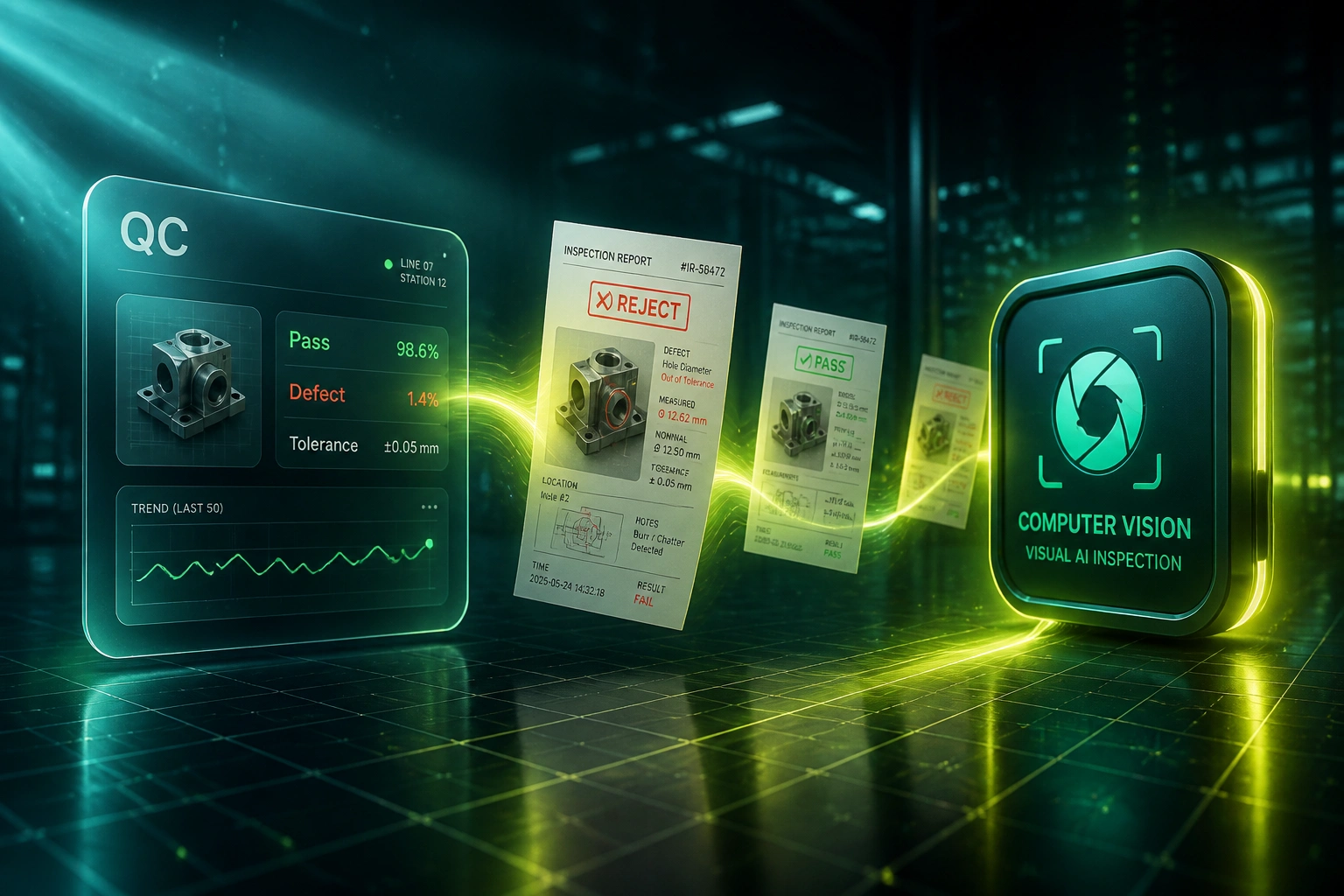
Part reaches the station → cameras inspect → reject or pass → MES/ERP updates. No waiting for the end-of-shift scrap report.
Part Hits the Station
Conveyor or robot presents the unit under fixed lighting and industrial cameras
Visual AI Inspects
Models check surface defects, missing features, and dimensional tolerances at line speed
Reject or Pass
Out-of-tolerance parts divert automatically; pass results and images are stored for traceability
MES / ERP Updated
Quality events sync in real time so production stops drift before a full batch ships
Everything You Need for Reliable Visual AI Inspection
Line-Speed Defect Detection
Cameras inspect every unit at production speed, catching surface defects, missing components, and dimensional outliers humans routinely miss under fatigue.
Tolerance & Dimensional Checks
Visual AI measures critical dimensions against your tolerances and flags out-of-spec parts before they leave the station.
MES / ERP Reject Sync
Pass, fail, and reason codes write back to MES, ERP, or WMS in real time so production and quality share one source of truth.
Escape & Scrap Alerts
Spike in rejects or a new defect class triggers alerts to the plant manager and quality lead before a full batch ships.
Traceable Inspection Records
Every inspected unit keeps an image, measurement, and disposition for audits, customer claims, and continuous improvement.
Shift-Consistent Standards
The same defect model runs on every shift. Night-shift quality matches day-shift quality without depending on who is on the bench.
Platforms and Systems We've Connected
From 2.4% Escapes to Under 0.2%
How a Midrand packaging plant stopped shipping defect escapes and recovered R2.1 million in scrap and returns in the first year.
Manual End-of-Line Inspection
- Three inspectors per shift checking seal integrity, print, and fill level by eye
- Accuracy dropped as shifts wore on; night-shift escapes were the worst
- Customer returns and retailer chargebacks arriving weeks after the defect left the plant
- Scrap logged at shift end, so process drift ran for hours before anyone noticed
- MES only saw production counts, never live reject reasons
Camera-Based Visual AI
- Industrial cameras inspect every pack at line speed with consistent lighting
- Out-of-tolerance seals and print defects divert automatically
- Reject codes and images sync to MES within seconds
- Quality lead gets spike alerts before a full batch ships
- Inspectors focus on exceptions and continuous improvement, not every unit
Before vs After Visual AI Defect Detection
How It Works
From first conversation to live inspection in 6–10 weeks for a single station.
Map Your Line
Which stations, defect classes, tolerances, and systems need the inspection data.
Free Scoping Call
30-minute call to size cameras, lighting, model training needs, and MES/ERP handoff.
Build & Parallel Run
We train on your defect library, run alongside human inspection, and validate escape reduction before cutover.
Go Live & Monitor
Vision becomes the primary gate. Monitoring tracks accuracy, false rejects, and system health.
Frequently Asked Questions
How long does a computer vision quality inspection project take?
A single-station pilot typically takes 6–10 weeks from scoping to live: camera and lighting setup, defect-model training, parallel validation, then cutover. Multi-station lines with MES and ERP sync usually land in 10–16 weeks.
Will this replace our quality inspectors?
No. Visual AI takes over repetitive, fatigue-prone checks so inspectors focus on exceptions, root-cause analysis, and process improvement. Most plants keep a smaller QC team for oversight and complex judgment calls.
Can it work at our line speed?
Yes. We size cameras, lighting, and inference hardware to your takt time so every unit is inspected without slowing the line. If a station is a bottleneck today, vision often removes it.
What about false rejects that stop good parts?
We tune sensitivity against your cost of scrap versus cost of escape, then validate during parallel run. Typical false-positive rates drop well below manual levels once the model is trained on your real defect library.
Does it connect to our MES or ERP?
Yes. Pass/fail results, defect codes, and images can sync to Ignition, Siemens, SAP, Syspro, Sage X3, or custom MES via OPC-UA, REST, or MQTT so quality events drive production decisions immediately.
How much does AI-powered defect detection cost?
Single-station pilots with MES write-back typically start from around R80,000. Multi-station lines with custom models and ERP integration usually range from R180,000 to R350,000. Most plants recover the investment within 4–8 months through scrap reduction and fewer customer escapes.
Stop Shipping Defects Your Inspectors Are Too Fatigued to Catch
If quality still depends on tired eyes at line speed, you are paying the 10–100× escape premium on every miss.
Tell us what you manufacture, which stations fail most often, and which MES or ERP must see the reject data. We will show you exactly how camera-based computer vision would work on your line.