Contract Management: Track Every Agreement, Obligation and Renewal Date
Expired leases, missed auto-renewals, and obligations buried in PDFs usually surface only when something goes wrong. If your contract management lives in folders and memory, agreement tracking is a liability waiting for a notice window to close.
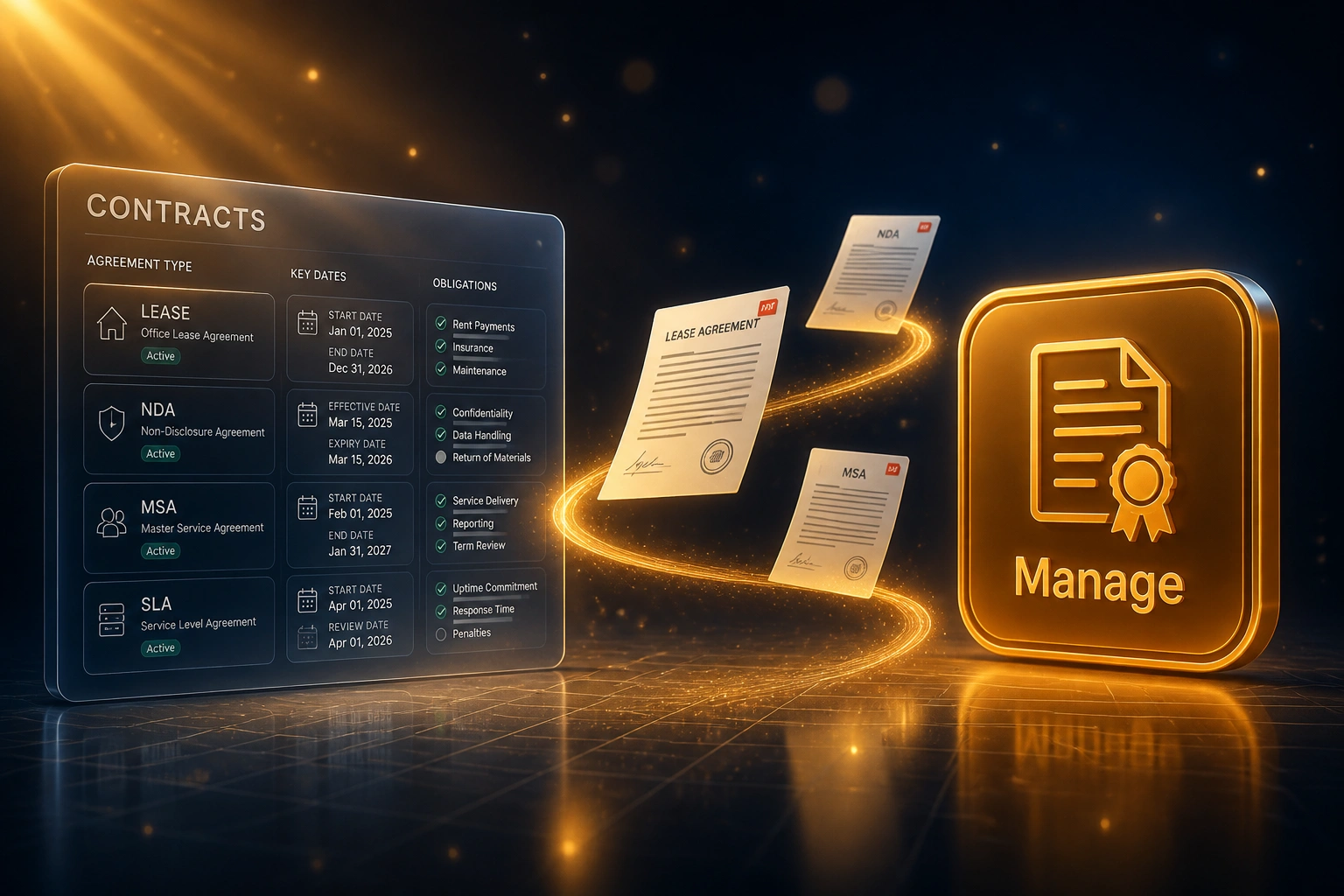
We build a living contract register with obligation tracking and renewal alerts that pays for itself by preventing one missed renewal or penalty clause.
Sound Familiar?
These are the exact issues CEOs, COOs, and Legal Ops leads bring us before we build agreement tracking:
- Supplier agreements, leases, NDAs, MSAs, SLAs, and employment contracts live across email, SharePoint, and filing cabinets with no single register
- Obligations buried in PDFs only surface when a penalty clause, audit, or landlord letter arrives
- Notice windows of 30 to 90 days pass unnoticed, so auto-renewals lock the organisation into another full term at an uplift
- Legal Ops and finance spend 45 minutes or more hunting for a single agreement when a CEO, auditor, or counterparty asks a simple question
- 71% of organisations cannot locate at least 10% of their contracts, so key dates and duties are effectively invisible
Auto-renewal traps and POPIA operator duties do not wait for your next tidy-up. Miss a 60 to 90 day notice window and you can be locked into another full term at a 3% to 12% uplift. POPIA section 21 also requires written operator agreements with retention and destruction duties: when those live only in PDFs, non-compliance risk sits next to commercial leakage, with Information Regulator fines of up to R10 million.
What Contract Renewals Automation Actually Does
Agreement lands → obligations and dates extracted → alerts fire → decision logged. No more discovering renewals after the window closes.
Agreement Captured
Lease, NDA, MSA, SLA, supplier, or employment contract enters the living register with owner and metadata
Obligations & Dates Set
Key duties, notice deadlines, and expiry dates become structured fields and owned tasks
Alerts Fire Early
90, 60, and 30 day reminders hit Legal Ops, finance, or the named owner before the notice window closes
Renew, Renegotiate, Exit
A decision is logged with evidence, so silent auto-renewal never chooses for you again
Everything You Need for Obligation Tracking Across the Estate
Living Contract Register
Every agreement type lands in one searchable register: supplier contracts, leases, NDAs, MSAs, SLAs, and employment contracts, with owner, value, and status.
Obligation Tracking
Key duties extracted from each agreement become owned tasks with due dates, so penalty clauses, insurance covenants, and reporting duties do not stay buried in PDFs.
Key-Date & Renewal Alerts
90, 60, and 30 day alerts fire against notice deadlines and expiry dates across the full estate, not just service renewals.
Renewal Decision Workflow
Each approaching renewal creates an owned decision pack: renew, renegotiate, or exit, with the notice deadline and commercial context attached.
Document Vault & Search
Signed PDFs sit next to structured metadata. Finding a clause or counterparty drops from roughly 45 minutes to seconds.
Leadership Visibility
COO and Legal Ops see agreements approaching notice windows, open obligations, and rand exposure before something goes wrong.
Sources We've Connected for Agreement Tracking
From Folder Chaos to a Living Contract Register
How an 80-person industrial services company stopped a R2.4M warehouse lease auto-renewal and brought obligation tracking under one roof.
The Manual Process
- Leases, supplier MSAs, NDAs, and SLAs scattered across email, SharePoint, and a filing room
- 45 minutes or more to find a single agreement when legal or the landlord asked a question
- Notice windows tracked in a personal calendar that vanished when the facilities lead left
- A warehouse lease auto-renewed for three years at a 12% uplift after the 90-day exit window closed
- POPIA operator agreements and retention duties existed only as unread PDF annexures
The Automated Process
- Every agreement type sits in one searchable register with owner, value, and status
- Obligation tracking turns insurance covenants, reporting duties, and penalty clauses into owned tasks
- 90, 60, and 30 day alerts fire against notice deadlines across the full estate
- Renewal decisions are logged before the window closes: renew, renegotiate, or exit
- COO and Legal Ops see rand exposure and open obligations without hunting PDFs
Before vs After Contract Management
How It Works
From first conversation to a live contract register in 3–5 weeks.
Map Your Estate
Where agreements live today, which types matter most, and which renewals or obligations already slipped last year.
Free Scoping Call
30-minute call to design the register fields, alert tiers, obligation owners, and renewal decision workflow.
Build & Test
We load your agreements, wire key-date alerts and obligation tracking, and validate against real notice windows before go-live.
Go Live & Monitor
Switch off the spreadsheet chase. Monitoring confirms every approaching deadline has an owner, a task, and a next action.
Frequently Asked Questions
How is this different from service contract renewal tracking or full CLM?
Service renewal tools focus on protecting recurring revenue from SLAs and retainers. Enterprise CLM covers drafting, negotiation, and e-sign. This system is a living contract register for the full estate: supplier agreements, leases, NDAs, MSAs, SLAs, and employment contracts, with obligation tracking, key-date alerts, and renewal workflows so nothing silent auto-renews or expires unnoticed.
Which agreement types can the contract management system track?
We routinely load supplier agreements, commercial leases, NDAs, MSAs, SLAs, employment contracts, and POPIA operator agreements. If the document, counterparty, value, key dates, and obligations exist somewhere, we can centralise them and drive alerts from that register.
How far ahead should renewal and obligation alerts fire?
Most B2B agreements need action 60 to 90 days before expiry, and notice windows of 30 to 90 days are common on auto-renewing terms. We configure alerts against your real notice deadlines and obligation due dates so Legal Ops and finance act before the window closes, not after.
Will this disrupt how Legal Ops, finance, and the COO work today?
No. Teams keep using the document stores and tools they already trust. The change is that agreement tracking, obligation tasks, and renewal decisions appear automatically with owners and deadlines, instead of a crisis when a lease or MSA silently renews.
How does this help with POPIA and contractual compliance?
POPIA section 21 requires written operator agreements with retention, return, and destruction duties. When those obligations live only inside PDFs, they are easy to miss. The register surfaces operator agreements, retention deadlines, and related duties as owned tasks so compliance is operational, not archival.
How much does a contract management and renewal system cost?
A living register with key-date alerts and obligation tracking typically starts around R25,000. Setups with renewal decision workflows, multi-source document ingest, and leadership dashboards usually sit between R35,000 and R65,000. Most mid-market estates recover that cost by preventing a single unwanted auto-renewal or missed penalty clause.
Stop Discovering Renewals After the Window Closes
If your agreements still live in folders and memory, one missed notice window or buried obligation can cost more than building a proper contract management system.
Tell us how many agreements you hold, where the PDFs live today, and which renewals already hurt last year. We will show you exactly how a living register with obligation tracking would work for your organisation.