Contract Renewal Automation: Never Miss a Renewal Window Again
Renewals that surface as calendar surprises get discounted or lost. When CS and sales ops only see the date in the final week, the customer sets the terms and your ARR takes the hit.
We automate renewal alerts, prep playbooks, and follow-up sequences so the conversation opens 60–90 days out.
Sound Familiar?
These are the exact issues CS, sales ops, and agency CEOs bring us before renewal automation:
- Renewals surface as calendar surprises in the final week, so the conversation starts with a discount ask instead of a value story
- CSMs spend hours assembling usage reports, pricing proposals, and stakeholder lists by hand for every account
- Follow-ups die in shared inboxes, so quiet champions never get a sequenced nudge before the notice window closes
- Health signals live in the CS tool while renewal dates live in the CRM, so at-risk ARR is invisible until it is too late
- Friday-afternoon scrambles force reactive concessions that quietly erode net revenue retention
ChurnZero's 2026 Renewal Risk Report found 71% of "surprise" downgrade decisions were visible in product usage for 60+ days. The signal was there. The renewal workflow was not. Median private SaaS NRR sitting near 101% (Benchmarkit) leaves little room for late, discounted saves.
What Contract Renewal Automation Actually Does
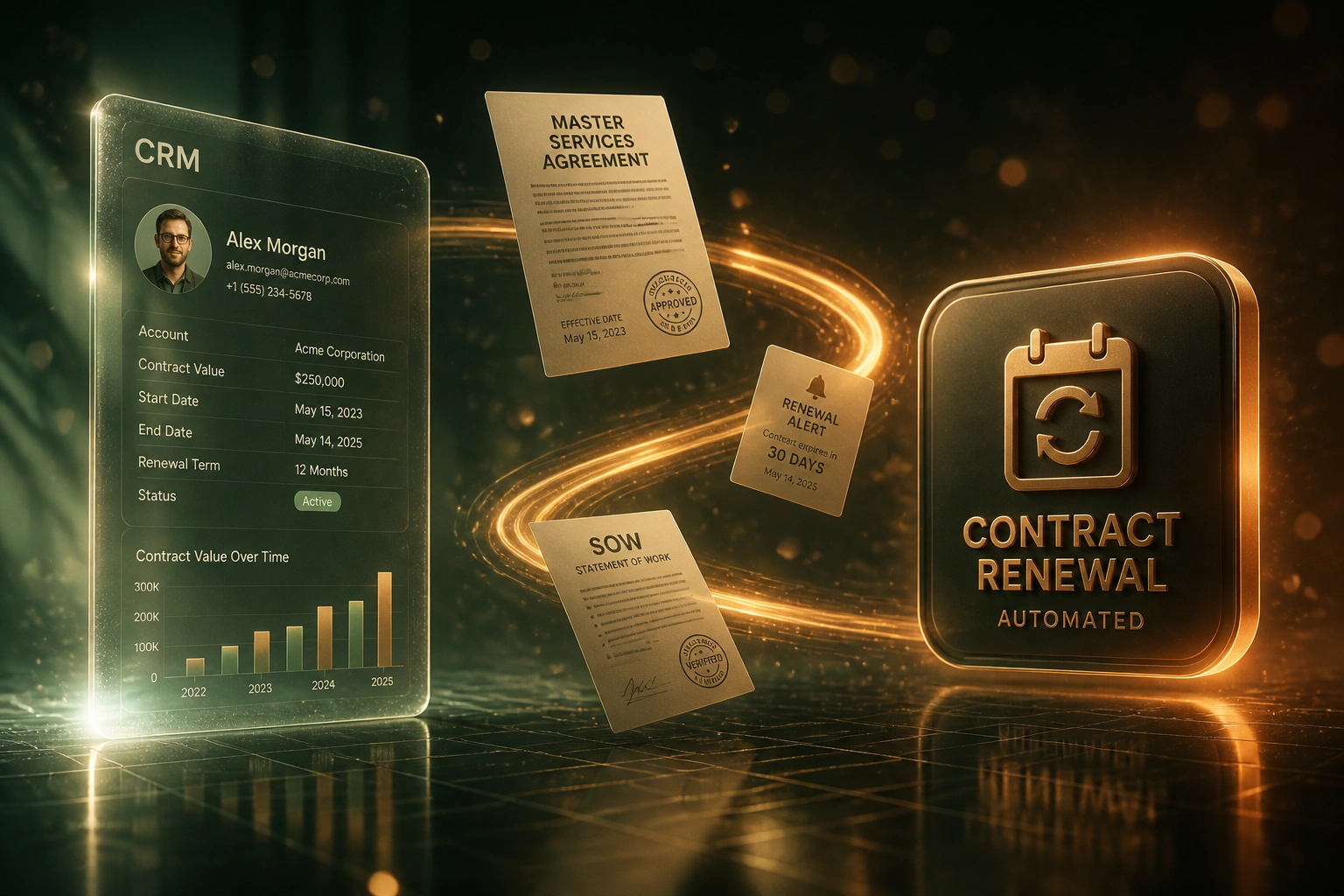
Alert fires → prep pack builds → stakeholders get sequenced → CRM updates. No Friday scramble.
Multi-Stage Alert Fires
At 90, 60, and 30 days the owner gets the account, ARR, health flags, and next action
Prep Playbook Assembles
Usage report, value summary, and pricing proposal draft land ready for review
Follow-Up Sequences Run
Champion, buyer, and legal get timed nudges until the renewal moves forward
CRM Write-Back Closes the Loop
Stage, proposal status, and outcome sync so forecast and CS share one renewal truth
Everything You Need for a Reliable Renewal Workflow
Multi-Stage Renewal Alerts
Timed triggers at 90, 60, and 30 days (plus custom milestones) open the renewal conversation early, with owner, ARR, and risk flags attached.
Prep Playbooks
Each stage auto-assembles the work: usage report, value summary, pricing proposal draft, and stakeholder map, so CSMs start prepared, not hunting.
Stakeholder Follow-Up Sequences
Email, CRM tasks, and Slack or Teams nudges keep champions, economic buyers, and legal moving without a shared-inbox chase.
CRM Write-Back
Renewal stage, next action, proposal status, and outcome sync back to HubSpot, Salesforce, or Pipedrive so forecast and CS share one truth.
At-Risk Save Routing
Health dips or stalled outreach escalate into documented save plans with AE pairing, matching the playbooks high-retention teams already run.
Renewal Pipeline Visibility
Leadership sees ARR at risk by days remaining, stage, and owner, so Friday surprises become a managed pipeline, not a fire drill.
Platforms We Wire Into Renewal Workflows
From Last-Week Scrambles to 90-Day Wins
How a mid-market SaaS CS team stopped discounting renewals under pressure and opened every conversation with a prepared value pack.
The Manual Process
- CSMs discovered renewals inside 30 days via a shared spreadsheet
- About 4 hours per account assembling usage, pricing, and stakeholder lists
- Follow-ups lived in email threads with no CRM stage truth
- At-risk saves started too late, often as solo CSM rescues
- Buyers negotiated hard because the vendor was out of time
The Automated Process
- 90/60/30 alerts create owned CRM tasks with ARR and health context
- Prep playbooks drop usage reports and pricing drafts before outreach
- Stakeholder sequences nudge champions and buyers on a fixed cadence
- At-risk accounts get documented save plans with AE pairing early
- Renewal stage and outcome write back so forecast stays honest
Before vs After Renewal Automation
How It Works
From first conversation to live renewal workflow in 3–5 weeks.
Tell Us Your Setup
Where renewal dates live, how CS preps proposals today, and which tools own health scores and follow-ups.
Free Scoping Call
30-minute call to map your 90/60/30 cadence, prep artefacts, escalation rules, and CRM write-back fields.
Build & Test
We build the alert and playbook flows, run sample renewals against real accounts, and validate with CS and sales ops.
Go Live & Monitor
Switch off spreadsheet chasing. Monitoring confirms every upcoming renewal has an owner, a playbook, and a next step.
Frequently Asked Questions
How is this different from simple renewal reminder tasks?
Reminders create calendar or CRM tasks. This programme automates the full renewal workflow: multi-stage alerts, prep playbooks (usage report, pricing proposal, stakeholder map), sequenced follow-ups, and CRM write-back so renewals are won early instead of salvaged in the final week.
When should the first renewal alert fire?
For most B2B and SaaS accounts we start at 90 days, with a formal proposal window around 60 days and a close cadence inside 30. Vendr research shows commercial outcomes are 18–24% better when conversations open 90+ days out versus inside the final 30 days. Enterprise books often start earlier.
Which systems can you connect?
We typically wire HubSpot, Salesforce, or Pipedrive as the system of record, with Gainsight, ChurnZero, or Catalyst for health signals, plus email, Slack or Teams, and proposal tools. If your stack stores a renewal date and an owner, we can orchestrate the workflow.
Will this replace our CS platform?
No. We keep Gainsight or ChurnZero for health and playbooks where you already use them. The integration orchestrates alerts, prep packs, follow-ups, and CRM write-back across the tools your CSMs and AEs already live in.
How much CSM time does renewal automation typically save?
Gainsight operational data cited in 2025 renewal automation benchmarks puts average admin time at about 4.2 hours per renewal for tracking, reminders, and document prep. Structured automation brings that closer to 1.1 hours, freeing CSMs for expansion conversations instead of chase work.
How much does contract renewal automation cost?
Multi-stage alert flows with CRM tasks typically start from around R35,000. Full prep playbooks, stakeholder sequences, health-based routing, and bidirectional CRM write-back usually sit between R45,000 and R75,000. Most clients recover that by avoiding a single late-cycle discount on a mid-market account.
Stop Salvaging Renewals in the Final Week
If your CS and sales ops teams still discover renewal dates as calendar surprises, you are leaving ARR and margin on the table.
Tell us which CRM and CS tools you run, how proposals get built today, and where follow-ups stall. We will show you exactly how a multi-stage renewal workflow would open conversations 60–90 days out for your book.