Handling Data Conflicts Between CRM and Accounting: Which System Wins?
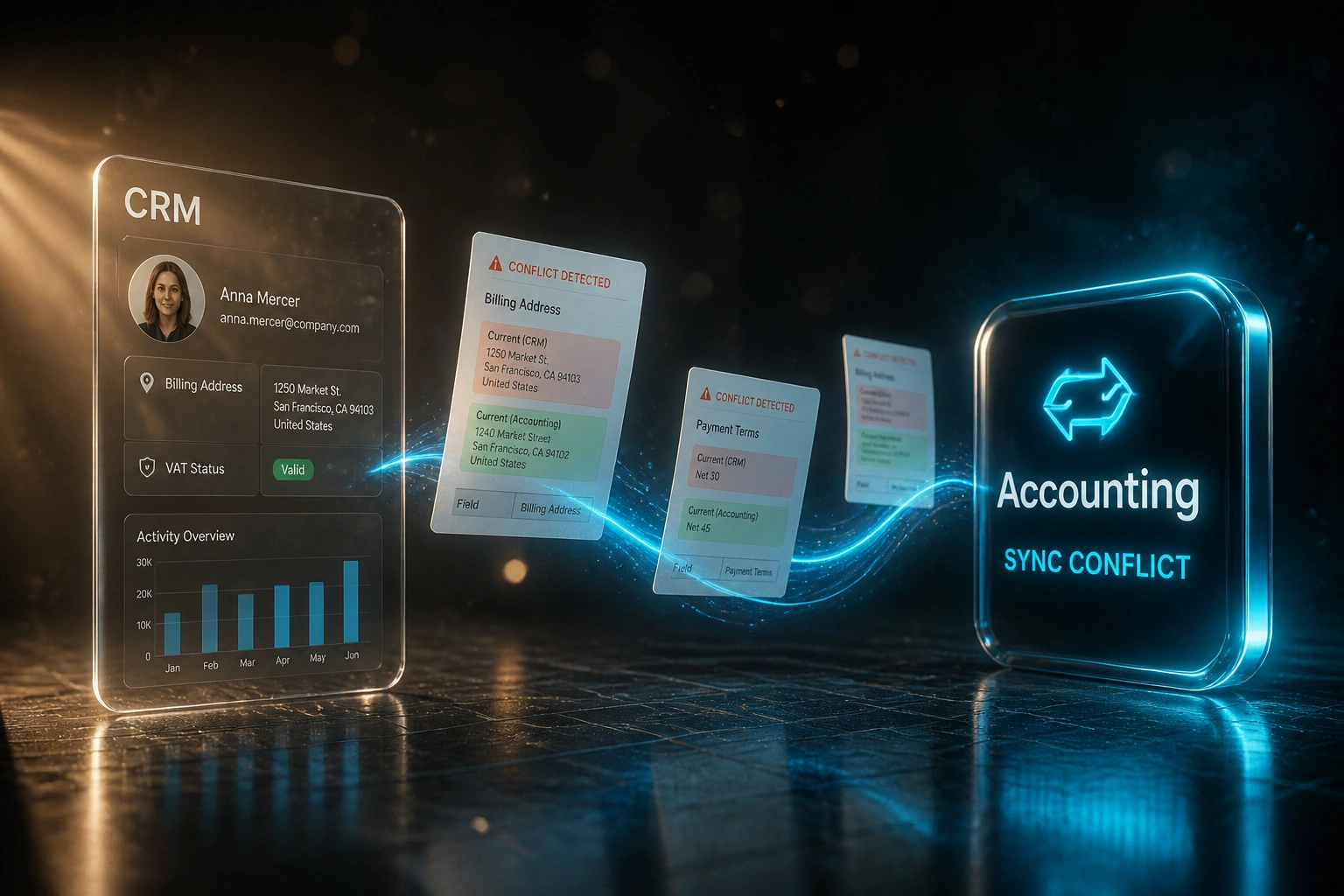
Sales changes the billing address in HubSpot. Finance updates payment terms in Xero the same afternoon. Without conflict resolution rules, the next sync silently overwrites master data, and the wrong address or VAT treatment hits the invoice before anyone notices.
We build the field ownership map and quarantine queue that stop bad data before it bills.
Sound Familiar?
These are the exact sync conflicts our finance and ops clients faced before named ownership rules:
- Sales updates a billing address in HubSpot or Pipedrive while finance changes payment terms in Xero, Sage, or QuickBooks, and the next sync silently overwrites one of them
- Invoices leave with the wrong VAT treatment or ship-to address because last-write-wins treated every field the same
- Statements bounce and collections chase a stale contact name that the CRM "won" over the ledger master
- Ops spends hours each week reconciling the same customer record across two systems with no audit of which field changed when
- Nobody can say which system is master for address, payment terms, VAT status, or legal name, so every sync is a coin toss
Xero retired its native HubSpot CRM integration on 13 March 2026. Teams rushing onto Data Sync or third-party connectors often inherit last-write-wins with no field ownership. Dual updates to address, VAT, and payment terms now collide harder, exactly when nobody has time for another silent overwrite.
What Conflict Resolution Actually Does
Dual update detected → ownership rule applied or quarantined → human review only when needed → clean master data on both sides.
Both Systems Change
CRM and accounting update the same customer field between sync cycles
Conflict Detected
Integration compares both values against the last synced state, not a blind overwrite
Rule or Quarantine
Owner wins automatically, or the pair lands in the review queue for finance
Master Data Intact
Invoices and statements use the approved value, with a full audit trail
Everything You Need for Reliable Conflict Resolution
Field Ownership Map
You name the master system per field: CRM owns engagement contacts, accounting owns payment terms, VAT status, and legal entity name. Sync never guesses.
Conflict Detection, Not Blind Overwrite
When both systems change the same field between sync cycles, the integration flags a sync conflict instead of applying last-write-wins by default.
Quarantine Review Queue
High-stakes conflicts (billing address, VAT, payment terms) land in a short queue with both values side by side. Finance decides before anything bills.
Last-Write-Wins Only Where Safe
Low-risk fields can still use timestamp precedence. Critical master data never does. The rule is written, versioned, and enforced on every sync.
Full Conflict Audit Trail
Every overwrite, quarantine, and resolution is logged with timestamps and actors so month-end and SARS queries have a clear chain of custody.
Works Across Your Stack
HubSpot, Pipedrive, Salesforce, and Zoho on the CRM side. Xero, Sage, and QuickBooks on the ledger side. Same conflict rules, same queue.
Platforms We've Wired for Conflict Rules
From 40+ Silent Overwrites a Month to Near Zero
How a Cape Town wholesale distributor stopped HubSpot and Xero from corrupting billing addresses and payment terms, and recovered seven hours a week for finance.
Blind Last-Write-Wins
- Bidirectional contact sync treated every field the same: whoever saved last won
- Finance found Net 30 terms overwritten by a sales note, and invoices issued on Net 45 by accident
- Roughly 40 field conflicts a month surfaced only after a statement bounce or credit-note request
- Ops spent about 8 hours a week comparing CRM and Xero customer screens in spreadsheets
- No audit of which system changed VAT status or legal name, or when
Named Rules and a Queue
- Accounting owns payment terms, VAT status, and legal name; CRM owns marketing contact fields
- Billing-address dual updates go to quarantine with both values side by side
- Silent overwrites dropped from 40+ a month to effectively zero on owned fields
- Finance reviews a short queue once a day, usually under an hour total
- Every resolution is logged for month-end and client disputes
Before vs After Conflict Resolution
How It Works
From first conversation to live conflict rules in 3 to 5 weeks.
Map Field Ownership
Which CRM, which ledger, and which system is master for address, payment terms, VAT status, contact name, and credit limit.
Free Scoping Call
30-minute call to design conflict rules, quarantine thresholds, and which fields may still use last-write-wins.
Build, Quarantine & Test
We wire detection, ownership precedence, and the review queue, then run parallel against live dual updates before go-live.
Go Live & Monitor
Silent overwrites stop. Your team only touches the quarantine queue. Alerts fire when conflict volume spikes.
Frequently Asked Questions
How is this different from customer deduplication?
Deduplication fixes two records that should be one (Acme vs ACME). Conflict resolution assumes one shared customer already linked across CRM and accounting, then decides which system wins when the same field is updated in both. Address, payment terms, VAT status, and contact name need named ownership rules and a quarantine queue, not a merge.
What is wrong with last-write-wins?
Last-write-wins is fine for low-risk notes. It is dangerous for billing address, VAT treatment, and payment terms. The system that happened to save last silently corrupts invoices and statements. We reserve timestamp precedence for fields you explicitly mark safe, and quarantine the rest.
How long does a conflict-resolution integration take?
Most projects take 3 to 5 weeks from scoping to go-live. Simple one-way ownership with a short quarantine list can finish in about two weeks. Multi-entity ledgers with many bidirectional fields usually take 5 to 7 weeks.
Which CRMs and accounting systems do you cover?
We have built conflict rules between HubSpot, Pipedrive, Salesforce, Zoho CRM, Monday.com, and Freshsales on the CRM side, and Xero, QuickBooks, Sage (including Pastel), Zoho Books, NetSuite, and FreshBooks on the accounting side. If both systems expose customer fields via API, we can enforce ownership and quarantine.
Will this stop invoicing while we roll out?
No. We run conflict detection in parallel first, so you see what would have been overwritten without changing live invoices. Only after you approve the ownership map and queue behaviour do we switch off blind last-write-wins.
How much does CRM-accounting conflict resolution cost?
Field-ownership maps with a quarantine queue typically start from around R25,000. Broader bidirectional rules, multi-entity ledgers, and audit packs usually land between R35,000 and R70,000. Most mid-size finance teams recover the investment within 2 to 4 months from rework hours and avoided invoice corrections alone.
Treat Conflict Resolution as Operational Insurance
If HubSpot, Pipedrive, Xero, Sage, or QuickBooks can both edit the same customer fields, last-write-wins is not a strategy. It is a liability waiting for the next invoice cycle.
Tell us which CRM and ledger you run, which fields finance must own, and how often dual updates already cause rework. We will show you the ownership map and quarantine pattern that fits your stack.