The Cost of Bad CRM Data: Revenue Leaks You Can Measure
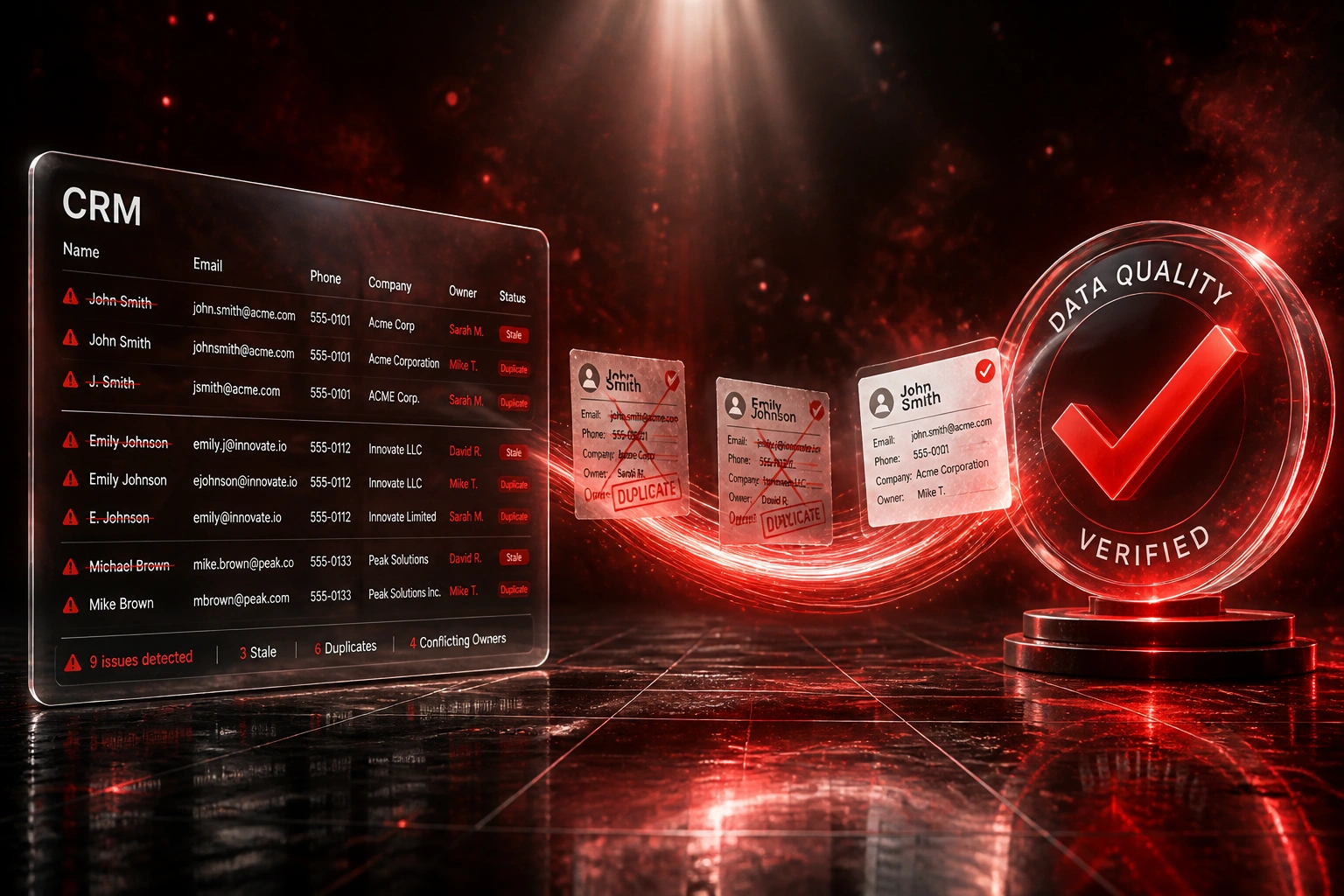
Your CRM is full of ghosts: duplicate contacts, stale mobiles, wrong owners. Missed follow-ups, wasted outreach, and fiction forecasts are not admin annoyances. They are a measurable revenue leak.
We quantify the leak, then run a fixed-scope cleanup that restores pipeline accuracy in weeks.
Sound Familiar?
These are the revenue leaks CEOs and sales directors bring us when the CRM stops matching reality:
- Duplicate contacts mean two reps call the same account, confuse the buyer, and burn trust
- Stale mobile numbers and bounced emails waste half a day of dialling before anyone notices
- Wrong owners leave warm leads sitting idle while the pipeline report still looks full
- Forecast meetings turn into arguments because nobody trusts stage, amount, or close date
- AI copilots and sequences fire on dirty records, amplifying every error at scale
Two clocks are ticking. AI CRM copilots and sequences amplify every dirty record. POPIA Section 16 also requires reasonably practicable steps to keep personal information accurate and up to date. Ghosts in the CRM are a revenue problem and a compliance exposure.
From Ghost Records to Pipeline You Can Trust
Audit the leak → merge duplicates → fix ownership → lock hygiene so bad CRM data stops coming back.
Measure the Leak
Duplicate rate, stale contacts, forecast variance, and Rand cost of wasted outreach
Merge & Enrich
Golden records replace ghosts. Invalid emails and dead mobiles get cleared or refreshed
Fix Ownership
Every open deal has one owner. Routing rules stop the free-for-all that recreates duplicates
Keep It Clean
Validation, bounce sync, and a hygiene scorecard so CRM ROI compounds instead of rotting
A Fixed-Scope CRM Cleanup That Sticks
Full CRM Data Audit
We measure duplicate rate, field completeness, stale contacts, bounced emails, and conflicting owners so you see the rand cost of bad CRM data before we fix a single record.
Deduplication & Golden Records
Match on email, company name, phone, and VAT number. Merge ghosts into one trusted record with clear ownership and a clean activity history.
Stale Contact Cleanup
Archive or refresh contacts with no activity, invalid emails, and outdated job titles so reps stop chasing people who left six months ago.
Ownership & Routing Rules
Every open opportunity has one accountable owner. Lead routing and territory rules stop the free-for-all that creates duplicates in the first place.
Validation & Hygiene Automation
Required fields, format checks, and duplicate warnings at entry. Ongoing enrichment and bounce sync keep CRM data quality from rotting again next quarter.
Forecast Hygiene Dashboards
Pipeline boards flag missing next steps, inflated duplicates, and stage drift so commit meetings run on numbers leadership can defend.
CRMs We've Cleaned and Governed
From 22% Duplicates to 1.5% in Six Weeks
How a Johannesburg B2B services firm recovered R2.4 million in year one by cleaning the CRM their sales directors no longer trusted.
The Ghost Database
- 18,000 contacts with a 22% duplicate rate and conflicting owners on open deals
- Reps spent about five hours a week verifying numbers and untangling accounts
- 45% of emails bounced or were invalid on active sequences
- Forecast landed within 30% of actual: useless for hiring and cash planning
- Two AEs routinely chased the same account without knowing it
The Trusted System
- 11,200 clean golden records after merges and dead-record removal
- Duplicate rate down to 1.5%, with validation blocking new clones at entry
- Invalid emails cut to 12%; sequences only hit reachable contacts
- Forecast variance inside 8% of actual within one full quarter
- SDR cleanup time dropped from five hours a week to about 45 minutes
Before vs After CRM Data Quality Work
How It Works
From first audit to trusted pipeline in 3–6 weeks.
Quantify the Leak
Audit duplicates, stale records, and forecast variance. We put a Rand figure on the revenue you are losing today.
Scope the Cleanup
Agree merge rules, ownership logic, and what stays vs archives. Fixed scope, fixed fee, clear success metrics.
Clean & Validate
Deduplicate, enrich, and reassign. Your team reviews edge cases while we run parallel reports to prove accuracy.
Lock In Hygiene
Validation rules, alerts, and a light governance rhythm so clean CRM data quality holds after we leave.
Frequently Asked Questions
How do you measure the cost of bad CRM data for our business?
We start with four numbers: duplicate rate, field completeness on open deals, percentage of contacts with no activity in 180+ days, and forecast variance (predicted vs actual). Industry research puts the typical revenue leak at 15–25%, with sales reps losing about 27% of their time to inaccurate records. We convert those findings into your Rand figures using your seat count, average deal size, and win rate.
How long does a CRM data quality engagement take?
Most fixed-scope cleanups run 3–6 weeks: one week of audit and scoping, two to four weeks of deduplication and enrichment, then a short handover with hygiene rules live. Databases over 100,000 records or multi-region ownership models take longer; a single sales team usually sees pipeline accuracy recover inside a quarter.
Will cleanup disrupt our sales team mid-quarter?
No. We work on a staging copy or behind feature flags where possible, merge in controlled batches, and keep the live pipeline available throughout. Reps only review flagged edge cases. We do not freeze the CRM or ask the team to stop selling while we clean.
Which CRMs do you clean and govern?
HubSpot, Salesforce, Pipedrive, Zoho CRM, Microsoft Dynamics, Freshsales, and custom-built CRMs. The platform matters less than whether duplicates, stale contacts, and wrong owners are quietly leaking revenue.
How do you stop bad data coming back after the cleanup?
One-off cleanups without guardrails rot within months. We add validation at entry, duplicate warnings, ownership rules, bounce and enrichment syncs, and a light monthly hygiene scorecard so CRM data quality stays a managed metric, not a surprise at year-end.
How much does a CRM data quality engagement cost?
Focused audits and cleanups for a single sales org typically start around R35,000. Full programmes with golden-record logic, routing rules, enrichment, and ongoing hygiene dashboards usually sit between R55,000 and R140,000. Against mid-market annual losses commonly measured in millions of Rand, most clients see payback inside one quarter.
Stop Paying for Ghosts in Your CRM
If your sales directors argue over forecast numbers and your reps keep dialling dead contacts, you are already funding the problem. Bad CRM data quality is a measurable revenue leak, not an IT tidy-up.
Tell us which CRM you run, roughly how many contacts and open deals you carry, and where trust has broken. We will show you the likely Rand leak and what a fixed-scope cleanup would recover.