CRM Data Model: Contacts, Companies, Deals and Custom Objects
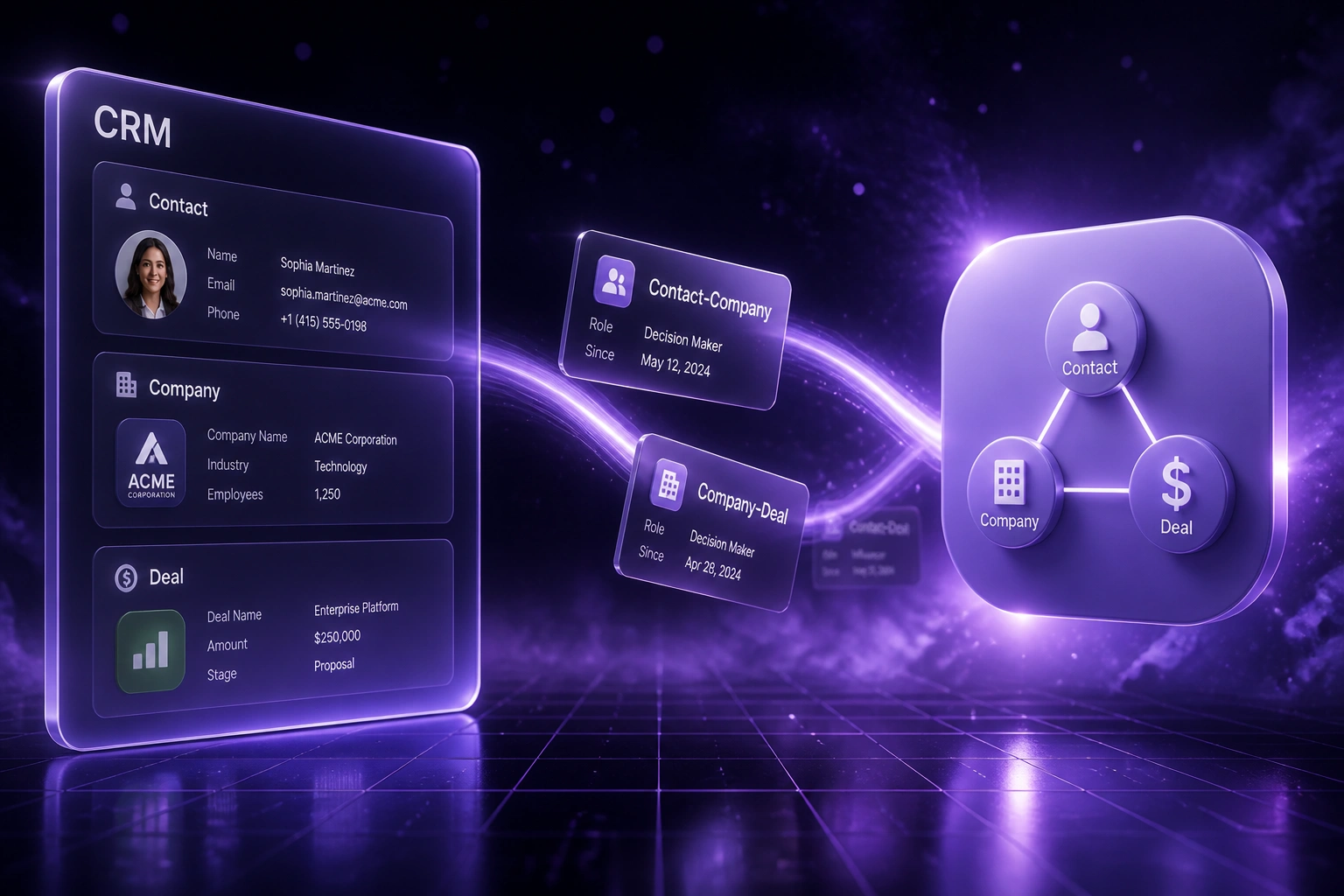
You inherited a CRM where everything is a Contact or a Deal. Duplicates multiply, associations are missing, and every board pack becomes an argument about whose numbers are right. Getting the data model right is the single most important CRM architecture decision you will make.
We design and remediate entity relationships so reporting, automation, and integrations stop fighting the schema.
Sound Familiar?
These are the exact symptoms ops leads and CTOs describe when the CRM schema was never designed:
- Everything lives as a Contact or a Deal, so companies, projects, and policies share one messy pile
- Duplicate people and accounts multiply every import, and nobody trusts the "unique customer" count
- Board reports never match sales reviews because relationships between records are missing or wrong
- Automations fire on the wrong record, skip orphaned deals, or create yet another duplicate
- Integrations to accounting and support keep breaking because the CRM schema cannot express how the business actually works
Cleanup without redesign does not stick. Without architectural clarity, hygiene projects become cyclical: most CRMs drift back to their pre-cleanup state within 6 to 12 months as imports and integrations reintroduce bad records.
From Flat Records to a Reporting-Ready Schema
Entities defined → relationships enforced → duplicates controlled → reports that leadership trusts.
Map the Business Entities
People, accounts, opportunities, and the custom objects your process needs
Design Relationships
Primary company links, deal associations, and labels that match how buying really works
Remediate Records
Merge duplicates, re-parent orphans, and migrate fields onto the right objects
Lock in Governance
Matching rules, required associations, and field standards keep the schema clean
Everything You Need for a Reliable CRM Schema
Entity Blueprint
We define Contacts, Companies, Deals, and the custom objects your business actually needs, with clear ownership of what belongs on each record.
Relationship Architecture
Associations and primary links are designed so every deal rolls up to the right company, every contact has account context, and reports stop double-counting.
Custom Object Design
Policies, properties, projects, placements, or subscriptions become first-class objects instead of buried custom fields that break reporting.
Dedup and Governance Rules
Matching rules, required associations, and field standards stop the mess from coming back after cleanup.
Reporting-Ready Schema
Pipeline, revenue, and account views are built on correct joins, so leadership stops arguing about whose spreadsheet is right.
Integration-Ready Foundation
A clean CRM data model is what makes accounting sync, marketing automation, and support tooling reliable instead of brittle.
Platforms We've Remodelled
From 18% Duplicates to Under 2%
How a Cape Town professional services firm stopped fighting its CRM schema and recovered 420 staff hours a year.
Everything Was a Contact or Deal
- Companies stored as free-text on Contact records, so account roll-ups never worked
- Projects and retainers jammed into Deal fields, breaking pipeline and revenue reports
- 18% duplicate rate across contacts and companies after years of imports
- Ops spent Fridays reconciling three conflicting customer counts for the board pack
- Accounting and marketing syncs created yet more duplicates every week
Deliberate Entity Relationships
- Contacts linked to Companies with required primary associations
- Deals parented correctly; projects became a custom object with clean links
- Matching rules and import standards stopped duplicate creation at the door
- One trusted customer count feeds sales reviews and the board pack
- Integrations sync against stable entity keys instead of free-text names
Before vs After a Proper CRM Data Model
How It Works
From first conversation to a live, governed CRM schema in 4 to 8 weeks.
Audit the Current Schema
We inventory objects, fields, duplicates, and broken associations, then map how sales, ops, and finance actually use the CRM.
Design the Target Model
Contacts, Companies, Deals, custom objects, and relationship rules are designed against your real commercial process, not platform defaults.
Migrate and Remediate
We merge duplicates carefully, re-parent records, introduce custom objects where needed, and validate reports against known truth sets.
Govern and Hand Over
Matching rules, required links, and a lightweight field-lifecycle process keep the schema clean as the team grows.
Frequently Asked Questions
What is a CRM data model, and why does it matter more than another feature?
A CRM data model is the set of entities (Contacts, Companies, Deals, custom objects) and the relationships between them. It is the architecture decision that determines whether reports add up, automations fire correctly, and integrations stay stable. Features on a broken schema just amplify the mess.
We already cleaned duplicates. Why do they keep coming back?
Cleanup without redesign is temporary. If Contacts and Deals are forced to hold company, project, and product data they were never meant to hold, every import and integration recreates duplicates. Durable hygiene needs the right objects, required associations, and matching rules, not another one-off scrub.
Do we need custom objects, or can we just add more fields?
Extra fields work until you need to report, automate, or integrate around a real business entity such as a policy, property, project, or subscription. Custom objects keep those entities first-class so relationships stay clean. We only introduce them when the commercial process demands it.
Which CRMs can you redesign data models in?
We have remodelled schemas in HubSpot, Pipedrive, Salesforce, Zoho CRM, Monday.com, Freshsales, and custom-built CRMs. The craft is entity and relationship design. The platform is secondary.
How long does a CRM data model redesign take?
Most mid-market redesigns take 4 to 8 weeks from audit to live schema, including careful record migration and a reporting validation pass. Highly customised multi-object models with heavy historical cleanup sit closer to 8 to 12 weeks.
How much does CRM data model design cost in South Africa?
Focused Contact, Company, and Deal relationship redesign typically starts from around R45,000. Multi-object models with custom objects, deduplication, and reporting rebuilds usually fall between R75,000 and R150,000. Teams losing hundreds of hours a year to duplicates and report scrubbing usually recover the build cost inside one or two quarters.
Stop Paying for Years of Schema Cleanup
If your CRM still treats every entity as a Contact or a Deal, you are paying for reporting rework, duplicate campaigns, and brittle integrations that a deliberate data model would prevent.
Tell us which CRM you run, what objects you are abusing today, and which reports never add up. We will show you the target entity model and the payoff of getting it right.