CRM and E-Commerce Integration: Unifying Online and Offline Sales
Your Shopify and WooCommerce orders live in one system. Your store and showroom conversations live in another. That split costs you repeat purchases, burns hours on copy-paste, and lets the same customer claim the same discount twice.
We build the ecommerce CRM that gives every team a 360-degree view of every customer.
Sound Familiar?
These are the exact issues ecommerce founders and retail CEOs bring us before an online sales CRM is in place:
- Shopify and WooCommerce orders live in one system, showroom conversations in another
- Store staff re-offer discounts customers already used online
- Sales and marketing copy-paste orders into the CRM every morning
- Abandoned carts never reach the CRM, so follow-up stops at a generic email
- Repeat purchase rate stalls because nobody sees the full customer history
HubSpot's native Shopify connector skips metafields and multi-store logic, and WooCommerce has no first-party HubSpot path. Growing brands outgrow plug-and-play syncs precisely when loyalty rules and showroom history start to matter.
What the Shopify CRM Integration Actually Does
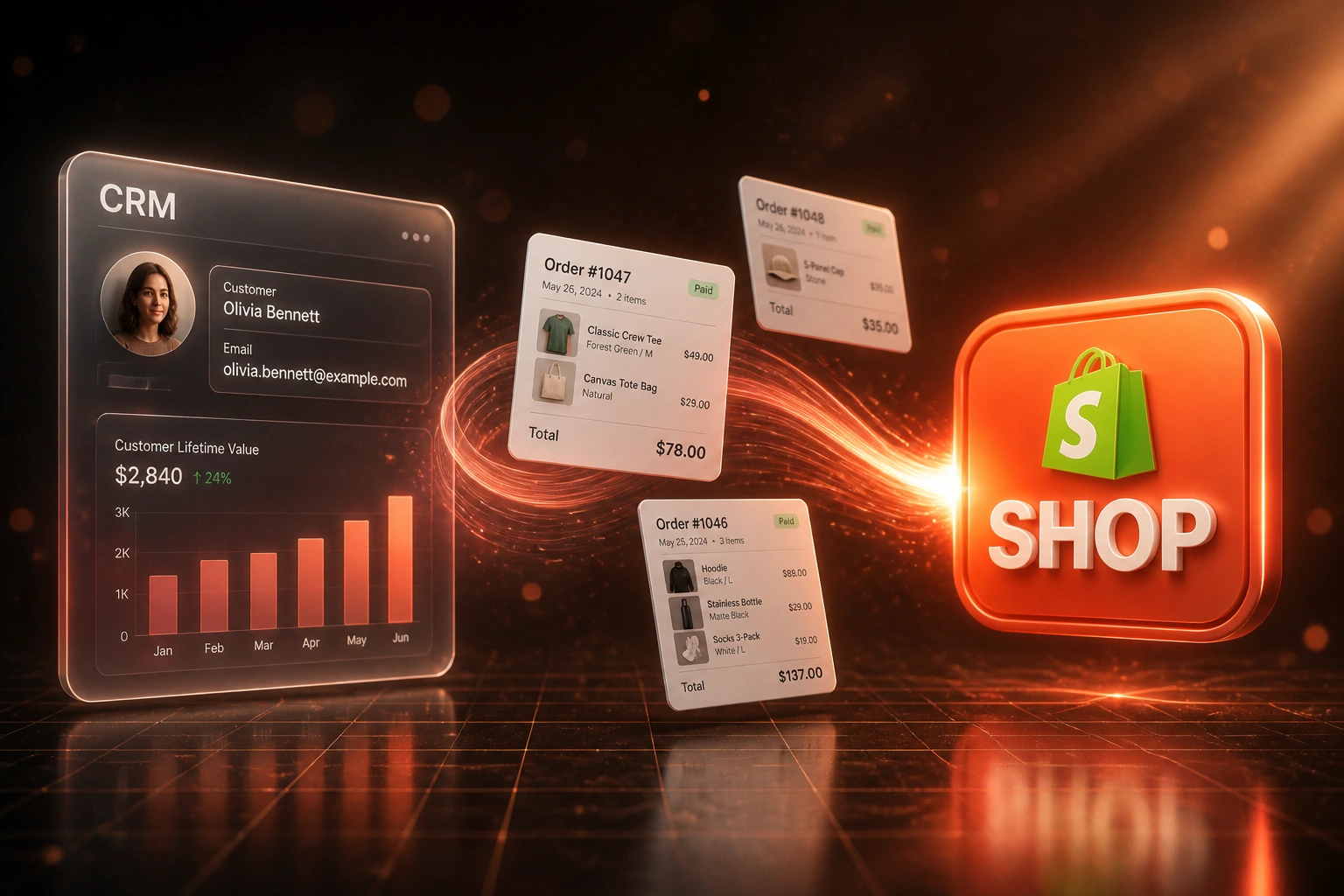
Order placed → CRM updated → showroom informed → recovery automated. No morning spreadsheet ritual.
Order Hits the Shop
Customer buys or abandons a cart on Shopify or WooCommerce
CRM Record Updates
Contact, order, and loyalty fields sync within seconds
Showroom Sees History
Floor staff open the same record before recommending or discounting
Recovery & Retention
Cart follow-ups and VIP journeys run on complete purchase history
Everything You Need for a Reliable Ecommerce CRM
Order-to-CRM Sync
Every Shopify or WooCommerce order creates or updates the CRM contact with line items, totals, and fulfilment status in seconds.
Unified Customer Timeline
Online purchases, abandoned carts, showroom visits, and support notes sit on one record so every team sees the same history.
Cart Recovery in CRM
Abandoned checkouts flow into CRM workflows, so follow-ups use purchase history, not a one-size-fits-all reminder.
Discount & Loyalty Guardrails
VIP codes, store credits, and prior promotions sync both ways, stopping double-discounting at the till and online.
Showroom Clienteling
Floor staff pull online browse and order history on a tablet, then log the in-store conversation back to the same CRM record.
Segment & Lifecycle Sync
High-value, at-risk, and first-time buyers update automatically so marketing emails match what the person actually bought.
Platforms We've Connected for Online Sales CRM
From 10 Hours/Week to Under 1 Hour/Week
How a multi-store fashion retailer stopped copy-pasting Shopify orders into HubSpot and lifted repeat purchases by 18%.
The Manual Process
- Ops exported Shopify orders each morning and typed them into HubSpot
- 10 hours a week on copy-paste, returns matching, and VIP code checks
- Showroom staff had no view of online history, so they reissued discounts
- Abandoned carts never entered CRM workflows beyond Shopify's native email
- Marketing segments lagged days behind real purchase behaviour
The Automated Process
- Every Shopify order and cart abandonment updates HubSpot within seconds
- Showroom tablets open the full timeline before any discount is offered
- Loyalty balances and used codes sync both ways, ending double-discounting
- Cart recovery flows use prior AOV and category history, not generic reminders
- Ops reviews exceptions only: under one hour a week
Before vs After Integration
How It Works
From first conversation to live Shopify CRM or WooCommerce CRM sync in 2–4 weeks.
Tell Us Your Setup
Shopify or WooCommerce, which CRM, how many stores or showrooms, and where the handoff breaks today.
Free Scoping Call
30-minute call to map order fields, loyalty rules, and the online-to-offline journeys that matter most.
Build & Test
We build the sync, test with real orders and showroom scenarios, and run parallel for a week before go-live.
Go Live & Monitor
Switch off the morning copy-paste. Monitoring and alerts keep orders and contacts flowing cleanly.
Frequently Asked Questions
How long does an ecommerce CRM integration take?
A standard Shopify or WooCommerce to CRM sync takes 2–4 weeks from scoping to go-live. Simple one-way order syncs can be live within a week. Bidirectional setups with loyalty rules, showroom clienteling, and cart recovery workflows typically take 4–6 weeks.
Which ecommerce platforms and CRMs do you connect?
We regularly connect Shopify and WooCommerce to HubSpot, Pipedrive, Salesforce, Zoho CRM, Klaviyo, and custom-built CRMs. If your store and CRM both have an API, we can connect them.
Isn't the native HubSpot Shopify app enough?
Native connectors cover basic contacts and orders, but they typically skip Shopify metafields, struggle with multi-store setups, and leave WooCommerce without a first-party HubSpot path. When you need loyalty guardrails, showroom history, or custom segments, a purpose-built sync is more reliable.
Will this disrupt our store or showroom operations?
No. Your team keeps selling in Shopify, WooCommerce, and on the floor. The integration runs in the background. We run parallel testing so you only switch off manual copy-paste once the sync is proven accurate.
How do you stop duplicate customers and double discounts?
We match contacts on email, phone, and loyalty ID, then merge history into one record. Promotion and credit balances sync both ways so the till and the online checkout see the same entitlements.
How much does ecommerce CRM integration cost?
Simple one-way order syncs start from around R15,000. Bidirectional integrations with loyalty rules, cart recovery, and showroom clienteling typically range from R25,000 to R60,000. Most retailers doing 50+ orders a week see ROI within 2–3 months against the manual sync cost alone.
Stop Running Online and Offline Sales in Parallel
If your team is still copying Shopify or WooCommerce orders into a CRM, or your showroom cannot see what the customer already bought online, you are paying for a problem that is already solved.
Tell us which shop and CRM you run, how many stores or showrooms you operate, and where the handoff hurts most. We will show you exactly how a unified ecommerce CRM would work for your business.