CRM for Car Dealerships: Test Drives, Finance and Aftersales
Leads fall between the showroom, the finance desk, and the workshop while your competitors answer first and book the first service at delivery. A purpose-built dealership CRM with DMS integration closes the gap from enquiry to handover to service booking.
We build the automotive CRM that connects sales, F&I, and fixed ops.
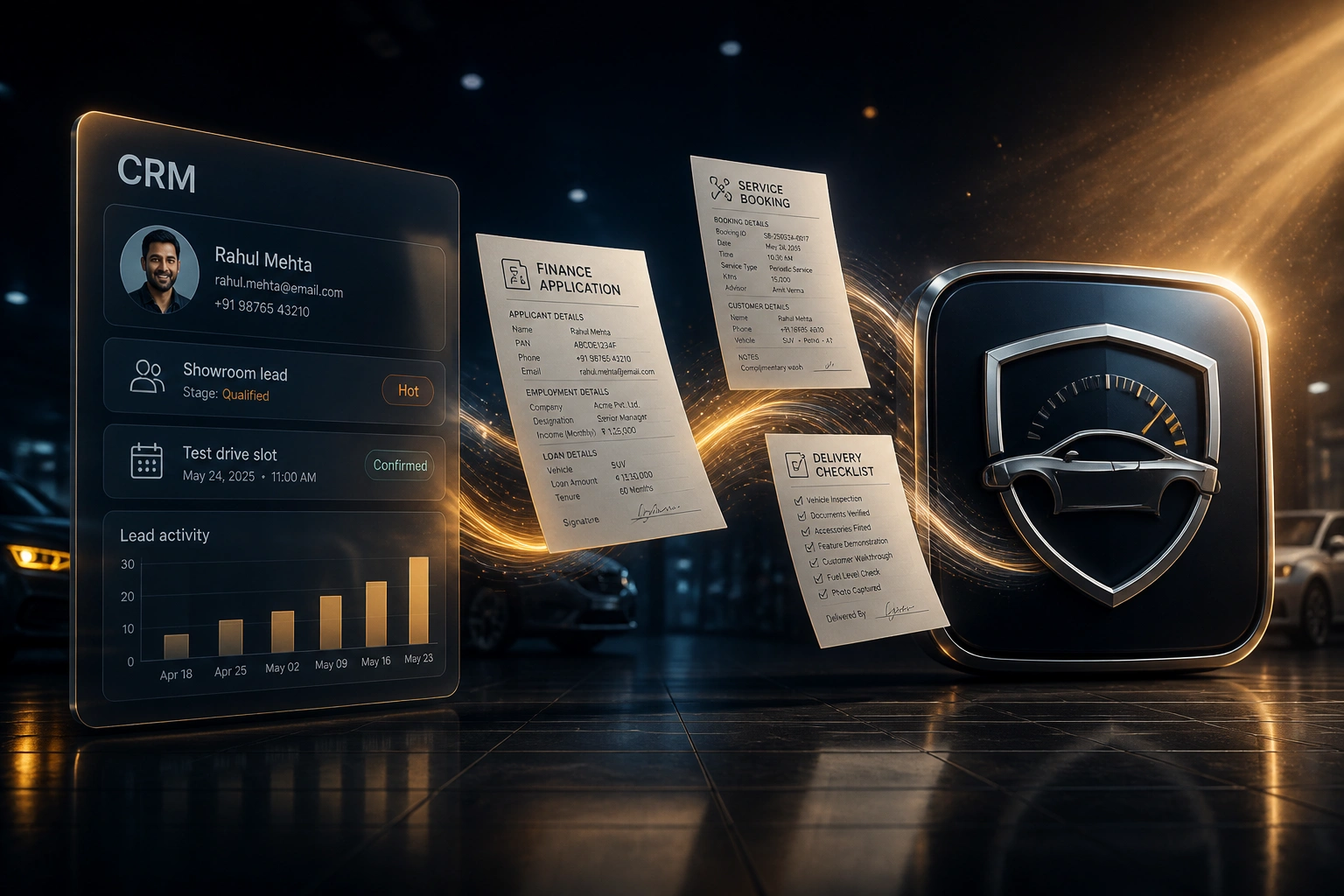
Sound Familiar?
These are the exact issues dealership principals and sales managers bring us before a purpose-built automotive CRM:
- Showroom walk-ins and WhatsApp enquiries sit on a salesperson's phone until the next morning
- Test drives are booked in a paper diary that never updates the CRM or the floor manager
- Finance applications are retyped from handwritten forms, then stall for hours on the F&I desk
- Sold deals never close out in the CRM because the DMS and the sales tool do not talk
- First service appointments are rarely booked at delivery, so aftersales revenue walks out with the car
Roughly 40% of vehicle sales still close after day three, yet most stores sharply cut follow-up once the early window passes. Meanwhile WhatsApp has become a primary SA lead channel, and POPIA expects documented consent, not informal phone chats. Dealers that log every enquiry, sustain follow-up, and book the first service at delivery recover revenue their competitors leave on the floor.
What Dealership CRM and DMS Integration Looks Like in Practice
Enquiry arrives → test drive booked → finance tracked → delivery and first service locked. One pipeline from showroom to workshop.
Lead Hits the CRM
Walk-in, web, or WhatsApp enquiry routes to a salesperson with a response clock
Test Drive Booked
Drive scheduled against stock, feedback captured, next follow-up queued automatically
Finance Desk Sync
Credit app and stipulations tracked so F&I waits shrink and fallthrough drops
Delivery and Service
Deal closes in the DMS, CRM opportunity closes, first service books before handover
Everything a Car Sales CRM Needs to Run Your Rooftop
Showroom and Digital Lead Capture
Walk-ins, website forms, AutoTrader-style portals, and WhatsApp enquiries land in named salesperson queues with response timers. Hot leads stop dying overnight.
Test Drive Scheduling
Book drives against stock, assign a salesperson, capture feedback, and trigger the next follow-up. No more diary collisions or forgotten walk-around notes.
Finance Application Pipeline
Credit apps, stipulations, and lender status tracked per deal. Pre-delivery collection shortens F&I turn times and cuts fallthrough at the desk.
DMS Bidirectional Sync
Customer, vehicle, and deal status flow between your dealership CRM and DMS. Sold units close opportunities automatically instead of leaving ghost pipelines.
Aftersales and Service Booking
First service appointment booked at delivery, RO history synced for retention campaigns, and service-to-sales flags when equity or warranty windows open.
POPIA Consent Trail
Consent type, channel, and timestamp recorded on every WhatsApp and marketing touch. Operator agreements and retention rules sit behind the workflows your team already runs.
Sources and Systems We Commonly Connect
From 18 Hours of Handoff Friction to Five
How a Pretoria multi-brand franchise stopped losing showroom leads between sales, F&I, and the workshop, booked first service at 86% of deliveries, and recovered R1.6 million in year-one aftersales and closed deals.
The Broken Showroom Stack
- WhatsApp and walk-in leads lived on personal phones; overnight replies were normal
- Test drives sat in a paper diary the CRM never saw
- Finance apps were retyped at the desk; average F&I wait near 48 minutes
- Sold units stayed open in the CRM because DMS write-back did not exist
- First service booked at delivery on roughly one in five handovers
The Connected Dealership CRM
- Every enquiry routes to a named salesperson with a same-hour SLA
- Test drives, finance status, and delivery milestones share one pipeline
- Credit apps collected before delivery day; F&I wait cut to about 22 minutes
- DMS deal posting closes the CRM opportunity automatically
- First service appointment is a required delivery step, not an afterthought
Before vs After a Purpose-Built Dealership CRM
How It Works
From first conversation to live dealership CRM in 10 to 16 weeks.
Map the Rooftop Flow
How leads arrive, how test drives get booked, how finance apps move, and where the DMS handoff currently breaks.
Scope the Dealership CRM
Showroom pipeline, finance desk, DMS sync, and aftersales booking scoped into a fixed quote.
Build, Integrate, Train
We build the CRM, wire DMS and lead channels, migrate open opportunities, and train sales, F&I, and service together.
Go Live and Tune
WhatsApp shadow lists retired, first-service booking enforced at delivery, and reporting refined for the principal's morning meeting.
Frequently Asked Questions
How is a dealership CRM different from HubSpot or a generic sales CRM?
Generic CRMs model contacts and deals. Automotive dealers need showroom ups, test drive slots against VIN stock, finance applications with lender stipulations, DMS write-back when a deal posts, and first service bookings that feed fixed ops. A purpose-built dealership CRM puts those objects at the centre so sales, F&I, and the workshop stop running parallel diaries.
Can it integrate with our existing DMS?
Yes. We design bidirectional handoff so customer and vehicle records stay aligned, sold deals close CRM opportunities when the DMS posts the deal, and service ROs flow back for retention. Industry benchmarks put mid-complexity DMS integration around R60,000 to R120,000 one-time plus ongoing data-access fees; fuller multi-store or write-back builds sit higher. We quote fixed scope after discovery.
How much does a purpose-built dealership CRM cost?
Most dealership CRM builds we scope land between R220,000 and R550,000, depending on rooftops, DMS depth, finance workflows, and aftersales modules. A focused MVP with lead routing, test drives, and deal pipeline sits toward the lower end. Full DMS write-back, multi-brand stock, and service retention push toward the upper range.
How long until the floor can use it day to day?
A disciplined MVP typically ships in 10 to 16 weeks. We phase delivery so lead capture and the showroom pipeline go live first, then finance status, DMS sync, and aftersales booking. Salespeople train on the journey they already run: enquiry, drive, finance, delivery, service.
Does this help with POPIA and WhatsApp lead handling?
It does not replace your Information Officer or legal advice, but it records consent type, channel, and timestamp on marketing and WhatsApp touches, keeps retention schedules visible, and supports operator agreements with processors. That beats scattered phone chats when the Regulator asks how you obtained and use personal information.
How quickly does a dealership CRM pay for itself?
Most stores we work with recover the build inside 8 to 14 months when you count reclaimed mishandled leads, faster finance turnaround, and aftersales retained by booking the first service at delivery. Industry research puts lifetime service value north of R200,000 per retained customer. Recovering a handful of those relationships funds the system on its own.
Stop Losing Deals Between Showroom, Finance and Workshop
If your sales, F&I, and service teams still pass buyers through WhatsApp threads and paper diaries, you are funding a gap that a purpose-built dealership CRM already closes.
Tell us which DMS you run, how leads arrive today, and where finance and aftersales currently leak. We will show you how a connected automotive CRM would work on your floor.