Customer Master Reconciliation: Aligning Records Across CRM, ERP, and Billing
Your sales, finance, and billing teams argue about "the same" customer because CRM, ERP, and billing each hold a different version. Duplicate billing, failed collections, and sales chasing the wrong contact are the cost of living with three masters.
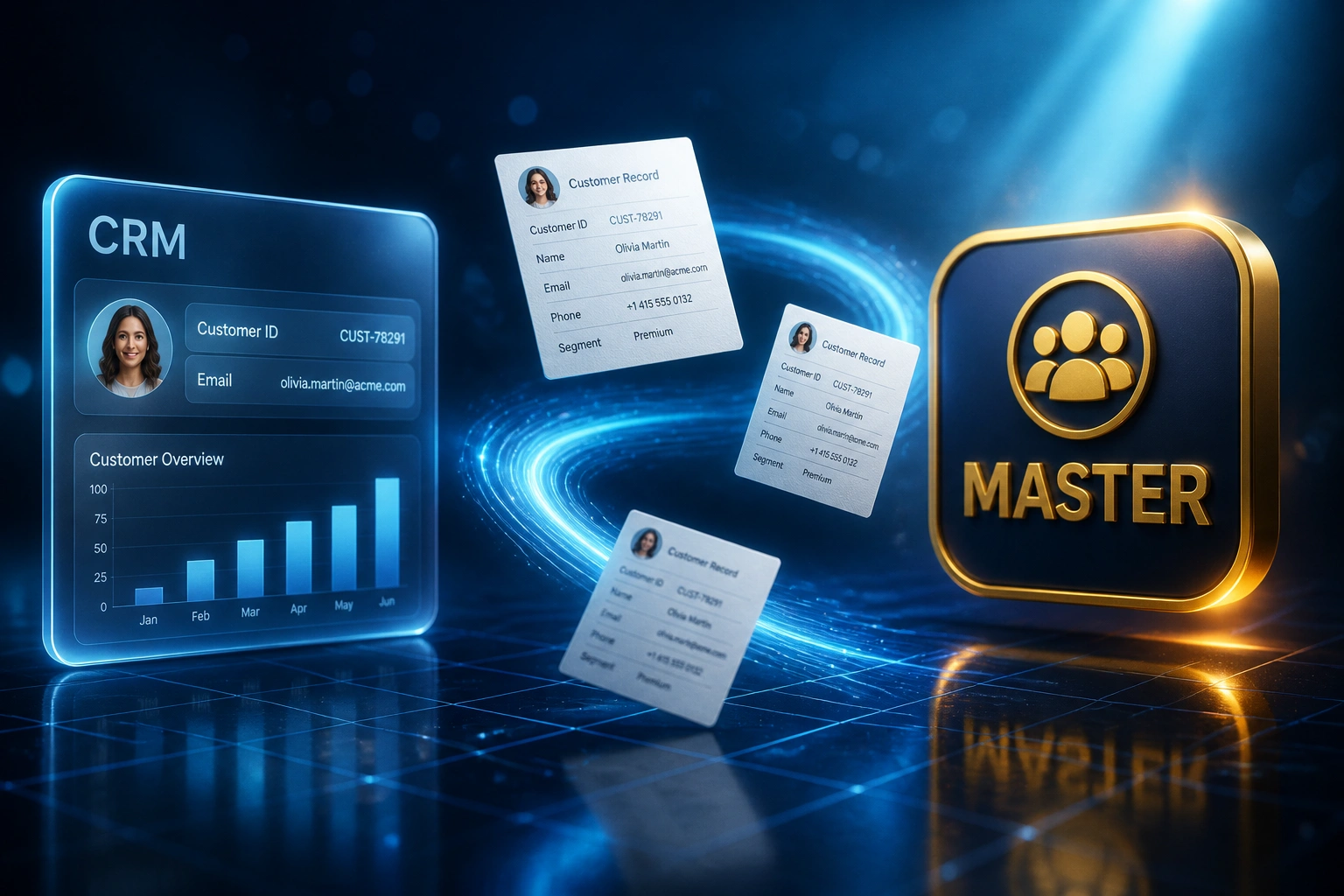
We reconcile once into a trusted customer master and keep the systems aligned.
Sound Familiar?
These are the exact issues our clients faced before CRM-to-ERP alignment and a trusted customer master:
- Sales, finance, and billing each defend a different version of the same customer, and every week starts with an argument about who is right
- Duplicate invoices and failed collections land because ERP and billing never received the CRM address, VAT number, or payment terms that actually matter
- Sales chase the wrong contact while collections chase a ghost account that was never linked to the live CRM record
- Month-end becomes a forensic exercise matching names, emails, and company registrations across three systems by hand
- Volume discounts and credit limits never trigger because spend is split across three master records that nobody has merged
Experian estimates companies lose about 12% of revenue to inaccurate customer data, while MIT Sloan puts the broader cost of bad data at 15% to 25% of revenue. Every week you live with three masters, you pay that tax in duplicate billing, failed collections, and wasted sales time.
What Customer Master Reconciliation Actually Does
Match across systems → choose the master → link IDs → keep CRM, ERP, and billing aligned.
Discover Conflicts
We scan CRM, ERP, and billing for the same customer under different IDs, spellings, and field values
Build the Master
Survivorship rules pick the trusted fields and create one golden customer record for each real entity
Link Every System
CRM, ERP, and billing IDs are cross-referenced so updates land on the same customer everywhere
Stop the Drift
Scheduled checks catch new duplicates and field drift before the next invoice or collection run
Everything You Need for CRM-to-ERP Alignment
Cross-System Customer Matching
We match the same customer across CRM, ERP, and billing on email, company name, VAT number, and registration, then surface every conflicting field before a master is chosen.
Trusted Master Record
Survivorship rules decide which system owns which field. The result is one golden customer master, not three half-truths that keep regenerating.
CRM, ERP, and Billing Alignment
Once the master is set, linked IDs keep CRM, ERP, and billing pointing at the same customer so updates land on the right record everywhere.
Conflict Quarantine Queue
Ambiguous matches go to a review queue with evidence from all three systems. Ops approve the master; nothing critical is overwritten in silence.
Ongoing Drift Prevention
Scheduled reconciliation catches new duplicates and field drift early, so customer master data management does not collapse back into spreadsheet archaeology.
Audit Trail for Every Merge
Every reconciliation records what disagreed, which value won, why, and who approved it. Finance and auditors get a defensible trail, not tribal knowledge.
Systems We've Aligned Into a Customer Master
From 12 Hours/Week to 2 Hours/Week
How a 45-person industrial supplier stopped three teams arguing over the same customers and recovered nearly a million rand in year one.
Three Conflicting Masters
- Sales worked HubSpot; finance worked Sage; billing ran a separate customer file
- Same trading name existed as three records with different VAT numbers and ship-tos
- Collections failed when dunning hit a stale ERP contact while CRM had the live buyer
- Ops spent 12 hours a week matching customers by hand for invoice and credit-limit decisions
- Duplicate invoices went out whenever billing created a "new" account for an existing CRM client
One Trusted Customer Master
- Every customer has one master with linked HubSpot, Sage, and billing IDs
- Survivorship rules decide which system owns address, VAT, and payment terms
- New conflicts land in a review queue instead of creating a fourth master
- Ops reviews exceptions in about two hours a week; the rest stays aligned automatically
- Collections and sales work the same contact, so dunning and outreach stop missing
Before vs After Customer Master Reconciliation
How It Works
From first conversation to a live customer master in 4 to 6 weeks.
Map Your Customer Masters
Which systems hold customer records today, where they disagree, and which mismatches drive billing errors or collection failures.
Free Scoping Call
30-minute call to set match keys, survivorship rules, and which customer cohort to reconcile first.
Reconcile and Parallel Run
We build the master, link CRM, ERP, and billing IDs, write back aligned values, and validate against your live collections and invoicing.
Go Live and Monitor Drift
Manual argument drops to exceptions. Ongoing checks flag new customer drift before the next billing cycle.
Frequently Asked Questions
How is customer master reconciliation different from merging duplicates in one CRM?
A CRM merge cleans duplicates inside one system. Customer master reconciliation aligns the same customer across CRM, ERP, and billing when each system holds a different version. We create one trusted master, link the IDs, and keep those systems pointing at the same record so the conflict cannot regenerate overnight.
Which systems can you include in a customer master project?
We routinely reconcile HubSpot, Salesforce, or Pipedrive against Xero, Sage, SAP, QuickBooks, and custom ERP or billing platforms. If each system exposes a customer entity we can match, we can align it into a single master.
What happens when CRM, ERP, and billing all disagree?
Ambiguous cases go to a quarantine queue with evidence from every side: timestamps, VAT numbers, invoices, and related contacts. Your ops or finance lead approves the winning master. We never silently overwrite a billing address or credit limit that affects collections.
Will this reduce duplicate billing and failed collections?
Yes. Most duplicate invoices and failed collection attempts start with a customer that exists under different IDs in CRM, ERP, and billing. Once those records share a master and linked IDs, invoices, credit holds, and dunning hit the right account.
How long does customer master reconciliation take?
A focused reconciliation across CRM, ERP, and billing typically takes 4 to 6 weeks from scoping to live. Larger catalogues with heavy historical duplicates and custom survivorship rules usually take 6 to 10 weeks, including parallel validation against current invoicing and collections.
How much does customer master reconciliation cost?
Focused three-system customer master work typically starts around R45,000. Broader programmes with heavy historical cleanup, custom match rules, and ongoing drift monitoring usually land between R60,000 and R120,000. Most clients recover that inside 2 to 4 months against the hours currently spent arguing over conflicting customer records.
Stop Living With Three Versions of Every Customer
If sales, finance, and billing still argue about who the customer is, you are paying for a problem that customer master reconciliation already solves.
Tell us which CRM, ERP, and billing systems you run, where the records disagree today, and which errors hurt cash most. We will show you how a trusted master would work for your business.