Win/Loss Analysis Automation: Learn Why Customers Stay or Leave
Most sales directors and CS leads only hear anecdotes after a painful loss. CRM dropdowns say "price," churn analysis never runs on schedule, and customer feedback stays scattered. Without systematic win/loss analysis, you keep repeating the same loss reasons while win rates stall.
We automate structured interview workflows, data collection, and trend reporting so retention insights and sales learnings compound every week.
Sound Familiar?
These are the exact issues our clients faced before win/loss analysis automation:
- You only hear why a deal died in a hallway anecdote after a big loss, never as a coded theme across the quarter
- Sales reps mark "price" in the CRM, while buyers later cite implementation risk, product gaps, or champion change
- Win interviews never happen because there is no trigger when a deal moves to Closed Won or Closed Lost
- Customer success learns churn reasons weeks later, if at all, so retention insights never feed sales playbooks
- Leadership reviews win rate and churn rate, but cannot answer why customers stay or leave with evidence
Average B2B win rates sit around 20–21%, while top performers clear 30%+. Much of that gap is learning speed: teams that systematise win/loss analysis improve faster than teams that rely on hallway stories. Clozd’s 2025 research also shows only 39% run an ongoing cross-functional programme.
What Win/Loss Analysis Automation Actually Does
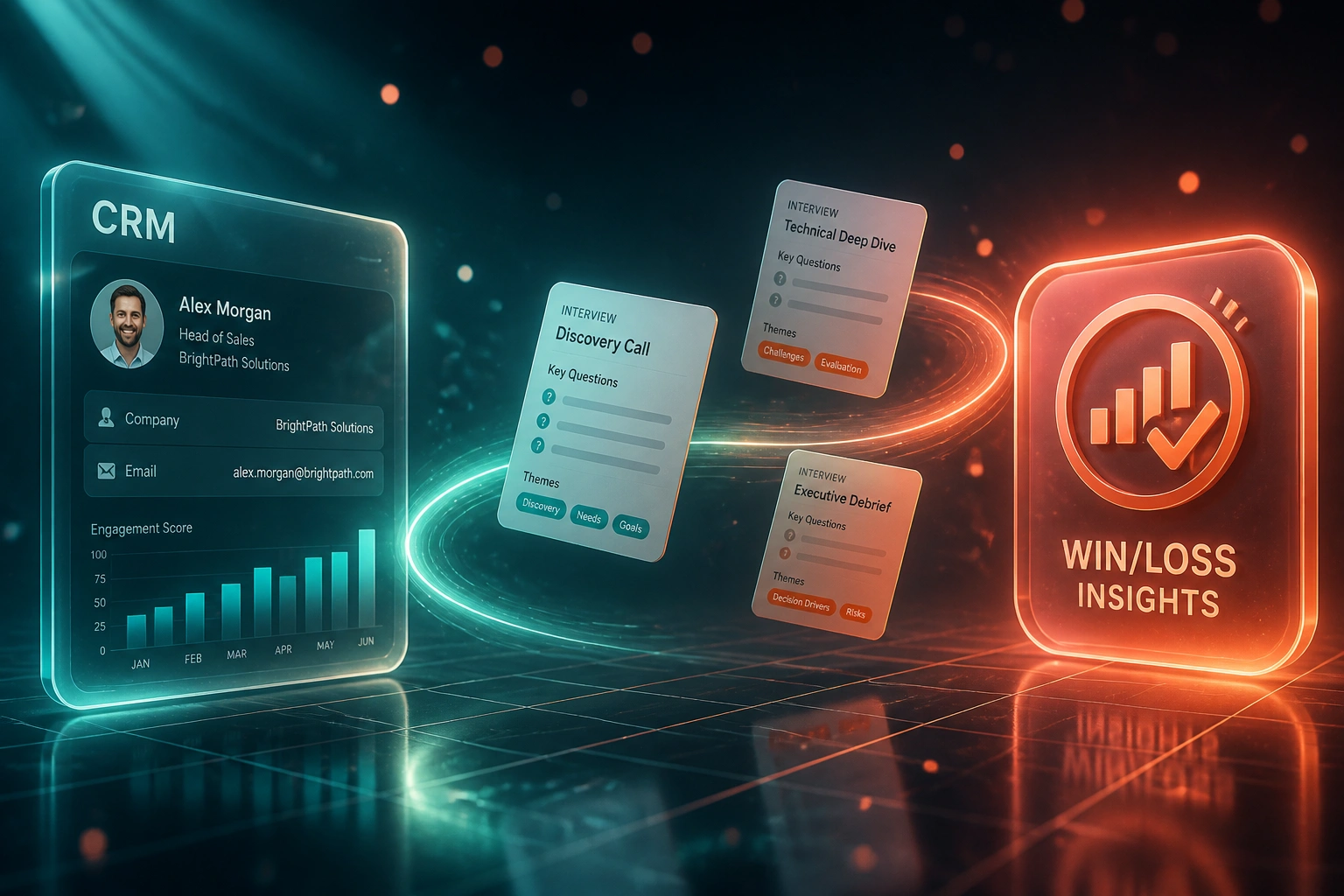
Deal closes or customer churns → interview launches → themes coded → leadership sees trends. No chasing anecdotes.
CRM Stage Changes
Closed Won, Closed Lost, or a churn event fires the workflow in your CRM
Interview Launches
Structured guide goes to the buyer or churned customer (and a short coded debrief for the AE)
Themes Coded
Answers consolidate against a taxonomy so customer churn reasons become countable trends
Insights Acted On
Sales and CS get trend packs; playbooks and battlecards update before the next quarter of losses
Everything You Need for Continuous Retention Insights
CRM Stage Triggers
Closed Won, Closed Lost, or churn/cancellation events in HubSpot, Salesforce, or Pipedrive launch a structured interview workflow within hours, while memory is fresh.
Structured Interview Guides
Neutral guides for buyers and churned customers cover decision criteria, competitors, risks, and stay-or-leave drivers, not free-text guesses from the AE who owned the deal.
Automated Data Collection
Responses land in a single store with deal size, segment, competitor, and owner attached, so every closed opportunity contributes to the pattern layer.
Theme Coding & Taxonomy
Answers are coded against a shared taxonomy (fit, product, price perception, sales experience, implementation risk) so churn analysis and win reasons become countable.
Trend Reporting for Leadership
Sales and CS directors get weekly or monthly packs: top loss reasons, rising themes, competitor patterns, and retention insights tied to save and win outcomes.
Closed-Loop Actions
Recurring themes route to battlecard owners, product, and CS playbooks so the same loss reason does not repeat for another quarter of deals.
Platforms We Commonly Wire In
From Hallway Anecdotes to Coded Win/Loss Trends
How a 45-person B2B software company stopped guessing after losses and lifted competitive win rate within two quarters.
The Manual Process
- Sales director asked for a "quick debrief" only after deals above R500K were lost
- CRM loss reason was "price" on most rows; buyers were never interviewed systematically
- CS ran occasional exit calls; notes lived in Slack and never joined sales themes
- Quarterly reviews debated anecdotes; the same competitor objection kept recurring
- No owner for routing retention insights into battlecards or onboarding fixes
The Automated Process
- Every Closed Won and Closed Lost deal triggers a structured interview workflow within 48 hours
- Churn events launch the same taxonomy so stay-or-leave reasons sit in one model
- Themes code automatically; leadership gets a fortnightly trend pack
- Top two loss themes feed enablement and product within the same sprint cycle
- Save playbooks and competitive talk tracks update from evidence, not memory
Before vs After Win/Loss Analysis Automation
How It Works
From first conversation to live win/loss analysis automation in 3–5 weeks.
Tell Us Your Setup
Which CRM, how you close deals today, and whether churn events should trigger the same interview workflow.
Free Scoping Call
30-minute call to design triggers, interview depth, taxonomy, and the trend report your CEO actually reads.
Build & Test
We wire CRM triggers, interview collection, theme coding, and reporting, then validate on a sample of real wins and losses.
Go Live & Coach
Every closed deal feeds the programme. We tune completion rates, taxonomy, and the leadership pack as volume grows.
Frequently Asked Questions
How is this different from churn reporting or NPS surveys?
Churn reporting shows who is leaving and which exit patterns appear in CRM, billing, and support. NPS and CSAT measure sentiment. Win/loss analysis automation captures structured buyer and customer interviews when deals are won or lost (and optionally when customers churn), then codes themes so you learn why outcomes happen and what to change next. You often need all three; this page is the continuous interview and insight loop.
How long does win/loss analysis automation take to set up?
A focused CRM-triggered interview workflow with theme coding and a leadership trend pack typically takes 3–5 weeks from scoping to go-live. Broader setups with churn triggers, multi-segment taxonomies, and BI embeds usually land in 5–8 weeks.
Will sales and CS teams actually complete the interviews?
Completion rises when the ask is triggered automatically, short, and routed to a neutral owner rather than the AE who lost the deal. Industry benchmarks show third-party style interviews often clear 30%+ participation, versus under 5% for cold post-loss surveys, and automated conversational interviews commonly reach 30–45% completion (roughly 3–5× survey rates).
Which CRMs and tools can you connect?
We commonly connect HubSpot, Salesforce, Pipedrive, and Zoho CRM for stage and churn triggers, with Typeform, Qualtrics, or conversational interview tools for capture, and Looker or Power BI for trend reporting. If your stack has an API, we can usually wire it.
Do we need to interview every deal?
Every closed deal should contribute structured data (even a short coded debrief). Deeper buyer interviews focus on significant wins, losses, and competitive deals. The automation ensures you stop relying on a handful of ad-hoc post-mortems that introduce selection bias.
How much does win/loss analysis automation cost?
Focused CRM-triggered interview and reporting builds typically start from around R25,000. Broader programmes with churn triggers, multi-source capture, theme automation, and executive packs usually range from R40,000 to R90,000. Most teams targeting improved win rate and fewer repeated loss reasons see payback within one to two quarters once insights change playbooks.
Turn Every Win and Loss Into Retention Insights
If your organisation still learns why customers stay or leave from hallway stories, you are leaving win rate and save rate on the table that specialised teams already recover with systematic win/loss analysis.
Tell us which CRM you use, how deals close today, and whether churn should share the same interview taxonomy. We will show you how automated win/loss analysis would work for your sales and CS teams.