Data Cleansing Pipeline Design: Stop the Cleanup Weekends
You run an annual data cleanse. It looks fine for a fortnight. Then partner CSVs, form fills, and API creates recontaminate the CRM, and your team is back fixing phone formats and duplicates by hand.
We design the cleaning pipeline that keeps data hygiene permanent.
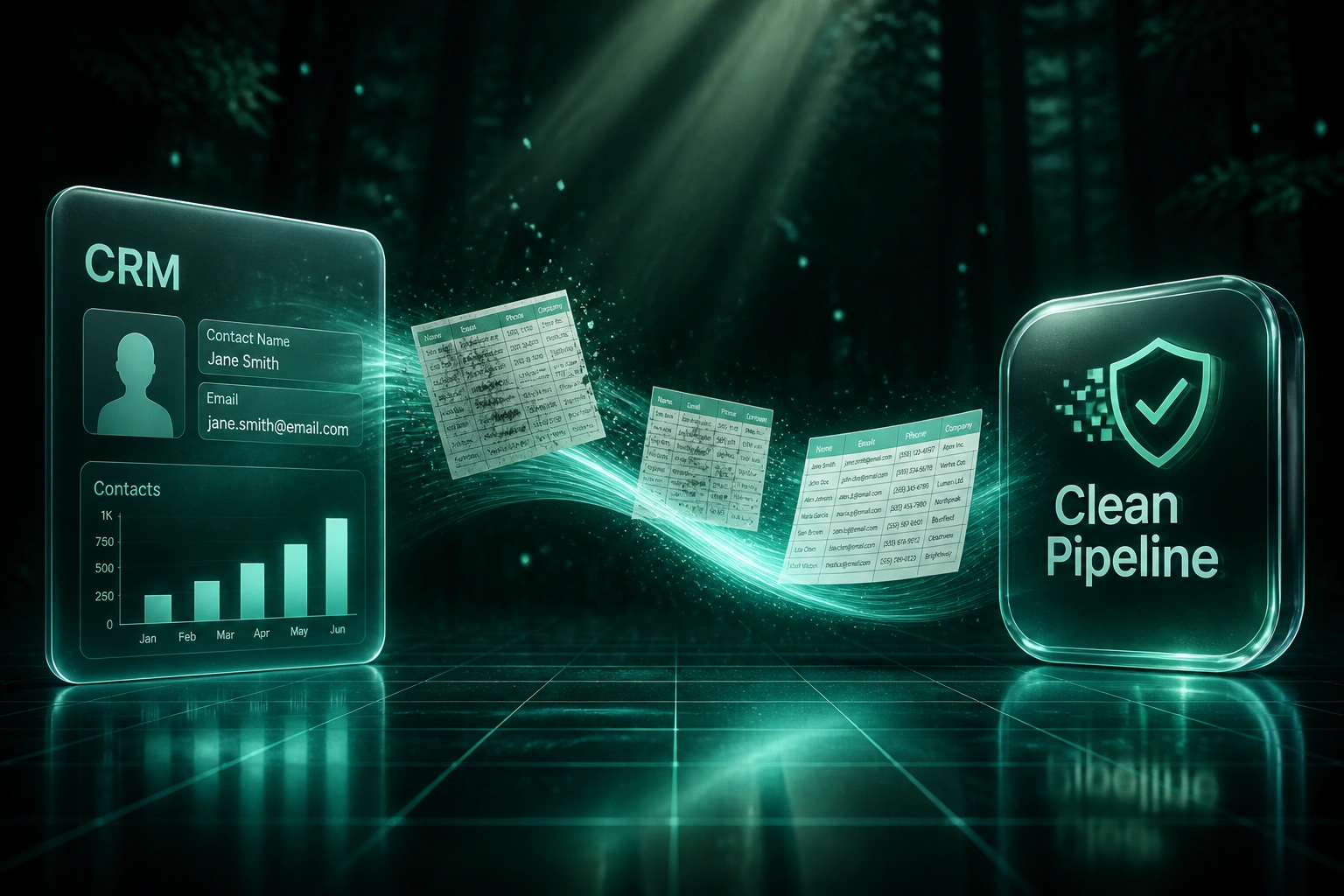
Sound Familiar?
These are the exact issues our clients faced before a continuous cleansing pipeline:
- Annual "data cleanup weekends" that look tidy on Monday and are dirty again by month-end
- Partner CSV drops and form fills land straight into production with no validation gate
- Ops and sales spend evenings fixing duplicates, wrong phone formats, and blank required fields
- Nobody notices a bad import until a campaign bounces or a warehouse pick fails
- Every new CRM, ecommerce channel, or partner feed restarts the same hygiene crisis
A new CRM, a partner feed, or ecommerce growth is usually the trigger. Volume jumps, intake paths multiply, and the next cleanup weekend cannot keep up. Point-of-entry hygiene becomes an ops risk, not a nice-to-have.
What the Cleaning Pipeline Actually Does
Record arrives → rules run → clean lands in production, dirty waits in quarantine. No silent pollution.
Record Arrives
CSV drop, form fill, ecommerce order, or CRM API create hits the intake gate
Validate & Standardise
Formats, required fields, picklists, and duplicates checked against your quality rules
Quarantine or Enrich
Failures queue with reason codes; clean rows can enrich before they land
Production Stays Clean
Only approved records reach the CRM or warehouse, with alerts when hygiene slips
Everything You Need for Permanent Data Hygiene
Point-of-Entry Validation
CSV drops, form fills, and API creates hit quality rules before they touch production. Bad formats, missing fields, and invalid values never get a free pass.
Standardisation Rules
Phone numbers, addresses, company names, VAT numbers, and picklists normalised to one house style so every system speaks the same language.
Quarantine & Review Queue
Suspect rows land in a quarantine queue with a clear reason code. Your team reviews exceptions, not every record.
Enrichment Hooks
Clean records can be enriched before they land: bounce checks, firmographics, CIPC lookups, or your own reference tables.
Alerting & Hygiene Scorecards
Threshold breaches, quarantine spikes, and freshness misses trigger alerts. Ops sees data hygiene as a live KPI, not an annual project.
Multi-Source Pipelines
One designed pipeline pattern covers partner feeds, website forms, ecommerce orders, and CRM API creates without reinventing the wheel each time.
Sources & Systems We've Piped Into Cleansing Flows
From 8 Hours/Week Fixing Data to 45 Minutes
How a 45-person wholesale distributor retired the annual cleanup weekend and stopped bad partner CSVs from poisoning their CRM.
The Cleanup Cycle
- Ops booked a yearly weekend: three people, two days, spreadsheet surgery
- Within six weeks, partner CSVs and form fills had reintroduced duplicates and blank phones
- Ops manager spent ~8 hours a week chasing bad imports and bounce fallout
- Sales blamed "the CRM" when campaigns hit dead contacts
- Every new ecommerce channel added another unvalidated intake path
The Continuous Pipeline
- Partner CSVs and form fills hit validation rules before the CRM
- Suspect rows quarantine with reason codes; clean rows enrich and land automatically
- Ops reviews exceptions in under an hour a week instead of fixing production
- Hygiene scorecard and alerts replace the next cleanup weekend
- New channels reuse the same cleaning pipeline pattern
Before vs After a Data Cleansing Pipeline
How It Works
From first conversation to a live cleansing pipeline in 3–5 weeks for a focused source set.
Map Your Dirty Paths
Which sources feed production today, what breaks most often, and where the annual cleanup weekends still happen.
Free Scoping Call
30-minute call to define quality rules, quarantine thresholds, and which systems must stay clean first.
Build & Parallel Test
We build the cleansing pipeline, run it against live sample feeds, and prove quarantine catches the failures your team already knows about.
Go Live & Monitor
Switch production intake through the pipeline. Scorecards and alerts keep hygiene permanent without another cleanup weekend.
Frequently Asked Questions
How is a cleansing pipeline different from a one-time data cleanup?
A one-time cleanse fixes what is already dirty. A cleansing pipeline stops dirty data from landing in the first place. Records from CSV drops, forms, and APIs are validated, standardised, and quarantined continuously, so the database does not recontaminate within weeks of the project ending.
Which sources can feed a data cleansing pipeline?
We routinely wire partner CSV drops, website and lead forms, ecommerce order feeds, CRM API creates (HubSpot, Salesforce, Pipedrive), spreadsheet uploads, and custom integrations. If a source can deliver structured records, we can put quality rules in front of it.
Will this slow down how fast records reach our CRM?
No. Clean records pass through in seconds. Only exceptions hit quarantine. Most clients find the pipeline is faster than the old pattern of importing first and fixing later, because rework disappears from the critical path.
What happens to records that fail validation?
They go to a quarantine queue with a reason code (missing email, invalid phone, unknown product code, duplicate match, and so on). Your ops lead reviews the queue, corrects or rejects, and clean versions are released into production. Nothing silent, nothing lost.
How long does a data cleansing pipeline take to build?
A focused pipeline for one or two high-volume sources typically takes 3–5 weeks from scoping to go-live. Multi-source designs covering partners, forms, and CRM APIs usually land in 5–8 weeks, including parallel testing against your real feeds.
How much does a data cleansing pipeline cost?
Focused pipelines for a single high-volume source start from around R35,000. Multi-source designs with custom rules, enrichment, and alerting typically range from R45,000 to R90,000. Most ops teams recovering 6+ hours a week of data-fixing see ROI within 2–4 months.
Stop Paying for Cleanup Weekends That Don't Last
If your team still schedules annual data cleanses while dirty CSVs and form fills keep landing in production, you are funding a problem a designed pipeline already solves.
Tell us which sources feed your CRM or warehouse, what breaks most often, and how much time ops spends fixing records. We'll show you how a continuous cleaning pipeline would work for your business.