Data Silo Consolidation: One Unified View from Disconnected Sources
You cannot get one straight answer about customers or revenue without asking three departments. Data silos hide churn, delay decisions, and force your team to rebuild the same numbers every week.
We link the records so leadership works from one consistent view.
Sound Familiar?
These are the exact issues our clients faced before data silo consolidation:
- The CEO asks for one customer number and gets three conflicting answers from sales, finance, and support
- Weekly leadership packs take a day or more because someone is still reconciling departmental reports by hand
- Churn risk sits invisible: support tickets, unpaid invoices, and CRM activity never land on the same record
- Marketing, ops, and finance each maintain a shadow spreadsheet because they do not trust the "official" systems
- AI and BI projects stall because the sources underneath are siloed, incomplete, or contradictory
Nearly half of enterprise AI projects are delayed or fail because the underlying data is not ready, and siloed sources are a top reason. If your analytics or AI roadmap depends on customers, orders, and finances living in four disconnected systems, the model will inherit that fragmentation.
What Data Consolidation Actually Does
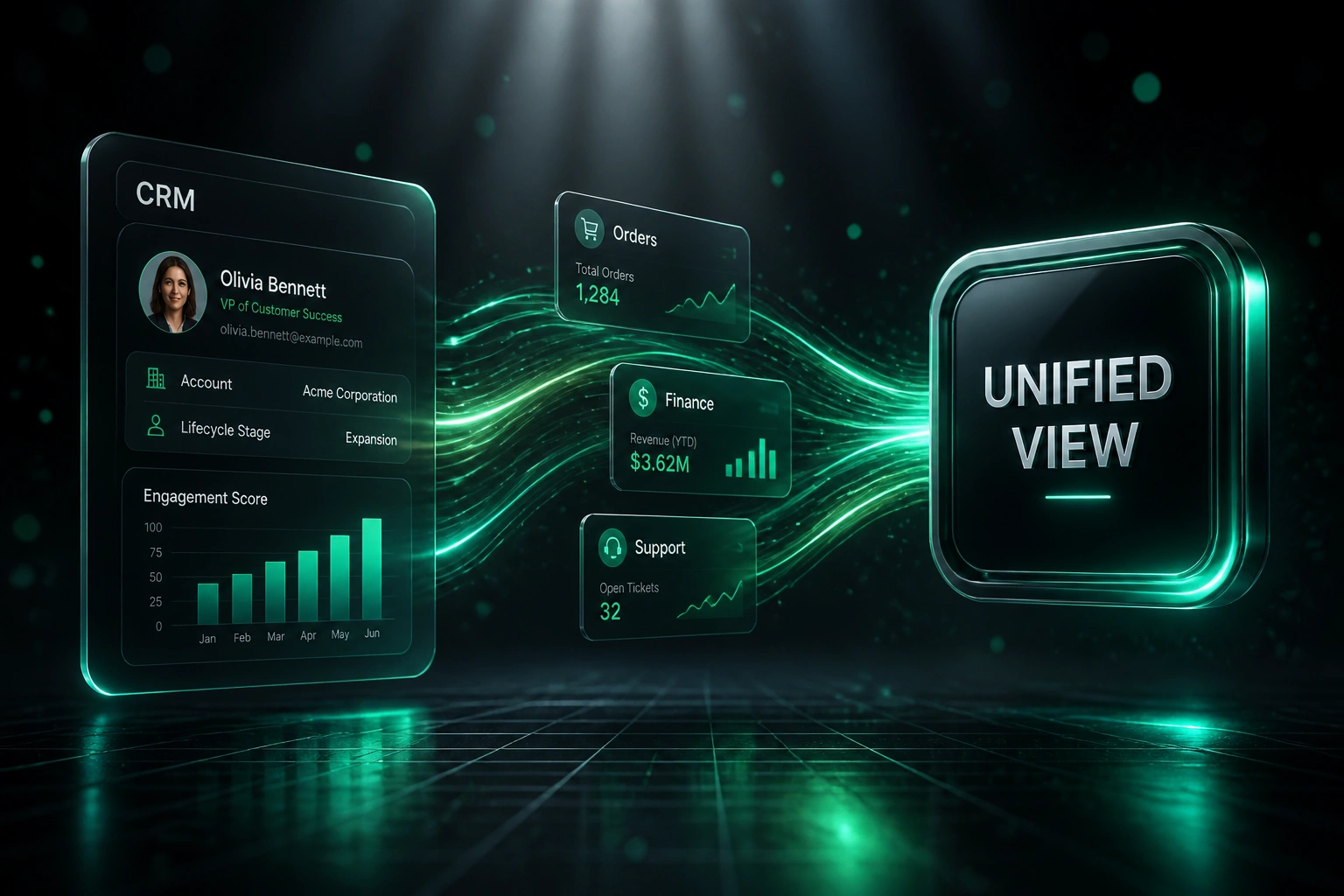
Match keys → linked records → one operational feed. No more chasing three departments for one answer.
Sources Stay Put
CRM, finance, orders, and support keep running as the systems of record for each team
Records Get Linked
Customers, orders, and invoices match on shared keys with conflict rules for edge cases
Unified View Updates
One consistent view of the customer refreshes as each department works in its own tool
Decisions Speed Up
Leadership packs and ops questions pull from one feed, not four reconciliations
Everything You Need for a Single Source of Truth
Cross-System Record Linking
Customer, order, and finance records match across CRM, accounting, ecommerce, and support so one ID means one person everywhere.
Unified Operational View
Leadership sees customers, orders, and finances in one consistent view instead of chasing three departments for the same answer.
Department Ownership Preserved
Sales keeps the CRM, finance keeps the ledger, support keeps the helpdesk. We link the records; we do not force a rip-and-replace.
Conflict and Duplicate Rules
When names, VAT numbers, or emails disagree, matching rules and quarantine queues stop silent wrong merges from poisoning the unified view.
Scheduled Reconciliation Packs
Board and ops packs pull from the linked store on a schedule. Manual copy-paste across departmental exports becomes the exception, not the ritual.
AI and BI Ready Feeds
Dashboards and models read one consolidated feed instead of four siloed extracts, so analytics projects stop failing on incomplete source data.
Systems We Commonly Link
From 16 Hours/Week to 2 Hours/Week
How a 50-person industrial distributor stopped chasing three departments for one customer number and recovered hundreds of thousands in year one.
The Siloed Process
- Sales lived in HubSpot, finance in Xero, orders in Shopify, support in Zendesk
- Ops coordinator spent 16 hours a week stitching four exports into the leadership pack
- "Revenue" and "active customers" never matched across departmental reports
- At-risk accounts were invisible because tickets and unpaid invoices never linked to CRM
- Every board question triggered a two-day chase across three managers
The Unified Process
- Customer, order, and invoice records link automatically across the four systems
- Leadership pack pulls from one operational feed; review takes about two hours
- One consistent view of customers, orders, and finances for sales, finance, and ops
- Support and finance signals surface on the same CRM account before churn hardens
- CEO questions get answered the same day without calling three departments
Before vs After Data Consolidation
How It Works
From first conversation to a live unified view in 4–6 weeks.
Map the Silos
Which systems hold customers, orders, and finances, where records diverge, and which questions leadership cannot answer today.
Free Scoping Call
30-minute call to design match keys, ownership rules, and which unified view pays back first.
Link and Parallel Run
We build the links, validate against your current departmental reports, and run in parallel until the numbers earn trust.
Go Live and Retire the Chase
Leadership reads the unified view. Shadow spreadsheets go read-only, and reconciliation hours drop to exceptions only.
Frequently Asked Questions
What does data silo consolidation actually mean for our business?
It means linking the records that already live in CRM, finance, ops, and support so you get one consistent view of customers, orders, and finances. Departments keep their tools. Leadership stops treating three conflicting exports as the source of truth.
Do we have to replace our CRM or accounting system?
No. Consolidation connects what you already run. Sales stays in the CRM, finance stays in the ledger, support stays in the helpdesk. We match and sync the shared entities so every team works from the same customer and order truth without a platform rip-and-replace.
How do you match records when departments use different identifiers?
During setup we catalogue the keys each system uses: email, VAT number, account code, order reference, and any internal IDs. Matching rules and human review queues handle ambiguous cases. Duplicates and conflicts surface instead of silently creating a fourth wrong version of the customer.
Will this help our AI and analytics projects?
Yes. Most delayed AI and BI work fails on incomplete or siloed sources, not on the model. A unified operational feed gives dashboards and models one clean place to read customers, orders, and finances from, which is the foundation those projects need.
How long does building a unified view from disconnected sources take?
A focused consolidation across three to five core systems typically takes 4 to 6 weeks from scoping to live. Broader programmes with heavy duplicate cleanup, custom ownership rules, and board-pack cutover can take 6 to 10 weeks including parallel validation against the old departmental reports.
How much does data silo consolidation cost?
Multi-system linking with match rules and a unified operational view typically starts around R45,000. Broader programmes with many platforms, custom reconciliation packs, and BI cutover usually land between R60,000 and R120,000. Most clients recover that inside 2 to 4 months against the hours currently spent reconciling departmental reports.
Stop Reconciling Departmental Reports by Hand
If leadership still needs three departments to answer one question about customers or revenue, you are paying for a problem that linking records already solves.
Tell us which platforms hold your customers, orders, and finances, and where the numbers disagree today. We will show you exactly how a unified data view would work for your business.