Data Warehouse Quality Remediation: Repairing Your Analytics Foundation
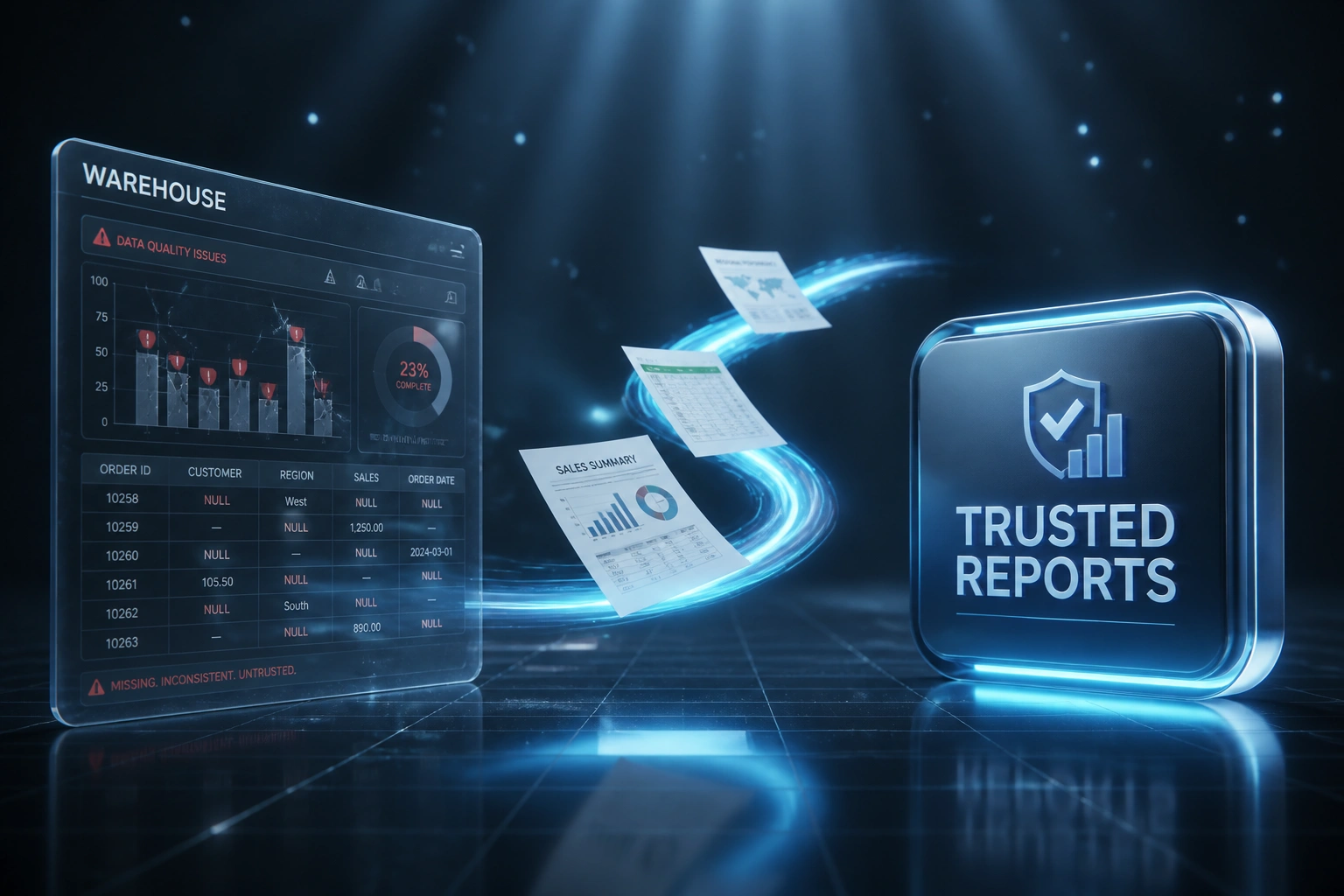
You no longer trust the dashboard. Board packs contradict finance, dimensions rewrite history, and silent nulls slip into every refresh. The warehouse is still running, but it is producing unreliable reports that leadership cannot defend.
We trace every disputed number to source, repair the pipelines, and validate output so decisions rest on accurate data again.
Sound Familiar?
These are the exact issues our clients faced before warehouse quality remediation restored reporting accuracy:
- Board packs and dashboards keep disagreeing with finance, so the CEO and CFO no longer trust the numbers on screen
- Fact tables go stale while dimensions overwrite history: revenue by segment quietly rewrites itself after SCD failures
- Silent nulls and broken joins ship into Looker, Power BI, or Metabase with no pipeline alert
- Analysts spend nights cleaning warehouse output instead of answering the business question
- Every AI or BI investment stalls because the analytics foundation still produces unreliable reports
MIT's 2025 GenAI Divide found 95% of enterprise GenAI pilots deliver zero measurable return, and industry analyses repeatedly tie that failure to dirty foundations. If your BI and AI spend sits on warehouse drift, silent nulls, and broken SCDs, you are funding the failure mode by default.
How We Restore Analytics Quality
Disputed report → root cause → pipeline repair → validated output. No more hoping the next refresh is clean.
Start from the Report
Pin the board metric or dashboard tile leadership no longer trusts
Trace to Source
Walk the warehouse model, transforms, and source feeds until the defect is named
Repair the Pipeline
Fix SCD models, fact loads, null rules, and transforms under change control
Validate the Output
Reconcile totals, sign off the pack, and leave monitors so drift cannot return silently
Everything You Need for a Pipeline Fix That Holds
Report-to-Source Tracing
We start from the disputed board metric and walk it back through the warehouse model, transform layer, and source systems until the defect class is named.
Dimension and SCD Repair
Broken slowly changing dimensions, Type 1 overwrites that rewrite history, and duplicate active keys get rebuilt so historical joins match the period that actually happened.
Fact Freshness and Null Hygiene
Stale facts, silent nulls, and orphaned foreign keys are quarantined, backfilled, or blocked so dashboards stop shipping incomplete rows as truth.
Pipeline and Transform Fixes
We repair the ETL/ELT jobs and dbt models that introduced the drift, with idempotent loads and validation gates before the next board pack.
Output Validation Packs
Reconciled totals, sample row checks, and written sign-off so leadership can trust reporting accuracy again, not just hope the refresh succeeded.
Ongoing Quality Gates
Freshness, null-rate, and SCD integrity monitors catch regression before the next AI pilot or BI roll-out lands on a dirty foundation.
Warehouses and BI Stacks We Remediate
From 3-Day Disputed Packs to a 4-Hour Trusted Board Pack
How a mid-market wholesale group restored analytics quality after SCD drift and silent nulls made every dashboard a negotiation.
The Untrusted Warehouse
- CFO rejected about 12% of key board metrics each month as unverifiable
- Analysts spent three full days assembling and defending the pack
- Type 1 dimension overwrites silently moved historical revenue by region
- Null rates on customer and product keys climbed without pipeline alerts
- A planned GenAI forecasting pilot was frozen until numbers could be trusted
The Remediated Foundation
- Report-to-source tracing named SCD, null, and freshness defect classes
- Dimensions rebuilt for point-in-time joins; facts backfilled and gated
- Board pack prep dropped to a four-hour validated refresh
- Disputed metrics fell below 1%, with a written reconciliation pack
- Quality monitors now block silent drift before the next AI or BI spend
Before vs After Warehouse Quality Remediation
How It Works
From first conversation to a signed-off, trustworthy warehouse in three to six weeks for most mid-market estates.
Name the Distrust
Which board metrics broke trust, which warehouse and BI tools are live, and which source systems still hold the ground truth.
Free Scoping Call
30-minute call with your CEO, CFO, or Head of Analytics to size defect classes, urgency, and the first validation sprint.
Trace, Repair, Validate
We trace report to source, repair dimensions, facts, and pipelines, then reconcile output against finance and ops baselines.
Sign Off and Guard
Written validation pack for leadership, then quality gates so silent nulls and SCD drift cannot creep back unnoticed.
Frequently Asked Questions
What is data warehouse quality remediation?
It is a structured engagement to repair quality failures already inside your warehouse: bad dimensions, stale facts, broken slowly changing dimensions, silent nulls, and pipeline defects that make board packs and dashboards untrustworthy. We trace each disputed report back to source, fix the models and loads, and validate output accuracy so leadership decisions rest on reliable numbers again.
How is this different from building a new warehouse or a post-migration spot check?
A greenfield warehouse project loads scrapers or SaaS extracts into new tables. Post-migration validation catches cutover defects after a system move. This engagement assumes the warehouse already exists and is producing unreliable analytics: we remediate the quality debt in place so your current BI stack becomes trustworthy without a rip-and-replace.
Which warehouses and BI tools do you remediate?
We commonly work across BigQuery, Snowflake, Amazon Redshift, and PostgreSQL warehouses, with dbt transforms and Looker, Power BI, or Metabase on top. The same report-to-source method applies when CRM, ERP, and accounting feeds have drifted inside the warehouse models.
How long does a warehouse quality remediation sprint take?
Focused mid-market estates with a clear set of disputed board metrics often land in three to six weeks from scoping to sign-off. Narrow defect classes (null hygiene on a few high-volume facts) can close faster. Multi-domain warehouses with years of SCD debt and undocumented transforms take longer. We give a timeline after the first forensic sample, not a vague promise.
Will this disrupt live dashboards and board reporting?
No. We remediate under change control, run parallel validation against the live pack, and only cut over once your CFO or Head of Analytics signs off the reconciled totals. Your team keeps using the same BI tools; the warehouse underneath them becomes accurate.
How much does warehouse quality remediation cost?
Focused remediation sprints for mid-market warehouses typically start around R45,000. Multi-domain repairs covering SCD rebuilds, fact backfills, and pipeline gates usually land between R75,000 and R180,000. Against Gartner's average annual cost of poor data quality (about R210 million for large enterprises), most clients recover the fee inside the first avoided board-pack firefight cycle.
Stop Leading from Unreliable Reports
If your CEO, CFO, or Head of Analytics no longer trusts the dashboard, you are paying for an analytics foundation that is actively undermining decisions.
Tell us which board metrics broke trust, which warehouse and BI tools you run, and where finance and ops still disagree. We will show you how report-to-source remediation would restore reporting accuracy for your business.