Database Schema Migration Repair: Fixing Data After Structural Changes
Your last schema migration dropped columns, changed types, or broke relationships. Reports are blank, apps are throwing errors, and integrations are offline. Another destructive cutover is not the only way out.
We restore structure and transform data safely, without wiping production again.
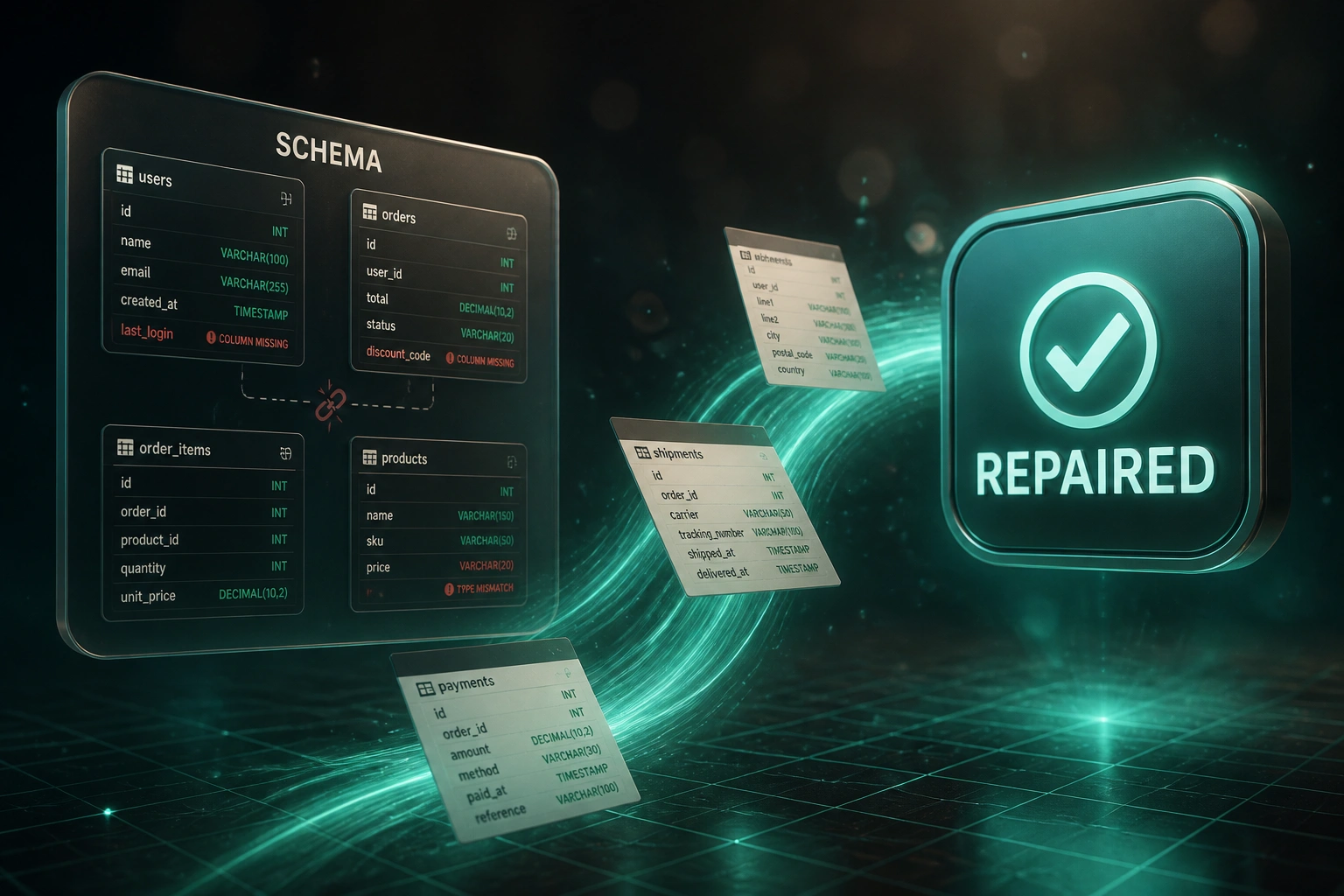
Sound Familiar?
These are the exact issues CTOs and ops leads face after a schema change goes wrong:
- A recent schema migration dropped columns your reports and integrations still expect, so dashboards show blanks and exports fail
- Column type changes broke application reads, ETL jobs, and partner APIs that assumed the old shape
- Foreign keys and relationships snapped after an ALTER, leaving orphan rows and joins that no longer resolve
- Ops and finance are running spreadsheet workarounds while production apps and integrations stay partially offline
- Leadership is being told the only options are a destructive wipe-and-restore or another risky cutover this weekend
One documented schema change cost US$127,000 (about R2.05 million) in 23 minutes when a column addition cascaded across 47 services. Caylent's 2025 survey found only 6% of challenging migrations finished on time, and only 6% achieved zero downtime. Waiting for another weekend cutover compounds silent data loss.
What Schema Migration Repair Actually Does
Assess damage → recover columns and types → repair relationships → prove integrations again.
Map the Structural Break
Diff live schema vs pre-migration copy: dropped columns, type changes, broken foreign keys
Restore and Transform
Recover missing columns, convert types safely, and backfill rows without wiping production
Repair Relationships
Remap broken foreign keys and re-validate joins so reports and apps resolve again
Prove Integrations Live
Smoke-test connected systems and hand leadership a sign-off pack, not another guess
Everything You Need for a Database Structure Fix
Schema Damage Assessment
We map what the migration changed: dropped columns, type changes, broken foreign keys, and which reports, apps, and integrations now fail.
Column Recovery
Missing columns are restored from pre-migration backups, replicas, or retained copies, then backfilled into the live schema without a full wipe.
Safe Type Transformation
Type changes are handled with dual-write or staged transforms so existing rows convert cleanly and applications keep reading valid data.
Relationship Repair
Broken foreign keys and parent-child links are remapped and re-validated so joins, invoices, and fulfilment packs resolve again.
Integration Smoke Tests
Warehouse, courier, accounting, and CRM connectors are re-tested against the repaired schema before you tell staff the fire is out.
No Second Destructive Cutover
We restore structure and transform data in place. No throwing good production history back into a wipe-and-restore blender.
Databases and Platforms We Repair
From 11 Days of Broken Reports to Stable Ops in 72 Hours
How a mid-market distributor recovered from a schema deploy that dropped columns, changed types, and broke three integrations, without a wipe-and-restore.
After the Schema Deploy
- Friday migration dropped four BI columns and changed order status from ENUM to VARCHAR
- Foreign keys between orders and shipments broke; warehouse and courier APIs failed
- Ops ran spreadsheet workarounds while Xero sync and WMS stayed offline
- Three senior engineers spent full days firefighting instead of shipping work
- Leadership was being pushed toward a weekend wipe-and-restore that would erase post-deploy orders
After Structural Repair
- Dropped columns restored from the pre-migration replica and backfilled into live tables
- Type transforms applied with dual-read so apps kept working during conversion
- Broken relationships remapped; warehouse, courier, and Xero connectors re-tested green
- Critical reporting paths live again inside 72 hours; residual exceptions queued for sign-off
- No wipe-and-restore, no second destructive cutover, and month-end closed on schedule
Before vs After Schema Migration Repair
How It Works
From first triage call to stable production, typically one to three weeks for a mid-market estate.
Incident Intake
What the migration changed, which columns and keys broke, and which reports, apps, and integrations are failing now.
Free Triage Call
30-minute call with your CTO or ops lead to confirm salvage vs wipe-and-restore and set an honest recovery window.
Restore and Transform
We recover dropped columns, apply safe type transforms, repair relationships, and validate against live workloads.
Re-Test and Hand Back
Integration smoke tests, sign-off packs for leadership, and monitoring until production stays stable.
Frequently Asked Questions
What is database schema migration repair?
It is the work of fixing data and structure after a schema change went wrong: columns dropped that reports still need, types changed so apps and integrations fail, or relationships broken so joins no longer resolve. We restore structure and transform data safely, rather than reconstructing history from logs alone.
How is this different from rebuilding historical data from logs?
Historical rebuild focuses on reconstructing missing past events from backups, audit trails, and bank or gateway logs. Schema migration repair focuses on the structural damage from a bad ALTER or deploy: column recovery, type transforms, and broken foreign keys that are breaking production right now.
Will you wipe the database and restore from backup?
Only if that is genuinely safer, and we will say so plainly. Most mid-market incidents are better served by surgical column recovery, staged type transforms, and relationship repair, because a full wipe often loses days of legitimate post-migration work and still needs the same structural fixes.
How long does schema migration repair usually take?
Critical paths for a mid-market estate are often restorable in 48–72 hours once we have backup and schema access. Full validation, integration re-tests, and residual exception cleanup typically land in one to three weeks depending on table size and how many systems consume the schema.
Which databases and platforms do you repair?
We regularly repair PostgreSQL, MySQL and MariaDB, SQL Server, Oracle, Azure SQL and Amazon RDS estates, plus custom ERP, CRM, and warehouse schemas that sit behind your applications. If you can grant read access to the live schema and a pre-migration copy, we can triage.
How much does schema migration repair cost?
Focused column recovery and relationship repair typically starts around R45,000. Multi-system type transforms, integration re-tests, and full validation packs usually land between R75,000 and R160,000. Against industry downtime at roughly R90,000 per minute for enterprises, and documented recovery incidents near R3.2 million, most mid-market teams see payback inside days, not months.
Stop Gambling on Another Destructive Cutover
If a schema migration left you with dropped columns, broken types, or failed relationships, every hour of spreadsheet workarounds and silent data loss is money you do not need to keep spending.
Tell us what changed, which systems are failing, and what backups you still trust. We will show you whether surgical schema migration repair can restore structure without wiping production again.