DHET HEMIS Reporting Automation: Higher Education Data Compliance
Your registrar and institutional research team still compile HEMIS data from ITS Integrator extracts and faculty spreadsheets. One late Valpac fatal-error loop before 31 July, and the university risks a mid-September resubmission, three-year historical amendments, and subsidy clawbacks on block grants that depend on those audited figures.
We automate extraction and validation so DHET HEMIS becomes a review, not a rebuild.
Sound Familiar?
These are the exact issues registrars, CIOs, and institutional reporting leads brought us before HEMIS automation:
- Enrolment, qualification, and staff extracts are rebuilt from ITS Integrator or SIS spreadsheets before every DHET HEMIS submission
- Valpac fatal errors only surface late, so your IR team reworks element tables under audit pressure
- Course CESM codes, credit values, and census-date rules do not match between faculty sheets and the student collection files
- Staff FTE and personnel-category fields drift from HR payroll, then fail the audited staff submission
- A late or incorrect final pack risks mid-September resubmission, three-year historical amendments, and subsidy clawbacks
DHET still treats 31 July as the hard stop for the third and final audited HEMIS submission. Audit directives note that late resubmissions after that date disrupt national subsidy verification. When errors surface, corrected databases with a revised audit report are expected by mid-September. Where necessary, institutions must amend historical databases for the past three years, and any overpayments are deducted from future block grants or earmarked funds under the Prescription Act.
What HEMIS Automation Actually Does
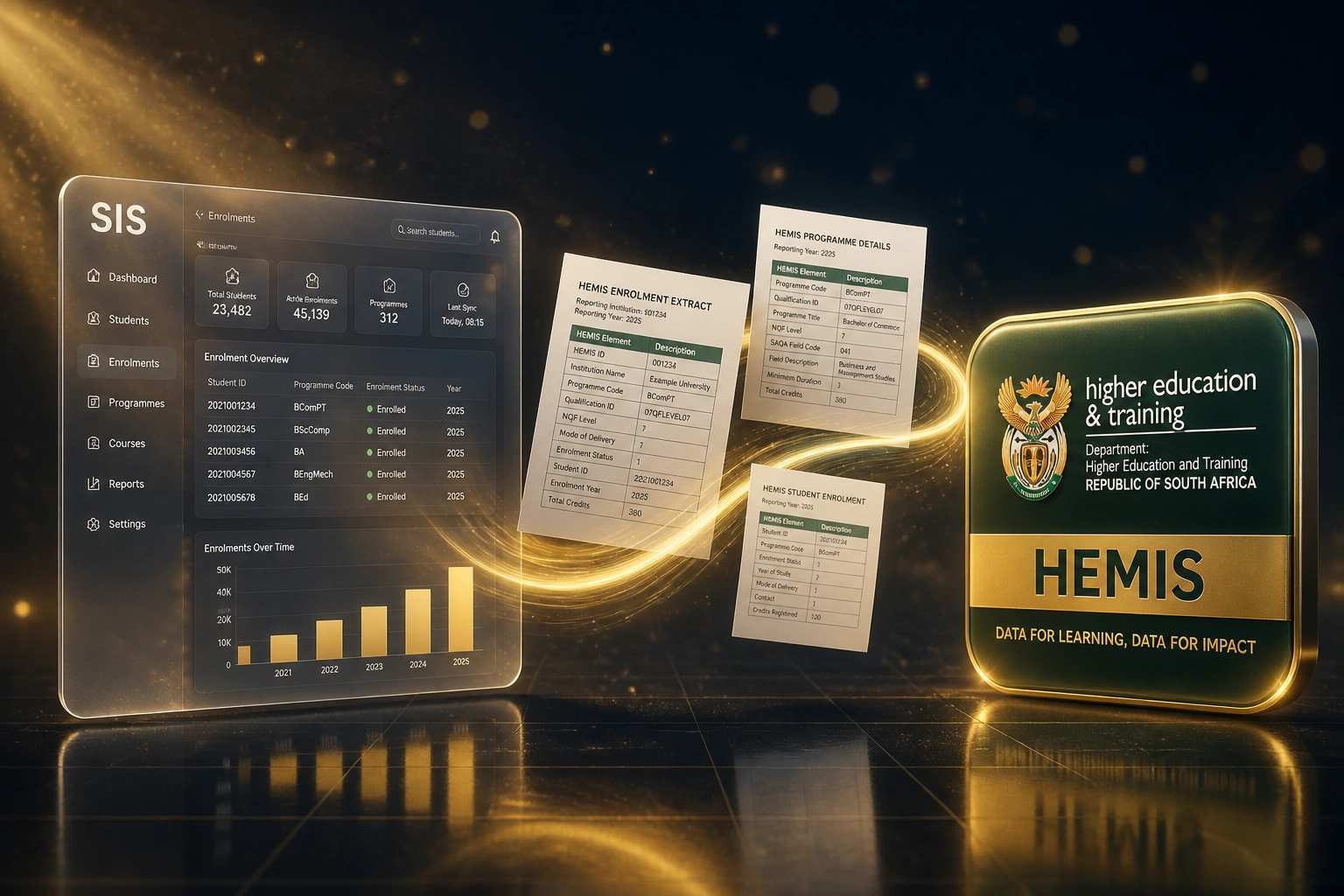
SIS and HR data in → Valpac-ready enrolment, qualification, and staff packs out. Your IR team reviews and submits, instead of retyping every element table.
Pull Live Institutional Data
Enrolments, qualifications, courses, and staff records sync from ITS Integrator or your SIS and HR sources
Map HEMIS Element Tables
Records land in the student, staff, and space collections Valpac expects, with CESM and credit rules applied
Pre-Validate Before Valpac
Cross-file checks surface fatal-error candidates while IR still has time to correct source data
Submit Audit-Ready Packs
Encrypted returns go to DHET on schedule; external auditors certify against cleaner source trails
Everything You Need for Reliable Higher Education Reporting
SIS Enrolment Extracts
Student, course registration, and qualification rows pull from ITS Integrator or your SIS on a controlled schedule, aligned to HEMIS census dates.
Element Table Mapping
Fields map into the six student-collection tables Valpac expects: student, course registrations, credit value, qualification, qualification CESM, and course.
Staff & FTE Packaging
Staff profile and staff FTE files assemble from HR and payroll sources so personnel category, race, gender, and FTE fractions stay consistent before audit.
Valpac Pre-Validation
Cross-file checks flag gaps and inconsistencies before you import into Valpac.Net, so fatal errors are cleared while there is still time to fix them.
Submission Pack Ready
Encrypted, Valpac-ready packs for the three student submissions, the annual staff return, and space extracts where your campus still reports them.
Deadline Control Tower
February staff cut-off, third-submission audit trail, and 31 July final audited HEMIS status are visible weeks ahead, not the night before council sign-off.
Platforms We've Connected for HEMIS Packs
From 11 Weeks/Year to 2.5 Weeks/Year
How a Gauteng university of technology cleared Valpac fatal errors before the 31 July audit and recovered R162,000 in IR staff time in year one.
The Manual Process
- IR exported enrolments from ITS Integrator, then rebuilt six student element tables in spreadsheets
- Staff FTE fractions were reconciled to payroll by hand ahead of the February staff window
- Roughly one in ten submission cycles hit late Valpac fatal errors near the audit cut-off
- External auditors waited on corrected packs while faculties rechecked CESM and credit fields
- Peak load stretched across three student submissions, staff, and the final 31 July return
The Automated Process
- Scheduled extracts produce Valpac-ready enrolment, qualification, and staff files
- IR reviews exception lists and funded-credit reports instead of rebuilding rows
- Pre-validation catches cross-file gaps before import into Valpac.Net
- Third-submission pack reaches auditors with a cleaner trail for certification
- February staff and July student deadlines become controlled reviews, not fire drills
Before vs After HEMIS Automation
How It Works
From first conversation to live HEMIS packs in 3–6 weeks.
Tell Us Your Setup
Which SIS holds enrolments, how you currently build Valpac files, and which HEMIS submissions consume the most IR time.
Free Scoping Call
30-minute call to map element tables, census dates, staff FTE rules, and the audit pack your council must sign by 31 July.
Build & Test
We wire the extracts, map HEMIS elements, and run a parallel dry-run against last year’s accepted Valpac database until IR signs off.
Go Live & Monitor
Switch off the spreadsheet rebuild. Monitoring keeps submission packs current ahead of each DHET window and the final audited return.
Frequently Asked Questions
What is DHET HEMIS reporting automation?
It is a controlled extract, validation, and packaging workflow that turns live SIS, HR, and academic records into Valpac-ready HEMIS files. Your institutional research team still owns quality assurance and the DHET submission; we remove the weeks spent rebuilding enrolment, qualification, and staff element tables by hand.
Which systems can you extract from?
We have shaped HEMIS-ready packs from ITS Integrator, PeopleSoft Campus, Banner, Oracle and SAP student systems, and spreadsheet-fed campuses. If your student information system can export structured enrolment and staff data, we can map it to the Valpac student, staff, and space collections your institution uses.
How does this protect our subsidy and audit position?
Block grants and earmarked funds depend on reliable audited HEMIS data. DHET audit directives require the final audited student submission by 31 July. Errors found after that date can force a mid-September resubmission with a revised audit certificate, and where necessary DHET can amend historical databases for the past three years and claw back overpayments from future budgets. Cleaner extracts reduce that clawback and late-resubmission risk.
Will this replace our institutional research office?
No. Registrars and IR leads still own policy interpretation, Valpac quality assurance, external audit liaison, and council accountability. We remove the manual compilation so specialists review exception lists and funded-credit reports instead of rebuilding six student element tables from scratch each cycle.
Do you support TVET colleges as well as universities?
Yes. Public universities report through HEMIS and Valpac; many TVET campuses report related unit-record packs through TVETMIS and EDUktiV extracts from the same SIS families. We scope the destination format to your DHET channel, while the underlying enrolment, staff, and programme mapping work stays the same.
How much does HEMIS reporting automation cost?
A focused one-way extract into Valpac-ready student packs typically starts from around R35,000. Builds with staff FTE packaging, multi-campus consolidations, pre-validation dashboards, and parallel audit runs usually sit in the R55,000–R95,000 range. Institutions recovering even one IR FTE-month per year, at specialist loaded rates near R700,000–R1.2 million annually for senior IR roles, typically see payback inside a single 31 July cycle.
Stop Rebuilding HEMIS Packs by Hand
If your IR team is still compiling enrolment and staff extracts from SIS spreadsheets before every DHET window, you are spending specialist time on a problem that automation already solves.
Tell us which SIS you run, how you currently feed Valpac, and which submission cycle causes the most friction. We will show you exactly how automated HEMIS packaging would work for your institution.