Duplicate Detection and Merge Automation: One Customer Count You Can Trust
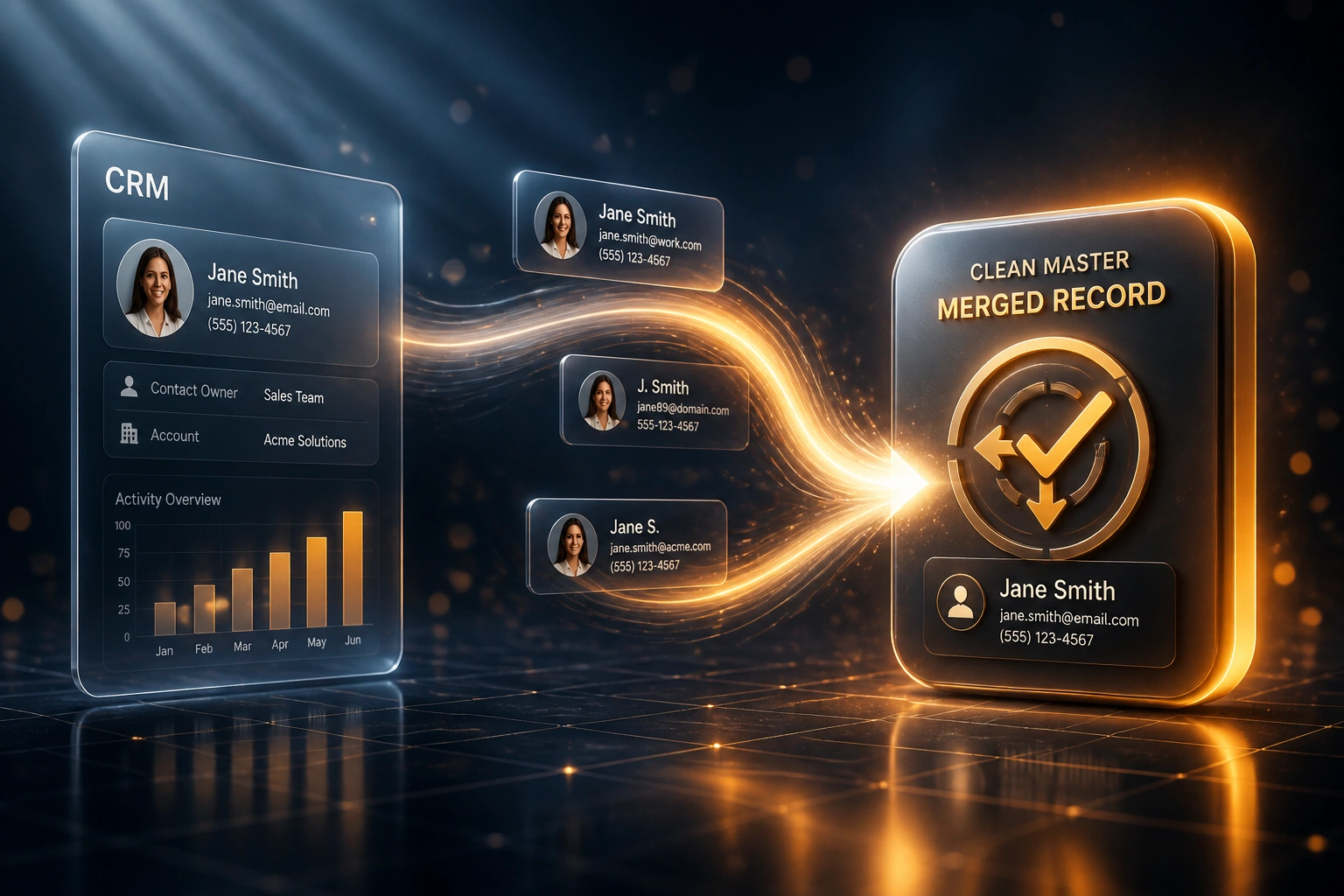
Duplicate records across CRM, ERP, marketing lists, and spreadsheets inflate customer counts, confuse sales teams, and waste marketing spend. Automated fuzzy matching identifies and merges duplicates reliably, so paid acquisition stops funding ghost contacts and sales stop double-calling the same account.
We build the cross-system merge that restores a clean master record.
Sound Familiar?
These are the exact issues our clients faced before cross-system record deduplication:
- Customer counts in the CRM, ERP, and marketing list never match, so board packs argue about which number is real
- Sales double-calls the same account because HubSpot, Sage, and a spreadsheet each hold a slightly different version
- Marketing pays seat fees and sends campaigns to the same person two or three times across overlapping lists
- Ops spends evenings merging records by hand, guessing which phone number or VAT field should survive
- Paid acquisition climbs while unique customer growth stalls, because duplicate contacts inflate the funnel
Paid acquisition costs keep rising while unique customer growth stalls. Every rand spent on ads that land on a duplicate contact is wasted twice: once on the click, and again when sales double-calls an account already in the pipeline.
What Duplicate Detection and Merge Automation Actually Does
Profile across systems → fuzzy match → apply survivorship → clean master. No more guessing which record is real.
Scan Every Source
CRM, ERP, marketing lists, and spreadsheets are profiled for likely duplicate clusters
Fuzzy Match
Email, phone, company, VAT, and name variants score as the same customer even when fields differ
Survivorship Merge
Agreed rules pick the winning fields; history and activities roll into one master record
Prevent Re-entry
New imports and form fills check the master first, so the duplicate backlog cannot return
Everything You Need for Reliable Record Deduplication
Cross-System Fuzzy Matching
Match on email, phone, company name, VAT number, and address variants across CRM, ERP, marketing lists, and spreadsheets, not just exact email equals.
Survivorship and Merge Rules
You define which system wins for each field. Activities, invoices, and history consolidate into one clean master record without silent data loss.
Automated Merge Queues
High-confidence matches merge automatically. Ambiguous clusters land in a short review queue so ops never re-opens ten browser tabs to decide.
Point-of-Entry Prevention
Imports, web forms, and API syncs check for existing masters before creating a new contact, so the duplicate rate stops climbing every month.
Marketing List Hygiene
ESP and CRM audiences dedupe against the master, so you stop paying for duplicate seats and stop emailing the same buyer twice in one campaign.
Audit Trail and Compliance
Every merge is logged with before and after field values. POPIA and GDPR accuracy requests become answerable from one authoritative record.
Systems We've Deduplicated Across
From 19% Duplicates to Under 1%
How a 45-person wholesale distributor restored one trustworthy customer count across HubSpot, Sage, Mailchimp, and three Excel lists.
The Manual Process
- 35,000 customer entities split across CRM, ERP, ESP, and spreadsheets
- Fuzzy audit found a 19% cross-system duplicate rate: about 6,650 duplicates
- Sales ops spent 14 hours a week merging by hand and resolving double-calls
- Marketing paid for 5,200 overlapping contacts and sent duplicate campaigns
- Board packs argued over three different "active customer" totals
The Automated Process
- Fuzzy matching across all four sources with agreed survivorship rules
- High-confidence clusters merge automatically; ambiguous ones hit a short queue
- Duplicate rate fell below 1% within eight weeks of go-live
- Marketing lists point at unique masters; seat waste and double-sends stopped
- Sales and finance share one customer count for forecasts and board packs
Before vs After Merge Duplicates Automation
How It Works
From first conversation to live merge automation in 3 to 5 weeks.
Profile Across Systems
We sample CRM, ERP, marketing lists, and spreadsheets to measure the real duplicate rate with fuzzy matching, not optimistic exact-match counts.
Free Scoping Call
30-minute call to agree match keys, survivorship rules, master-record ownership, and which systems create the most duplicates.
Build and Dry-Run
We configure detection and merge automation, run parallel against live data, and validate outcomes before any bulk merges go live.
Go Live and Monitor
Prevention rules fire at entry. Scheduled scans keep the rate low. Alerts fire only when a human needs to choose the surviving fields.
Frequently Asked Questions
How is this different from CRM-only duplicate cleanup?
CRM-only tools clean one database. Most businesses also hold the same customers in an ERP, a marketing platform, and one or more spreadsheets. We build fuzzy matching across those systems, then merge into a defined master with survivorship rules so sales, finance, and marketing share one trustworthy customer count.
Which systems can you include in duplicate detection and merge automation?
We have wired master-data deduplication across HubSpot, Salesforce, Pipedrive, Zoho CRM, Sage and Pastel, Xero, Mailchimp and similar ESPs, plus Excel and CSV lists. If a system exposes contacts or accounts via API, import, or export, we can include it in the match and merge design.
Will automated merges overwrite the wrong fields?
No. Survivorship rules are agreed with your sales ops or data owner before anything runs at scale. High-confidence matches can merge automatically; ambiguous ones go to a review queue. Dry-runs on a sample set come first so you see exactly which fields would survive.
How does this reduce wasted marketing spend?
Duplicate contacts inflate ESP and CRM seat counts and cause the same person to receive the same campaign multiple times. After merge automation, marketing lists point at unique masters, so you stop paying for ghost contacts and stop burning paid-acquisition budget on people you already own twice.
How long does duplicate detection and merge automation take to set up?
A standard cross-system build takes 3 to 5 weeks from profiling to go-live. Large historic backlogs across four or more systems, or complex custom objects, take closer to 5 to 7 weeks. We clear the highest-impact duplicate clusters first so customer counts and sales routing improve early.
How much does duplicate detection and merge automation cost?
Cross-system detection with survivorship rules and a review queue starts from around R30,000. Builds covering CRM plus ERP plus marketing lists, historic backlog clearance, and ongoing prevention typically range from R45,000 to R85,000. Teams burning a day a week on manual merges and duplicate campaign sends usually recover the investment within 2 to 4 months.
Stop Paying for Duplicate Customers
If sales is double-calling accounts and marketing is funding the same contact twice, you are spending money on a problem that fuzzy matching and automated merge already solve.
Tell us which systems hold your customers, where the conflicts show up, and how much time ops spends merging by hand. We'll show you exactly how cross-system duplicate detection would work for your business.