Email Bounce Cleanup: Validating and Repairing Your Contact Email Data
Hard bounces keep hitting the CRM list and your sender reputation is tanking. Invalid, misformatted, and risky addresses still sit in the database, burning send cost and pushing good subscribers toward spam.
We repair the contact email data so inbox placement can recover.
Sound Familiar?
These are the exact issues marketing leads bring us once bounce damage is already in the CRM:
- Hard bounces keep hitting every send, and Google Postmaster or your ESP is already flagging domain reputation
- Syntax errors, typos, and misformatted addresses still sit in the CRM months after the first bounce
- Role accounts (info@, sales@) and risky catch-alls quietly drag inbox placement for everyone else
- Marketing burns hours scrubbing bounce logs by hand while campaigns keep paying for dead contacts
- Sender reputation is tanking, so even engaged subscribers land in spam more often than the inbox
Google and Yahoo require bulk senders (5,000+ messages a day) to authenticate and keep spam complaints under 0.1%, never reaching 0.3%. High hard-bounce rates compound that pressure: ESPs throttle above roughly 5%, and repairing the CRM list is cheaper than six weeks of reputation recovery labour at R33,000–R67,000.
What Email Bounce Cleanup Actually Does
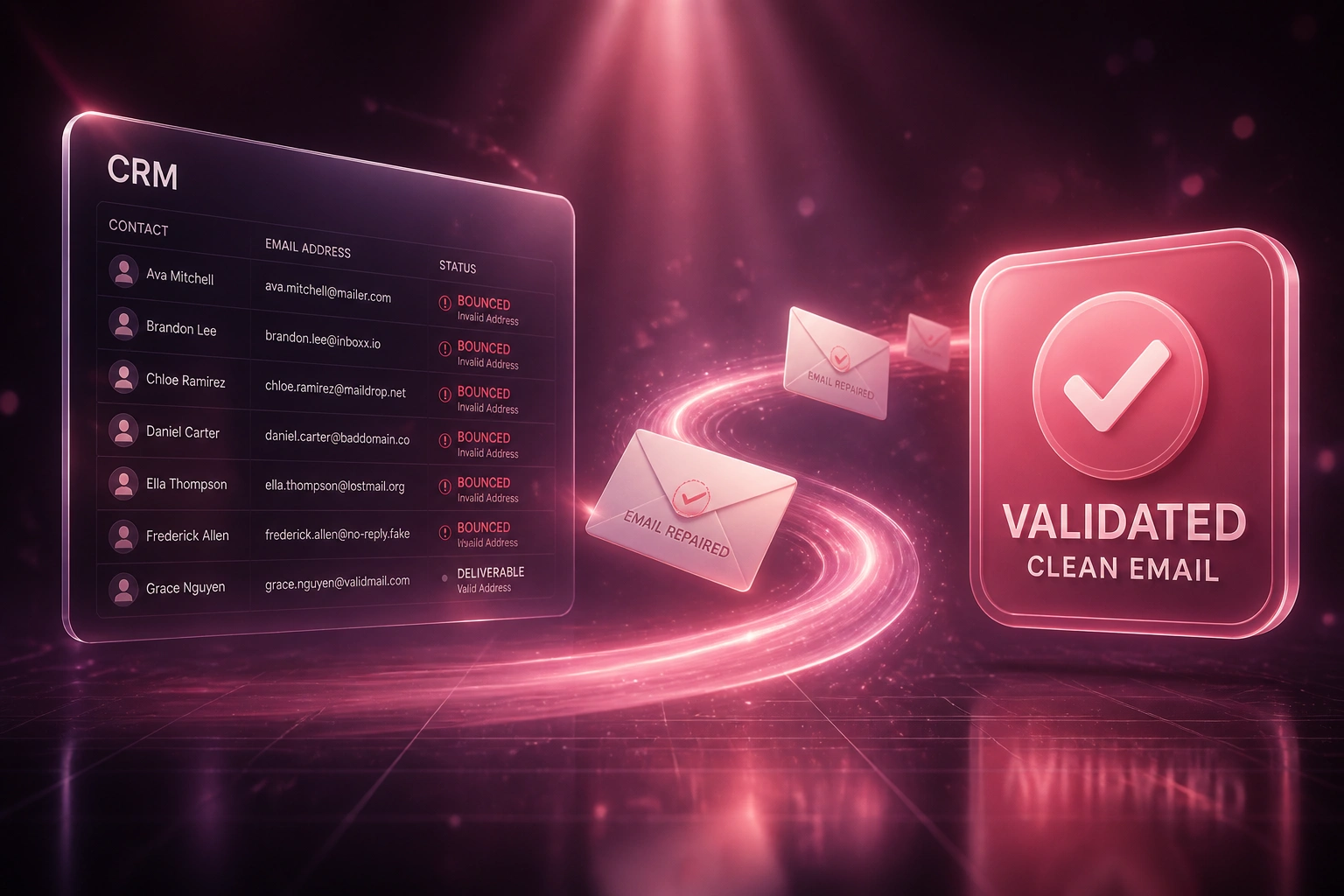
Audit the damaged CRM → validate and repair → suppress risk → recover inbox placement. No more mailing the same hard bounces.
Audit Bounced Records
Pull CRM and ESP contacts already marked bounced, invalid, or never opened
Validate and Repair
Syntax fixes, MX and deliverability checks, plus flags for role, disposable, and catch-all risk
Write Statuses Back
CRM fields and ESP segments update so hard bounces and risky entries stay suppressed
Recover Inbox Placement
Bounce rates drop, ESP throttle risk eases, and engaged subscribers start landing again
Everything You Need for Email Data Repair
Syntax and Format Repair
We catch malformed addresses, common typos, and encoding damage already sitting in the CRM, then fix or quarantine them before the next send.
MX and Deliverability Checks
Each address is checked against mailbox infrastructure so hard-invalid domains and dead mailboxes are suppressed, not left to bounce again.
Risky Entry Flagging
Role accounts, disposable domains, and catch-alls are flagged for review or exclusion so they stop poisoning reputation without wiping grey-area contacts blindly.
Hard-Bounce Suppression Write-Back
Bounce outcomes sync into CRM fields and ESP segments. Confirmed hard bounces never re-enter active campaigns.
Post-Damage Reputation Recovery
After a bounce spike, we rebuild a send-safe list, stage volume carefully, and help marketing get off throttle and spam-folder risk.
Ongoing Hygiene Cadence
B2B emails go invalid at roughly 25–30% a year. Scheduled re-checks keep repaired lists clean instead of letting damage rebuild.
Systems We've Connected for Bounce Cleanup
From 4.8% Hard Bounces to 0.4%
How a South African retailer recovered inbox placement after years of uncleaned CRM bounce debris.
The Damaged List
- Hard bounce rate sat near 4.8% on lifecycle sends from HubSpot into Brevo
- ESP throttle warnings and falling open rates on engaged segments
- Marketing ops spent 6–8 hours a week scrubbing bounce CSVs by hand
- Typos, role accounts, and dead domains still sat in the CRM after every campaign
- Domain reputation kept dragging good subscribers toward spam
The Repaired Process
- Syntax, MX, and risk validation ran across the full active CRM list
- Hard-invalid and high-risk statuses wrote back into HubSpot and Brevo segments
- Campaigns only mailed send-safe contacts while recovery volume staged carefully
- Hard bounces fell to 0.4%, inside the healthy under-0.5% band
- Ops time shifted from bounce firefighting to campaign work
Before vs After Bounce Cleanup
How It Works
From first conversation to live bounce cleanup in 2–4 weeks.
Tell Us Your Bounce Pain
Current bounce rates, ESP warnings, CRM size, and which segments are still being sent after hard bounces.
Free Scoping Call
30-minute call to map syntax, MX, and risk rules, then size the first bounce cleanup and write-back.
Build & Pilot
We repair a pilot segment, write statuses back, and compare bounce rate and inbox placement against your baseline.
Go Live & Monitor
Hard bounces stay suppressed. Ongoing hygiene and bounce feedback keep sender reputation recovering.
Frequently Asked Questions
What is email bounce cleanup and repair?
It is post-damage contact data repair: we validate syntax, check deliverability (including MX), flag risky entries, and suppress hard bounces already sitting in your CRM or ESP. Unlike pre-send list verification alone, this recovers reputation after bounces have already hit and stops the same invalid addresses from being mailed again.
How is this different from bulk email list verification?
Bulk verification is a gate before campaigns. Bounce cleanup is repair after damage: hard bounces, typos, role accounts, and misformatted emails already in the database. Marketing leads use it when sender reputation is already tanking and the CRM still holds the addresses that caused the problem.
What bounce rate should we aim for after cleanup?
Healthy programmes keep total bounce under 2%, with hard bounces ideally under 0.5%. Rates above 5% commonly trigger ESP throttling, spam-folder placement, or blacklisting. Cleanup plus suppression is how teams climb back inside that band.
Which systems do you connect for bounce repair?
We commonly wire HubSpot, Salesforce, Pipedrive, Zoho CRM, Mailchimp, Klaviyo, or Brevo with NeverBounce, ZeroBounce, or equivalent validators, plus CSV exports when needed. Statuses write back as CRM fields and ESP segments so repaired contacts stay send-safe.
How long does email bounce cleanup take?
A focused bounce audit with syntax, MX checks, risky flagging, and status write-back is typically live in 2–4 weeks, including a measured pilot. Deeper reputation recovery staging, catch-all review queues, and ongoing hygiene usually take 4–6 weeks.
How much does email bounce cleanup cost?
Focused repair pipelines that validate, flag risk, and write statuses back start from around R15,000. Full setups with reputation recovery staging, catch-all handling, and scheduled hygiene typically range from R25,000 to R60,000, plus validator usage. Most teams facing six weeks of reputation recovery labour (often R33,000–R67,000 in marketing-ops time alone) see payback within one to two campaigns.
Stop Letting Hard Bounces Tank Your Reputation
If bounced and invalid emails are still sitting in the CRM, every campaign is paying for damage that email bounce cleanup already solves.
Tell us your current bounce rate, which CRM and ESP you use, and how badly sender reputation has slipped. We will show you how syntax validation, deliverability checks, and risky-entry flagging would work on your list.