Email Finding and Verification Automation: Outreach That Hits Real Inboxes
Your outbound is dying because bounce rates are killing sender reputation. Guessed addresses and aged CRM emails never reach the people you meant to sell to, and every hard bounce makes the next campaign worse.
We automate email finding combined with verification so every sequence sends to a real mailbox.
Sound Familiar?
These are the exact issues our clients faced before email validation automation:
- Hard bounce rates sit above 5%, so mailbox providers throttle or dump campaigns in spam
- SDRs burn evenings guessing patterns like first.last@company.com and praying they land
- Bought or aged CRM lists quietly rot: 22–30% of B2B emails go invalid every year
- Reply rates keep falling even when copy and sequencing look fine, because half the list never reaches an inbox
- Sender reputation takes months to rebuild after one bad blast, while quota and domain warm-up get reset
Since February 2024, Gmail and Yahoo enforce bulk-sender rules for domains sending 5,000+ messages a day: SPF, DKIM, and DMARC authentication, one-click unsubscribe, and spam complaints below 0.3%. Dirty lists that bounce and draw complaints get throttled or rejected, not politely ignored.
What Email Finding and Verification Actually Does
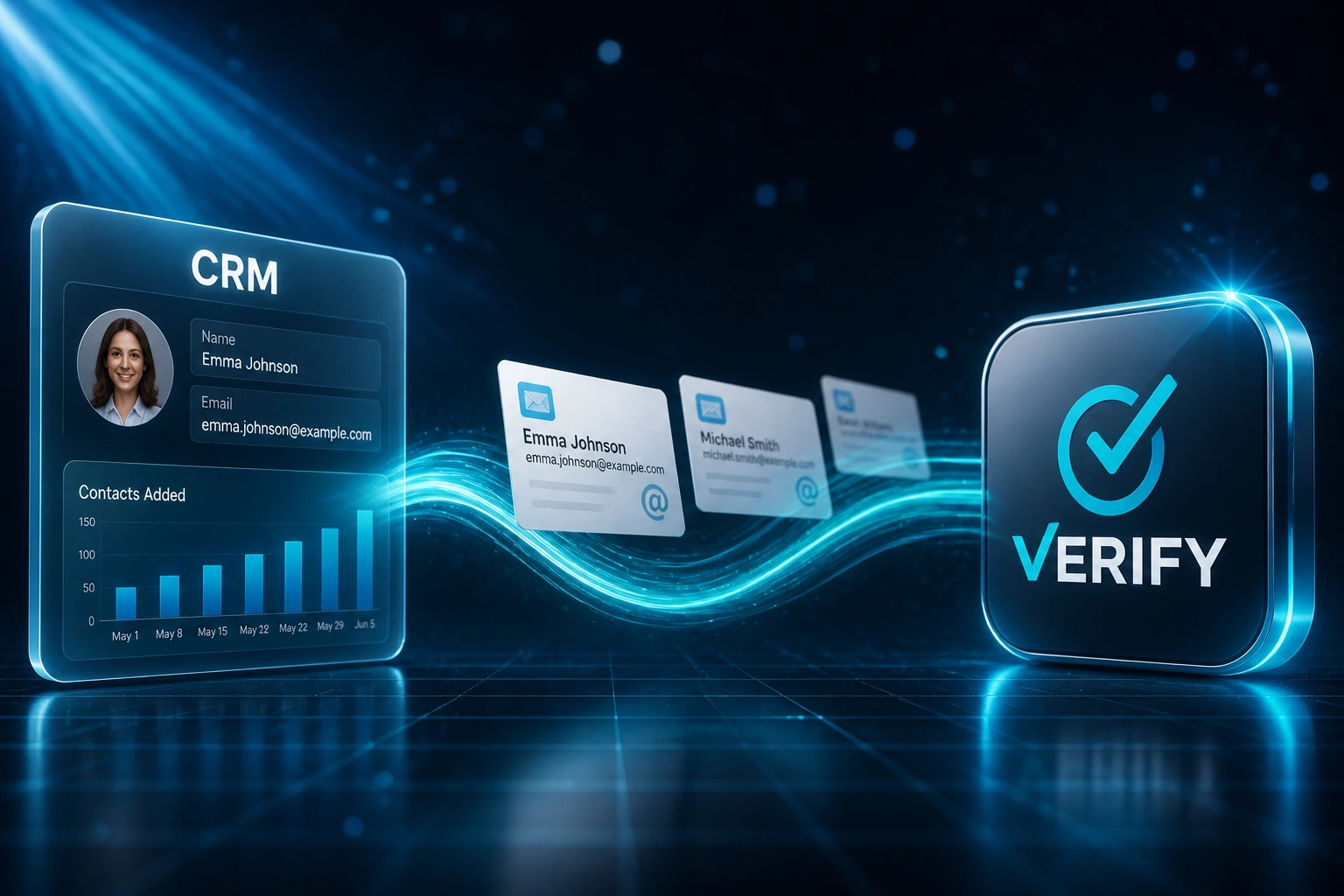
Contact enters the pipeline → email found → address verified → only valid mailboxes enter outreach.
Contact Hits the Queue
New lead or ICP match lands in HubSpot, Pipedrive, or your CRM with name and company
Email Finder Runs
Hunter, Apollo, or your chosen finder returns the best-match work address
Verifier Checks Inbox
NeverBounce or ZeroBounce marks valid, invalid, catch-all, or risky before any send
Only Valid Enters Sequences
Verified emails sync to the CRM and sequencer; dead addresses never touch your domain
Everything You Need for Reliable Email Validation Automation
Automated Email Finding
Name, company, and domain feed Hunter, Apollo, or similar finders so verified-pattern emails land in the CRM without manual guessing.
Verify-Before-Send Gate
NeverBounce, ZeroBounce, or equivalent checks every address before it enters a sequence, so invalid and risky mailboxes never hit your ESP.
CRM Status Sync
Valid, invalid, catch-all, and risky statuses write back to HubSpot, Pipedrive, or Salesforce fields your sequences already filter on.
Catch-All and Role Handling
info@ and catch-all domains get flagged for human review instead of auto-sending, protecting deliverability without discarding every grey result.
Scheduled Re-Verification
Active outbound segments re-verify on a cadence, because B2B emails decay roughly 2–3% a month and an eight-week-old "verified" flag is already stale.
Bounce Feedback Loop
Hard bounces from your ESP suppress and reclassify the CRM record automatically, so the same dead address never burns the domain twice.
Tools and CRMs We've Wired Into This Pipeline
From 7.5% Hard Bounces to 0.6%
How a 14-person B2B sales team stopped burning their sending domain and recovered nine hours a week of email hunting.
The Manual Process
- SDRs guessed email patterns and scraped LinkedIn profiles by hand
- Cold sequences launched against CRM exports that had not been cleaned in months
- Hard bounce rate sat at 7.5%, well above the 5% danger threshold
- Gmail started throttling Monday blasts; reply rate stuck near 1.8%
- Sales leadership debated buying a new domain instead of fixing the list
The Automated Process
- New contacts auto-enrich through an email finder, then a verifier API
- Only valid and low-risk addresses enter Lemlist; catch-alls queue for review
- Hard bounce rate dropped to 0.6% within two campaign cycles
- Reply rate climbed to 4.2% on the same copy and ICP
- SDRs spend time on conversations, not inbox archaeology
Before vs After Email Verification
How It Works
From first conversation to a live find-and-verify pipeline in 2–4 weeks.
Tell Us Your Outbound Stack
Which CRM, finder, verifier, and sequencer you use, plus current bounce and reply rates.
Free Scoping Call
30-minute call to map the find → verify → sync pipeline, pick accuracy thresholds, and size the first cohort.
Build & Pilot
We wire the tools, run a pilot list through finding and verification, and compare bounce rates against your baseline.
Go Live & Monitor
Sequences only send verified addresses. Monitoring catches spike bounces and stale CRM segments before they damage reputation.
Frequently Asked Questions
What is email finding and verification automation?
It is a pipeline that discovers likely work emails for named contacts, then validates them with a dedicated verifier before anything enters your outbound sequences. Finding alone is not enough: Apollo and Hunter still return stale or guessed addresses, so verification (NeverBounce, ZeroBounce, and similar) is the gate that protects deliverability.
How is this different from buying a verified lead list?
A purchased file is a snapshot that starts decaying the day you buy it. Automated finding plus verification runs against your live ICP, writes statuses into your CRM, and can re-verify before each campaign. You stop paying for rows that bounce and stop burning domains on aged data.
Will this fix our bounce rate on its own?
Verification typically cuts hard bounces by more than 80% when it sits in front of every send. You still need authentication (SPF, DKIM, DMARC), sensible volume, and complaint rates under the Gmail and Yahoo 0.3% ceiling. We design the hygiene layer so those other controls have a clean list to work with.
Which tools do you connect?
We commonly wire Hunter or Apollo for finding, NeverBounce or ZeroBounce for verification, and HubSpot, Pipedrive, or Salesforce for status sync, with sequencers such as Lemlist or Instantly reading only verified contacts. If your stack differs, we map the same find → verify → sync pattern onto the APIs you already pay for.
How long does setup take?
A focused one-way find-and-verify pipeline into the CRM is typically live in 2–4 weeks. Bidirectional status sync, catch-all review queues, scheduled re-verification, and ESP bounce feedback usually take 4–6 weeks including a measured pilot.
How much does email finding and verification automation cost?
Focused pipelines that find, verify, and write statuses back to the CRM start from around R15,000. Full setups with re-verification schedules, catch-all handling, and ESP feedback typically range from R25,000 to R60,000, plus the usage fees on Hunter, Apollo, NeverBounce, or ZeroBounce. Most teams recovering eight or more research hours a week, and avoiding a domain reputation rebuild, see payback within two to three months.
Stop Sending to Addresses That Do Not Exist
If your outbound bounce rate is eating sender reputation, you are paying for a problem that email finding and verification automation already solves.
Tell us which CRM and sequencer you use, what your current bounce and reply rates look like, and which finder or verifier licences you already have. We will show you exactly how a verify-before-send pipeline would work for your team.