ETL Error Recovery: Repairing Data Quality Failures in Your Pipeline
Your pipelines passed. Your dashboards still look fine. Meanwhile invoices, stock, and CRM records have already drifted: dropped rows, silent duplicates, and corrupted fields that no green check ever caught. For a Head of Ops or data lead, that is not a monitoring gap. It is forensic damage already sitting downstream.
We diagnose the failure, repair the damaged records, and add validation checkpoints so it cannot happen again.
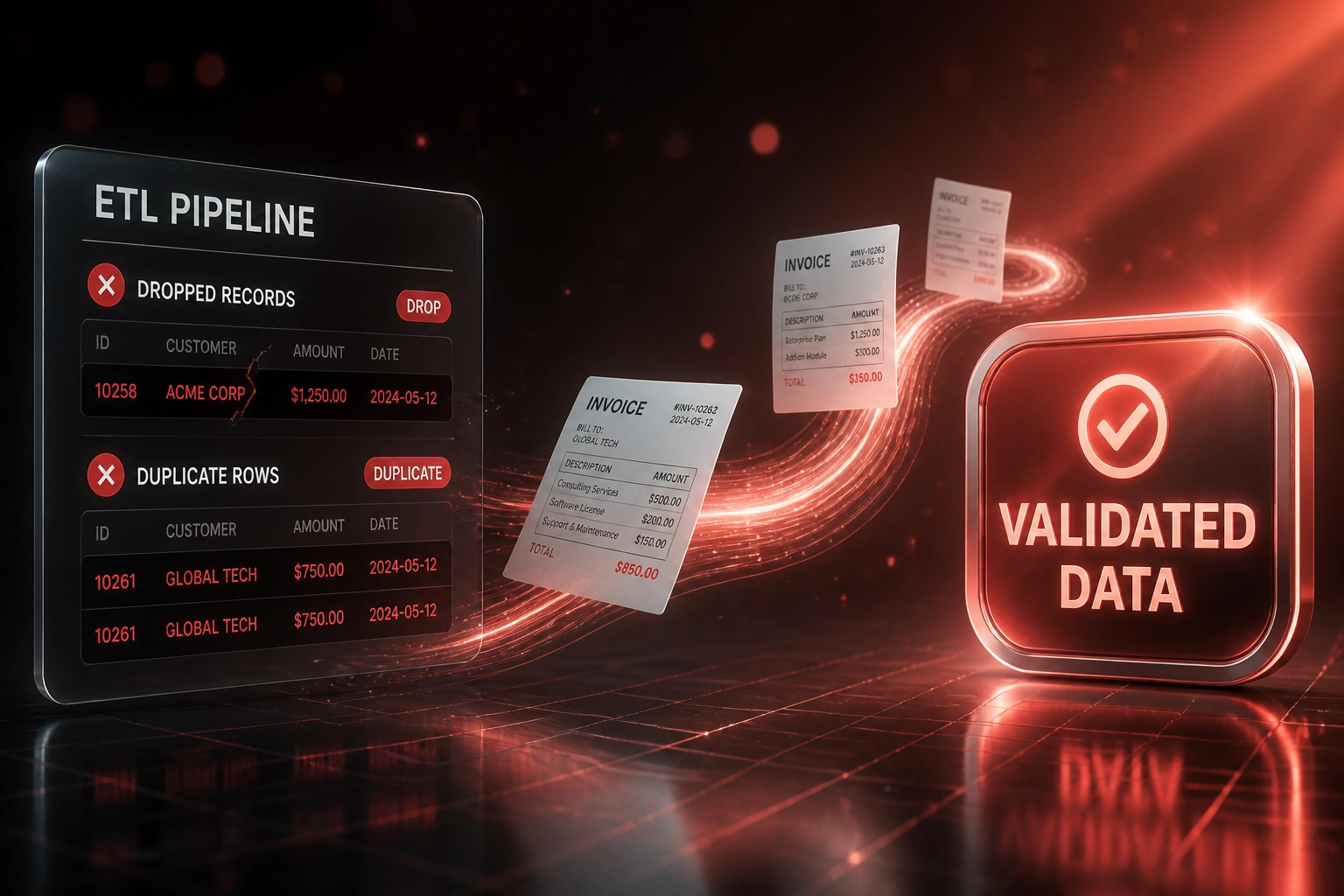
Sound Familiar?
These are the exact issues our clients faced before ETL pipeline repair:
- The ETL job shows green, yet invoices, stock, or CRM records are missing, duplicated, or wrong
- Finance and ops discover the damage in reports days later, not from a pipeline alert
- Nobody can say which runs corrupted which tables, so repair starts as a forensic dig
- Downstream systems already hold bad data: rebilling, stockouts, and trust erosion compound weekly
- There are no validation checkpoints, so the next "successful" load can reintroduce the same defects
Schema drift and cloud ETL pricing changes raise the stakes. SaaS vendors ship field renames without warning, and managed ELT platforms continue to alter how rows, deletes, and history modes are metered. Without validation checkpoints, a "successful" sync after a vendor update can quietly drop or duplicate records while reports and invoices keep drifting.
What ETL Error Recovery Actually Does
Diagnose the silent failure → repair damaged downstream data → gate every stage → prove the pipeline is clean.
Map the Blast Radius
Which jobs, windows, and tables dropped, corrupted, or duplicated records
Repair Downstream Data
Correct, deduplicate, and backfill CRM, ERP, warehouse, and billing records
Add Validation Gates
Row counts, uniqueness, null rates, and business rules quarantine bad batches
Prove Reconciliation
Source matches target, replays are safe, and ops has a runbook for the next incident
Everything You Need for Pipeline Repair and a Data Quality Fix
Forensic Pipeline Diagnosis
We reconstruct which jobs, windows, and transforms dropped, corrupted, or duplicated records, then map blast radius across CRM, ERP, warehouse, and billing.
Downstream Record Repair
Damaged rows are corrected, deduplicated, or backfilled from trusted sources so reports and invoices stop drifting from operational truth.
Validation Checkpoints
Row counts, null rates, uniqueness, referential checks, and business rules gate each stage. Failures quarantine instead of writing silently.
Duplicate and Drop Detection
Idempotency keys, source-to-target reconciliation, and volume baselines catch silent drops and double loads before they become month-end surprises.
Schema Drift Guards
SaaS vendors rename fields and change types without warning. We trap drift at the boundary so green jobs cannot load half-mapped payloads.
Replay with Proof
Once root cause is fixed, controlled replays restore missing history without creating new duplicates, with an audit trail for ops and finance.
Pipelines and Platforms We've Hardened
From 11 Days of Silent Drift to Same-Day Quarantine
How a national distributor recovered 14,000 corrupted order lines and stopped green ETL jobs from rewriting bad invoices.
The Silent Failure
- Nightly order sync showed success while duplicate lines inflated warehouse picks
- Finance spotted revenue variance 11 days after the first bad load
- Ops spent evenings cross-checking CRM, ERP, and spreadsheet exports by hand
- No row-count or uniqueness gate, so replays created more duplicates
- Board packs and customer invoices disagreed for three consecutive weeks
The Recovered Process
- Forensic map traced the defect to a schema rename after a SaaS vendor update
- 14,000 order lines repaired and deduplicated against source evidence
- Validation checkpoints quarantine volume and uniqueness failures before write
- Safe replay restored missing history without new duplicates
- Finance and ops reconcile from one trusted pipeline view
Before vs After Pipeline Repair
How It Works
From first conversation to repaired data and live validation gates in 3–6 weeks.
Tell Us What Broke
Which pipelines look healthy, what downstream systems already hold bad data, and how long the drift has been visible.
Free Scoping Call
30-minute call to size blast radius, prioritise repair targets, and design validation gates that stop recurrence.
Diagnose, Repair & Gate
We forensically map the failure, repair damaged records, and add ETL validation checkpoints on critical paths.
Prove & Hand Over
Source-to-target reconciliation, replay tests, and a runbook so your ops and data leads can keep quality locked.
Frequently Asked Questions
How is ETL error recovery different from retry logic or monitoring?
Retries keep a job moving when something fails loudly. Monitoring tells you when data goes stale or empty. ETL error recovery starts after silent corruption, drops, or duplicates have already landed downstream. We diagnose the damage, repair the records, and add validation checkpoints so the next green run cannot reintroduce the same defects.
Our pipeline jobs all show success. Can data still be wrong?
Yes. Success usually means the job finished without an unhandled exception, not that row counts, uniqueness, or business rules held. Industry surveys show 68% of teams need four or more hours to detect data issues, and business users find problems first 74% of the time. Green checks with drifting invoices are the classic silent failure pattern.
Can you repair data that is already in CRM, ERP, or the warehouse?
That is the core of the engagement. We reconcile source evidence against downstream systems, remove or merge duplicates, restore dropped rows where a trusted source still exists, and correct corrupted fields with an auditable trail. Prevention alone does not undo last month's bad invoices.
Which ETL tools and warehouses do you support?
We have diagnosed and repaired pipelines on Airflow, dbt, Fivetran, Stitch, Azure Data Factory, and custom Python or Node ETL landing in SQL Server, Postgres, BigQuery, Snowflake, and Azure Synapse. If jobs move files, API payloads, or database rows into operational systems, we can add validation and recover damaged history.
Will validation checkpoints slow our overnight loads?
Checks run in milliseconds relative to extract and load time. Teams typically recover far more from avoided rework than the gate costs in latency. Quarantined rows are cheaper than silent corruption inside billing, inventory, or board packs.
How much does ETL error recovery and pipeline repair cost?
Focused diagnosis and repair for a critical path typically starts from around R35,000. Broader recovery across CRM, ERP, and warehouse tables with validation checkpoints usually ranges from R50,000 to R120,000. Against Gartner's average annual cost of poor data quality (about R210 million per organisation), payback is measured in prevented rework and restored trust, often within one or two billing cycles for mid-market teams.
Stop Living with Silent ETL Damage
If green jobs are already writing bad data into the systems your team bills and reports from, monitoring alone will not undo what is already broken.
Tell us which pipelines look healthy, which downstream systems already disagree, and how long the drift has been visible. We will show you how diagnosis, repair, and ETL validation would work for your stack.