Facial Recognition for KYC: Match Selfies to ID Documents
Document-only KYC cannot prove the applicant is the person on the ID. Your examiners still compare selfies by eye, photo queues grow, and inspection packs lack a biometric match score.
We automate selfie verification and ID matching so FICA onboarding closes that gap with examiner-ready evidence.
Sound Familiar?
These are the exact issues compliance leads face when facial recognition is missing from biometric compliance SA onboarding:
- Examiners still eyeball selfies against ID photos, with no consistent match score on the file
- Document-only KYC confirms the ID looks genuine, not that the applicant is the person on it
- Photo review queues stretch hours to days when volume spikes, while clear clients wait
- Fraudulent applicants reuse stolen Smart ID images with lookalike or spoofed selfies
- FIC inspection asks for biometric corroboration evidence and the pack only has a human tick-box
Remote identity validation testing shows document face extraction causes most match failures, not the selfie capture itself. If your programme still relies on human photo comparison without scored 1:1 matching, imposters and queue delays both stay unmeasured.
What Facial Recognition KYC Actually Does
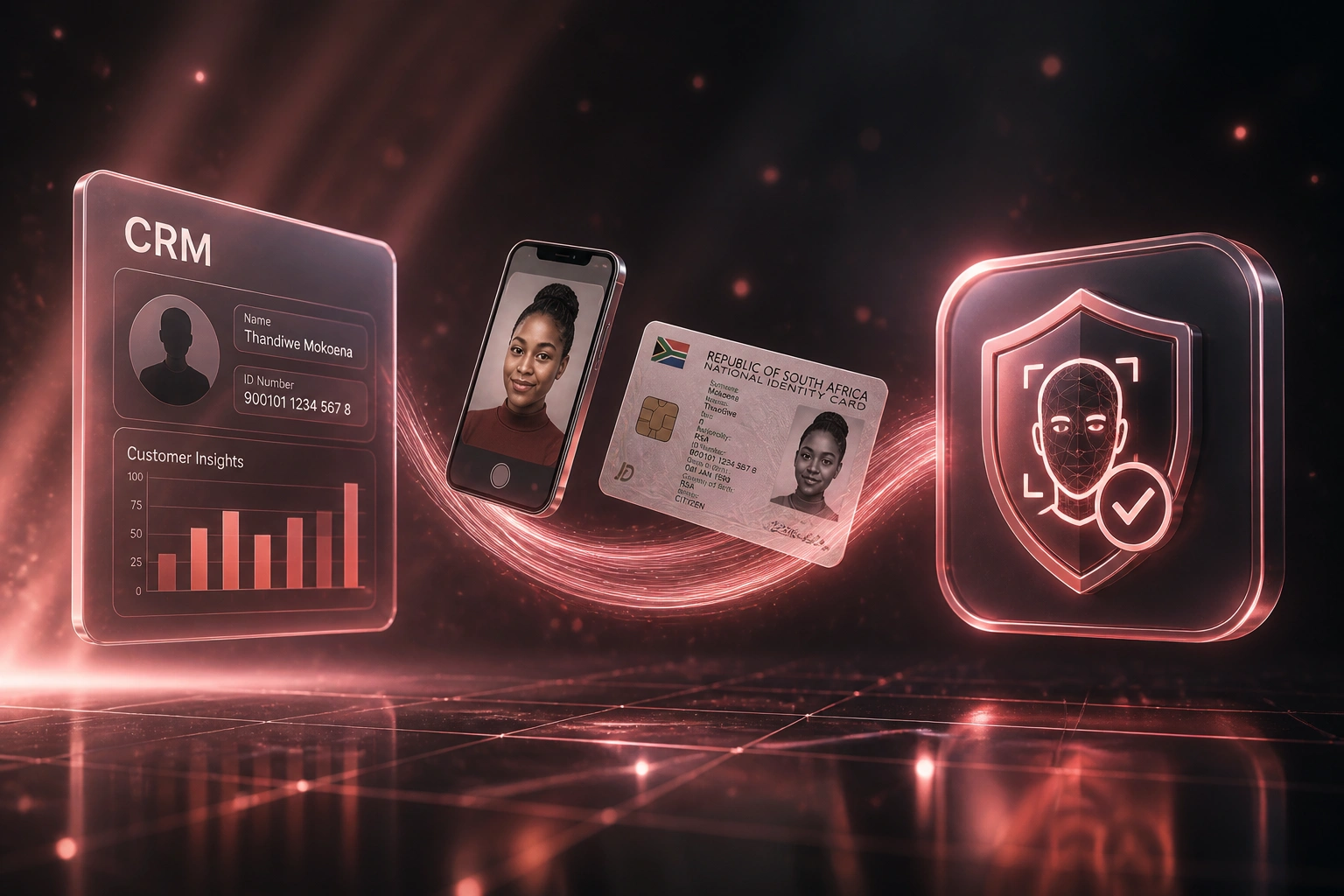
Selfie captured → face matched to ID → score written back. No examiner comparing photos by eye.
Applicant Captures Selfie
Client submits a live selfie in your app or web onboarding journey
ID Face Extracted
Face photo is cropped from the Smart ID or ID book already on the file
1:1 Biometric Match
Selfie verification scores against the ID photo, with optional HANIS face check
Evidence on File
Match score and images write back for FICA inspection and CRM status
Everything You Need for Biometric Compliance SA
Selfie-to-ID Face Match
The applicant selfie is compared 1:1 against the face photo extracted from the SA Smart ID or ID book, with a scored match result written to the case.
Optional HANIS Face Corroboration
Where your access allows, the live selfie can be matched against the Home Affairs facial biometric for higher-assurance FICA verification.
Configurable Match Thresholds
Set false-match targets aligned to your RMCP risk appetite, typically around the 1:10,000 NIST-style operating point used in remote ID validation.
Examiner-Ready Match Score
Every decision stores the match score, document face crop, selfie frame, and threshold used so inspectors see evidence, not a vague "verified" flag.
Exception Queue Routing
Clear matches pass automatically. Low-score or extraction failures land in a compliance queue with the images attached for human review.
CRM & Core Write-Back
Match results, status, and evidence links sync back to your CRM, loan origination, or core banking case so onboarding never leaves the system of record.
Systems We've Connected for Face Match Write-Back
From 9 Hours/Day of Photo Review to Under 90 Minutes
How a mid-size SA credit provider cut selfie-to-ID manual review and put match scores on every FICA file.
The Manual Process
- Two compliance officers compared every selfie to the Smart ID photo by eye
- 8–10 minutes average per file when glare, rotation, or lookalikes appeared
- Photo queue backlog hit 24–48 hours on high-volume days
- Inspection packs showed a human tick-box with no numeric match score
- Stolen-ID applications still reached account opening when faces were merely "close enough"
The Automated Process
- Selfie-to-ID facial recognition scores every application in seconds
- Clear matches auto-pass; only low scores and extraction failures hit the queue
- Same-day decisions for the majority of retail applications
- Each file stores score, threshold, selfie frame, and ID face crop for examiners
- Optional HANIS face corroboration reserved for higher-risk products
Before vs After Face Match Automation
How It Works
From first conversation to live facial recognition KYC in 3–6 weeks.
Tell Us Your Setup
Where selfies and ID images land today, how examiners review them, and whether HANIS face access is in scope.
Free Scoping Call
30-minute call to map capture points, match thresholds, exception routing, and evidence write-back.
Build & Test
We wire face matching, score storage, and queues, then test against your real ID and selfie samples.
Go Live & Monitor
Clear face matches stop hitting the photo queue. Monitoring keeps false-reject and exception rates visible as volume grows.
Frequently Asked Questions
How is facial recognition KYC different from liveness detection?
Liveness proves a live person is present at capture. Facial recognition KYC proves that person matches the face on the ID document (and optionally the HANIS facial biometric). Most FICA remote onboarding programmes need both: liveness to stop spoofs, and face match to bind the applicant to the identity document.
How accurate is selfie-to-ID face matching?
Independent DHS Remote Identity Validation testing found a median false non-match rate around 0.2% at a 1:10,000 false match operating point among systems that completed the match successfully, with more than half of evaluated systems matching genuine pairs above 99% of the time. Document face extraction, not the selfie itself, is usually the largest error source, so we design capture and crop quality into the flow.
Can you match against HANIS facial biometrics?
Where your institution has licensed access, we can add HANIS face corroboration alongside selfie-to-ID matching. FIC PCC 33 recognises HANIS biometric verification for SABRIC member banks as an alternative to document-only identity verification under Regulation 4(1). Access terms, POPIA consent, and your RMCP risk model determine when that step is mandatory versus optional.
What happens when the match score is too low?
The application pauses in an exception queue with the selfie, ID face crop, score, and threshold attached. Your compliance examiner decides accept, reject, or request a retake. Clear high-score matches never enter that queue, which is how photo-review backlogs shrink.
Will this disrupt our current FICA onboarding?
No. Your team keeps the same CRM or case system. Face matching runs as a step in the existing journey and writes evidence back for inspection. We run parallel testing before switching off manual photo comparison.
How much does facial recognition KYC integration cost?
Focused selfie-to-ID match builds typically start from around R30,000. Packs with HANIS face corroboration, CRM write-back, and examiner evidence packs usually sit in the R45,000–R80,000 range. Firms reviewing 300+ photo matches a month often recover the build cost within 2–4 months from analyst time alone.
Stop Relying on Document-Only KYC
If your examiners still match selfies to ID photos by eye, you are spending analyst hours on a biometric problem that already has a scored answer.
Tell us where selfies and ID images land today, whether HANIS face is in scope, and how photo queues behave under volume. We will show you exactly how facial recognition KYC would write match evidence into your FICA pack.