Field Service Management System: Schedule, Dispatch, Complete
If your field crews still run on WhatsApp groups, a whiteboard, and phone calls, you are already losing same-day jobs to competitors with digital dispatch. Operations directors and owners feel it as fewer jobs finished per day, more no-shows, and rework that never shows on the whiteboard.
We build the field service management system that lifts jobs completed and cuts wasted truck rolls.
Sound Familiar?
These are the exact issues our field-service clients faced before they moved to a proper FSM system:
- Jobs live on a whiteboard, WhatsApp threads, and the dispatcher's memory, so nobody has a single source of truth
- Same-day emergency calls get lost while techs drive past each other on poorly planned routes
- Technicians arrive without the right parts or job history, forcing expensive return visits
- Customers call asking "where is my tech?" because nobody has sent an ETA or completion update
- Invoices wait for paper job cards to come back to the office, stretching cash flow by days
Competitors already running digital dispatch are winning the same-day jobs you cannot reach. South African HVAC, electrical, plumbing, and facilities firms that still rely on paper job cards and WhatsApp are competing against crews who get live ETAs, skills-matched assignment, and same-day invoices. Every week you wait, they take the emergency work your whiteboard never sees in time.
What Field Operations Management Actually Does
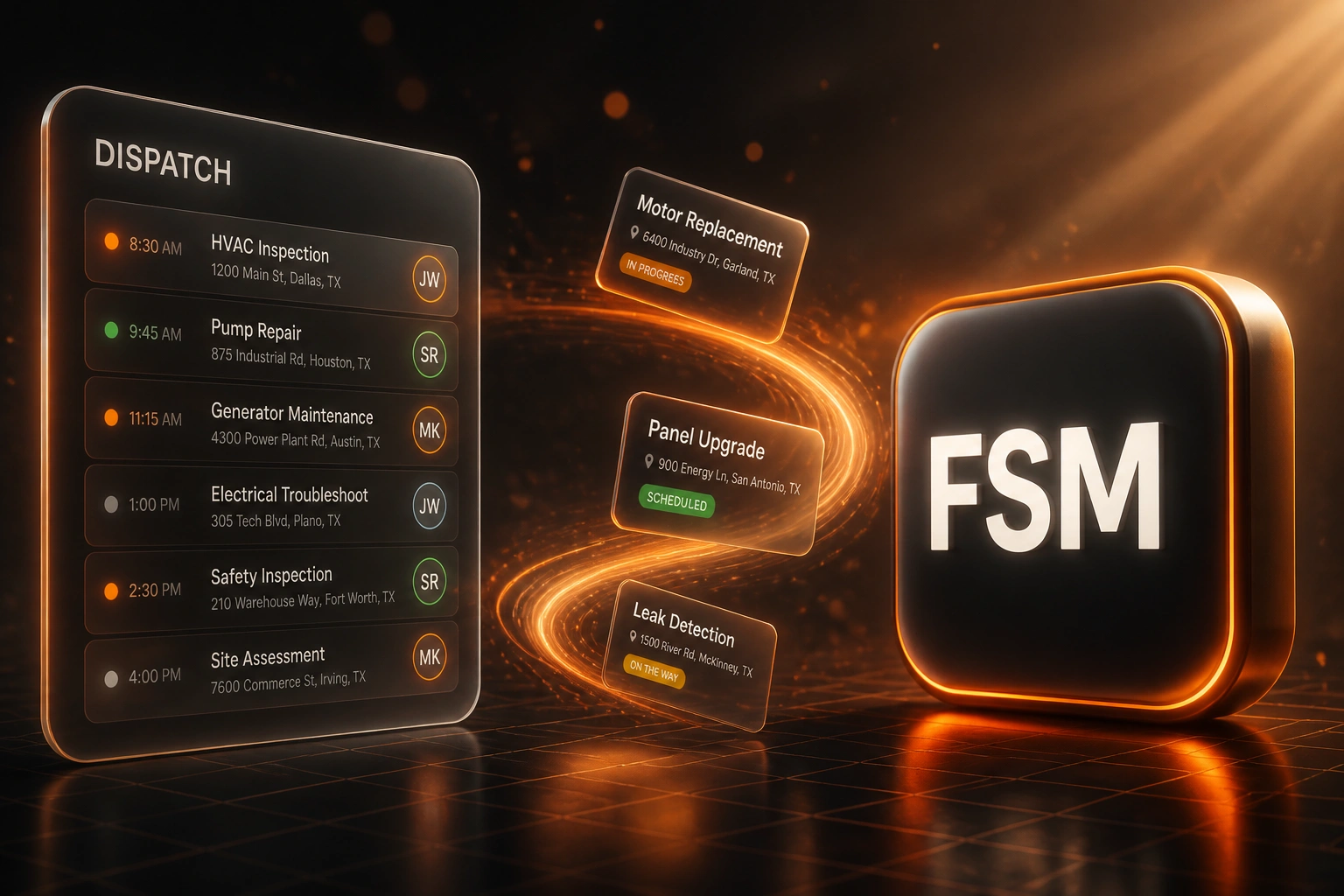
Job booked → tech dispatched → work completed → customer and invoice updated. One system, not five chat threads.
Job Enters the Board
Booking, emergency call, or CRM request becomes a scheduled job with skills, SLA, and site notes
Dispatcher Assigns
Right technician by skill, location, and load; mobile notification replaces the morning WhatsApp scramble
Tech Completes On Site
Photos, parts used, notes, and customer signature captured on the phone before leaving the driveway
Office Closes the Loop
Customer gets a completion update; invoice draft and CRM timeline update the same day
Everything You Need in an FSM System
Digital Scheduling & Dispatch
Jobs land on a live board with skills, location, and availability matching. Dispatchers assign in seconds instead of phone-tagging the whole crew.
Mobile Job Cards
Technicians open the job on their phone: site history, parts list, photos, and customer notes. No more incomplete paper cards in the bakkie.
Completion Tracking
Status moves from assigned to en route to on site to complete in real time. Ops sees the day as it happens, not at 17:00 when everyone phones in.
Customer Updates
Automated SMS or WhatsApp confirmations, ETAs, and completion notices cut "where is my tech?" calls and reduce no-shows.
Parts & First-Time Fix Context
Job details surface required parts and prior work orders before the van leaves. Fewer second truck rolls, higher first-time fix rates.
Invoice & CRM Hand-Off
Completed jobs push labour, parts, and signatures into invoicing and your CRM so billing starts the same day, not when the paper arrives.
FSM Platforms and Stacks We've Worked With
From 3.1 to 4.5 Jobs Per Tech Per Day
How a 12-technician Gauteng HVAC and electrical firm replaced WhatsApp dispatch with a field service management system and recovered capacity within one quarter.
The Manual Process
- Dispatcher ran the day from a whiteboard and three WhatsApp groups
- Average 3.1 completed jobs per technician per day (in line with Service Council industry average)
- First-time fix around 70%, with callbacks eating the afternoon schedule
- Customers phoned for ETAs; no-shows and late arrivals were common
- Invoices waited 2–4 days for paper job cards to reach the office
The FSM Process
- Live dispatch board with skills and location matching; techs get mobile job cards
- Average climbed to 4.5 jobs per technician per day within 10 weeks
- First-time fix rose to 82% as parts and history travelled with the job
- Automated SMS ETAs and completion notices cut "where is my tech?" calls
- Same-day invoice drafts from completed mobile job cards
Before vs After an FSM System
How It Works
From first conversation to live field operations management in 3–6 weeks.
Tell Us Your Setup
How many techs, how you dispatch today (WhatsApp, whiteboard, spreadsheet), and where jobs fall through the cracks.
Free Scoping Call
30-minute call to map intake → schedule → dispatch → complete → invoice for your HVAC, electrical, plumbing, or facilities operation.
Build & Test
We configure the FSM workflows, mobile job cards, and customer updates, then run parallel against your current process for two weeks.
Go Live & Monitor
Switch off whiteboard dispatch. Monitoring flags stuck jobs, missed completions, and delayed invoices before customers complain.
Frequently Asked Questions
How long does a field service management system take to set up?
A focused FSM build covering scheduling, dispatch, mobile completion, and customer updates typically takes 3–6 weeks from scoping to go-live. Small crews (under 10 techs) with a clear job types list can be live in about three weeks. Multi-branch operations with parts inventory, CRM sync, and custom reporting usually take 6–8 weeks.
Is this just GPS clock-in or shift rostering?
No. GPS clock-in and shift scheduling solve attendance and roster problems. A field service management system sits above those: it runs the full job lifecycle from booking and dispatch through completion tracking and customer updates. Many clients add GPS verification later; this page is about the operations platform that lifts jobs completed per day.
Which FSM platforms and tools can you work with?
We have implemented and integrated Jobber, ServiceTitan, Housecall Pro, FieldPulse, Simpro, Dynamics 365 Field Service, and custom-built FSM stacks wired into CRM, Xero or Sage, and WhatsApp or SMS gateways. If you already own a platform, we configure and connect it. If not, we help you choose and build the workflows around your crew.
Will our technicians actually use it?
Adoption succeeds when the mobile job card is simpler than WhatsApp. We keep the field app to essentials: today's jobs, navigation, parts checklist, photos, and signature. Office staff keep the full board. We train on real jobs during the parallel run so go-live is not the first time anyone opens the app.
How does this help first-time fix rates and utilisation?
Industry research (Aberdeen Group) puts average first-time fix around 75%, with top performers at 88%+. Better job context, skills-based dispatch, and parts checks before departure are the levers. Typical technician utilisation sits near 60–65% of available hours; high performers reach 75–85% once scheduling and travel waste are under control. An FSM system is how those levers get pulled consistently.
How much does a field service management system cost?
A focused FSM configuration with scheduling, dispatch, mobile completion, and customer SMS updates starts from around R45,000. Multi-branch builds with parts inventory, CRM and accounting sync, and custom dashboards typically range from R75,000 to R150,000. Clients who lift even one extra billable job per tech per day usually recover the investment within three to four months.
Stop Running Jobs on WhatsApp and Whiteboards
If competitors with digital dispatch are already winning the same-day work you cannot reach, you are paying for a problem a field service management system already solves.
Tell us how many technicians you run, how you dispatch today, and where callbacks and no-shows hurt most. We will show you exactly how an FSM system would lift jobs completed per day for your HVAC, electrical, plumbing, facilities, or telecoms install business in South Africa.