Fragmented Records Repair: Merging Data Scattered Across Multiple Systems
Your customer and product data is splintered across CRM, ERP, billing, and spreadsheets. Every fragmented record costs sales trust, billing errors, and support rework. A controlled cross-system merge recovers a single reliable record and measurable hours and Rand.
We build the record unification that restores one source of truth.
Sound Familiar?
These are the exact issues our clients faced before cross-system record unification:
- Sales quotes from the CRM while billing uses a different address and VAT number from the ERP
- Support opens three tabs to rebuild one customer story across CRM, billing, and a spreadsheet
- Product codes in the catalogue do not match SKUs in finance, so invoices and stock disagree
- Ops spends evenings stitching partial records by hand, guessing which field should survive
- Board packs argue over which system holds the real customer count and revenue figure
Mid-market firms now run 40 to 75 SaaS apps on average. Every migration, acquisition, and new billing tool adds another partial copy of the same customer. Without a controlled merge, fragmented records become the permanent operating model.
What Cross-System Record Unification Actually Does
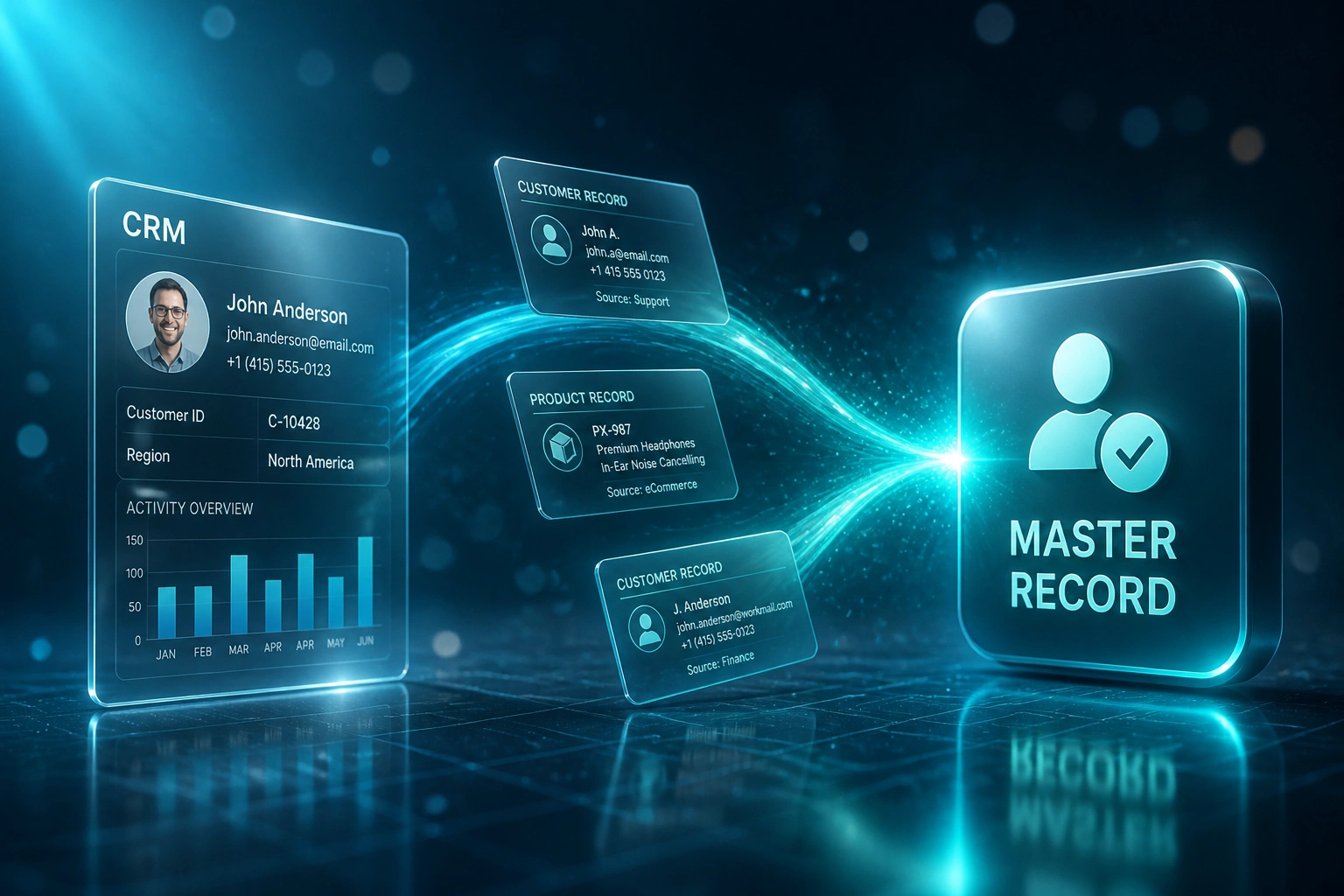
Profile fragments → match entities → merge into a master → write trusted fields back. No more hand-stitched customers.
Map the Fragments
We inventory partial customer, product, and transaction records across CRM, ERP, billing, and files
Match Across Systems
Fuzzy matching links the same entity even when IDs, spellings, and field names disagree
Build the Master
Survivorship rules pick the winning field from each system into one reliable record
Write Back and Guard
Trusted masters sync to source systems, with scans that stop new fragments from rebuilding
Everything You Need for Reliable Data Consolidation
Cross-System Record Mapping
We link the same customer, product, or transaction across CRM, ERP, billing, and spreadsheets, even when IDs, spellings, and field names differ.
Fragment Consolidation Rules
Partial copies merge into one master. Contact details, billing terms, product attributes, and history land in the right place without silent loss.
Survivorship by Field
You decide which system wins for each field. CRM may own the mobile number while ERP owns the VAT number and credit limit.
Controlled Merge Queues
High-confidence fragments unify automatically. Ambiguous clusters go to a short review queue so ops never re-opens ten browser tabs.
Write-Back to Source Systems
Once the master is agreed, trusted fields sync back to CRM, ERP, and billing so teams stop working from stale fragments.
Audit Trail and Ongoing Hygiene
Every merge is logged. Scheduled scans catch new fragments from imports, migrations, and SaaS sprawl before they poison forecasts again.
Systems We've Included in Cross-System Merges
From 15 Hours/Week to Under 2
How a Johannesburg industrial distributor stopped hand-stitching customers across CRM, Sage, and billing into one trusted master.
The Fragmented Process
- Ops manager reconciled the same account across HubSpot, Sage, and a billing export every week
- Sales quoted ship-to details that finance rejected on the invoice
- Support rebuilt order history from three partial records before every escalation
- Product SKUs in the CRM catalogue disagreed with ERP stock codes on roughly one in five lines
- Month-end customer counts never matched between sales and finance
The Unified Process
- One master customer and product record feeds CRM, Sage, and billing
- Field-level survivorship keeps VAT and credit limits authoritative in ERP
- Ambiguous clusters land in a short review queue instead of evening spreadsheet work
- Billing disputes from wrong addresses and mismatched SKUs dropped sharply
- Board packs use one customer count both sales and finance recognise
Before vs After Cross-System Merge
How It Works
From first conversation to live master records in 3 to 5 weeks.
Profile the Fragments
We sample CRM, ERP, billing, and spreadsheets to measure how often one entity is split across systems, not just exact-match duplicates.
Free Scoping Call
30-minute call with your CEO or ops lead to agree match keys, field ownership, and which systems create the most conflicting fragments.
Build and Dry-Run
We configure cross-system merge rules, run parallel against live data, and validate masters before any bulk consolidation goes live.
Go Live and Monitor
Masters write back to source systems. Prevention rules and scheduled scans keep new fragments from rebuilding the mess.
Frequently Asked Questions
How is fragmented records repair different from duplicate detection?
Duplicates are full or near-full copies of the same person or product in one place. Fragmented records are partial copies split across systems: CRM holds the contact, ERP holds the ship-to and VAT number, billing holds payment history. We unify those pieces into one reliable master with field-level survivorship, then write trusted values back so every team works from the same source of truth.
Which systems can you include in a cross-system merge?
We have consolidated customer, product, and transaction masters across HubSpot, Salesforce, Pipedrive, Zoho CRM, Sage and Pastel, Xero, custom ERPs, billing platforms, and Excel or CSV extracts. If a system exposes records via API, export, or database access, we can include it in the mapping and merge design.
Will the merge overwrite the wrong fields in our live systems?
No. Survivorship rules are agreed with your ops or data owner before anything runs at scale. High-confidence consolidations can merge automatically; ambiguous ones land in a review queue. Dry-runs on a sample set come first so you see exactly which fields would survive before write-back.
How does this reduce billing errors and support rework?
When address, VAT, pricing, and payment history live on different partial records, invoices go out wrong and support rebuilds history by hand. After record unification, billing and support read one master, so disputes drop and agents stop hunting across tabs for the full customer picture.
How long does a fragmented records cross-system merge take?
A standard consolidation across three systems takes 3 to 5 weeks from profiling to go-live. Large historic backlogs across four or more systems, or complex product and transaction domains, take closer to 5 to 8 weeks. We clear the highest-impact customer and product clusters first so sales trust and billing accuracy improve early.
How much does fragmented records repair and consolidation cost?
Cross-system profiling with survivorship rules and a review queue starts from around R35,000. Builds covering CRM plus ERP plus billing, historic backlog clearance, write-back, and ongoing hygiene typically range from R50,000 to R95,000. Teams burning a day a week on manual consolidation usually recover the investment within 2 to 4 months.
Stop Paying for Fragmented Records
If your teams still stitch customer and product data across CRM, ERP, and billing by hand, you are funding a problem a controlled cross-system merge already solves.
Tell us which systems hold the fragments, where sales trust breaks down, and how much time ops spends reconciling. We will show you how record unification would work for your business.