Low Stock Notification System: Inventory Warnings Before Customers Complain
Learning about stockouts from angry tickets or greyed-out SKUs is too late. Supplier lead times leave no room for reactive reordering. Threshold-based low stock alerts give buyers and ops time to act while cover still exists.
We build the stock notification layer that reaches the right people, on the right channel, before the shelf goes empty.
Sound Familiar?
These are the exact issues our clients faced before low stock alerts:
- You only learn a SKU is empty when customers complain or the storefront goes grey
- Low stock alerts live in one inbox nobody watches during peak hours
- Multi-warehouse stock looks fine in total, while one location is already out
- Buyers and warehouse ops hear about the same shortage hours apart, or not at all
- Supplier lead times leave no buffer once you finally notice the gap
Shopify shows a low stock indicator around 10 units but does not send automated alerts natively. Flow on eligible plans struggles with per-location inventory warnings, and ignored alerts never escalate. Multi-warehouse teams need purpose-built stock notification routing, not another inbox nobody owns.
What the Low Stock Alerts Actually Do
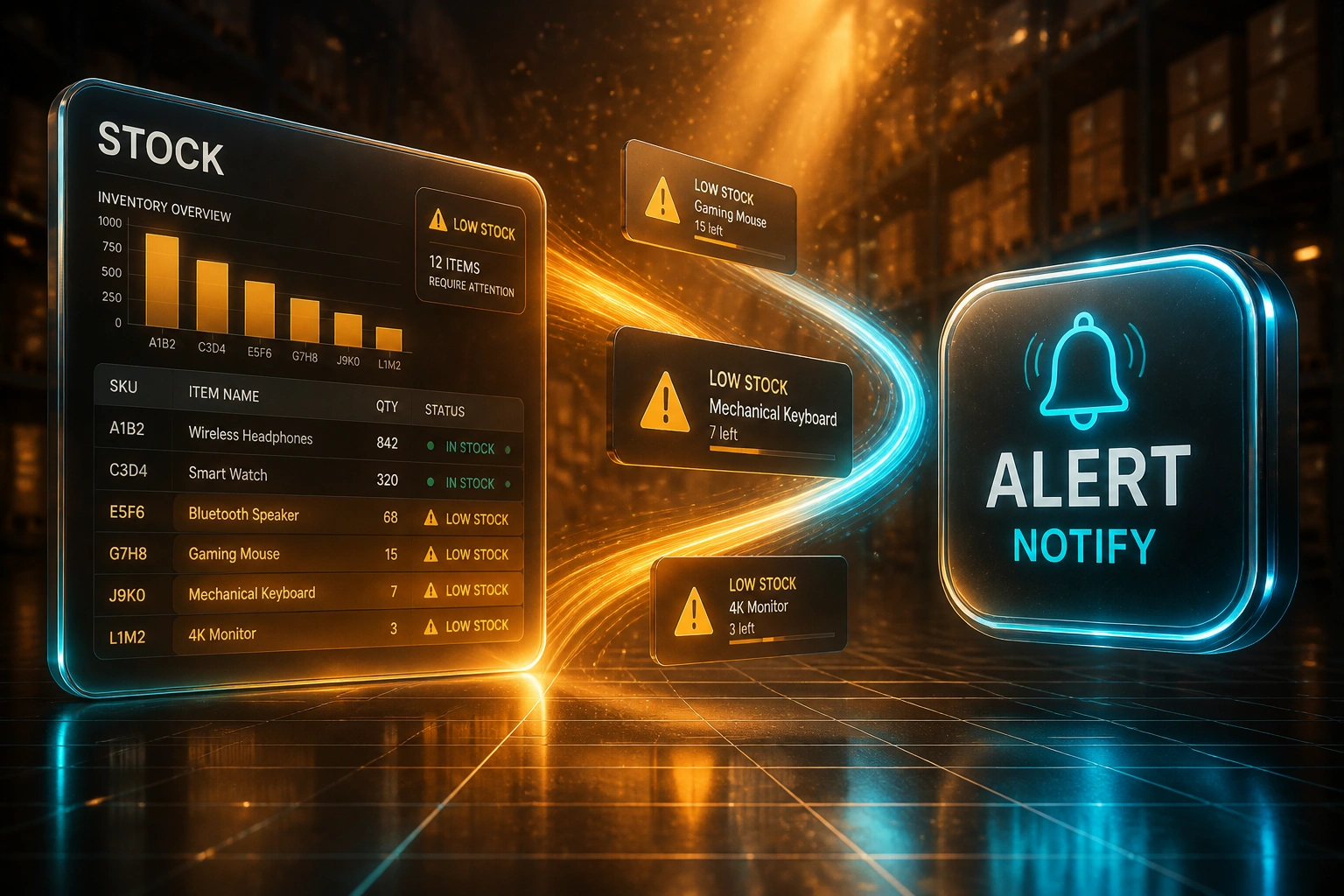
Threshold crossed → people notified → escalation if ignored → stockout avoided. No weekly spreadsheet chase.
Stock Hits Threshold
Available qty at a SKU or warehouse drops below the low-stock rule you set
Multi-Channel Notify
Buyers and ops get WhatsApp, email, Slack, or Teams with SKU, location, and qty
Escalate If Ignored
Unread inventory warnings climb to the next owner after your chosen window
Act While Cover Remains
Reorder or transfer stock before customers see a stockout on the storefront
Everything You Need for Reliable Stock Notification
Threshold-Based Low Stock Alerts
Each SKU and location gets its own low-stock threshold. When available qty crosses it, a stock notification fires immediately, not after the next weekly stock review.
Multi-Channel Delivery
WhatsApp, email, Slack, and Teams reach the people who can act. Route buyers one way and warehouse ops another so inventory warnings land where the work happens.
Escalation Paths
If nobody acknowledges an alert within 2, 24, or 48 hours, it escalates to the next owner. Unread inventory warnings stop dying quietly in a shared inbox.
Per-Warehouse Visibility
Alerts name the location, not just the SKU. Cape Town can be fine while Johannesburg is critically low, and the right team sees which warehouse needs cover.
Quiet Hours & Deduplication
Repeat triggers for the same SKU are collapsed into one thread. Quiet-hour rules batch overnight noise so peak-day alerts stay urgent and readable.
Audit Trail for Ops
Every low stock alert, acknowledgement, and escalation is logged. Ops can see what fired, who saw it, and how long it took before stockouts hit customers.
Systems We've Connected for Inventory Warnings
From Customer Complaints to Two-Minute Alerts
How a Cape Town ecommerce ops team stopped discovering stockouts on the storefront and cut complaint volume by 70%.
The Manual Process
- Ops checked Shopify inventory every few days, or when a ticket arrived
- Multi-warehouse totals looked healthy while one DC was already empty
- Buyers and warehouse leads used separate email threads with no escalation
- Average 3–5 days from low stock to anyone acting on it
- Hero SKUs went grey on the storefront before a PO was even discussed
The Automated Process
- Threshold crossed → WhatsApp to buyers and Slack to warehouse ops in under two minutes
- Alerts name the warehouse, SKU, and available qty, not a vague inbox ping
- Unread inventory warnings escalate to the ops lead after 24 hours
- Stockout complaints on hero SKUs dropped sharply within the first quarter
- Team still decides how to cover, but they decide while stock remains
Before vs After Low Stock Alerts
How It Works
From first conversation to live low stock alerts in 2–4 weeks.
Tell Us Your Setup
Which stock system, how many warehouses, and who should get low stock alerts today.
Free Scoping Call
30-minute call to map thresholds, channels, escalation owners, and quiet-hour rules.
Build & Test
We wire live available stock to multi-channel notifications and run parallel alerts for a week.
Go Live & Monitor
Switch off spreadsheet stock checks. Monitoring keeps thresholds and routing honest as catalogues grow.
Frequently Asked Questions
How is this different from reorder point automation?
Reorder point systems focus on calculating when to buy and often draft purchase orders. This page is about early warning: threshold-based low stock alerts, multi-channel stock notification, and escalation so buyers and ops act before customers see a stockout. Many teams run both.
How long does a low stock notification system take to set up?
A focused A-SKU pilot with WhatsApp and email usually takes 2–4 weeks from scoping to go-live. Multi-warehouse routing with Slack/Teams escalation and quiet-hour rules typically takes 4–6 weeks.
Which inventory and messaging platforms can you connect?
We have built low stock alerts against Shopify, WooCommerce, Takealot seller stock, custom WMS databases, Slack, Microsoft Teams, email, and WhatsApp. If available quantity is accessible per location, we can notify the right people.
Will Shopify Flow cover this for multi-warehouse stores?
Shopify shows a low stock indicator around 10 units but does not send automated alerts natively. Flow can help on eligible plans, yet multi-location triggers are fragile: conditions often evaluate totals or every location at once, with no built-in escalation if an alert is ignored. Custom routing is what multi-warehouse ops usually need.
Who receives the alerts?
You choose. Typical setups route buyers and procurement on WhatsApp or email, warehouse managers on Slack or Teams, and escalate unread inventory warnings to an ops lead after a set window. Different SKU families can use different owners.
How much does a low stock notification system cost?
Alert-only setups for a focused SKU set start from around R15,000. Multi-warehouse thresholds, multi-channel delivery, and escalation typically range from R25,000 to R60,000. Most clients recovering even one hero-SKU stockout cycle see payback within 1–3 months.
Stop Learning About Empty Shelves From Customers
If your team still discovers stockouts from complaints or greyed-out SKUs, you are paying the cost of late inventory warnings every week.
Tell us which stock system you run, how many warehouses you have, and who should get low stock alerts. We will show you exactly how multi-channel stock notification and escalation would work for your catalogue.