KPI and OKR Tracking: Align Every Team Around Measurable Business Goals
Your strategy deck dies in spreadsheets while departments invent their own metrics. By the time the board pack is ready, the numbers are already stale, and nobody can see how team KPIs connect to company objectives.
We build the cascading OKR system that keeps every layer aligned with live progress.
Sound Familiar?
These are the exact issues our clients faced before cascading KPI and OKR tracking:
- Company objectives sit in a strategy deck while departments invent their own KPIs in separate spreadsheets
- Strategy and ops spend a full day each week chasing status updates before the Monday leadership pack
- Department OKRs rarely link back to board goals, so teams hit local targets while company metrics stall
- Hybrid and remote leads report progress in slides that are already stale by the time the board opens them
- Quarterly planning resets the cascade from scratch because ownership and progress never stayed in sync
Seventy percent of companies run OKR cycles every quarter, yet board packs still start from blank spreadsheets while hybrid teams report stale status. The next planning cycle is the urgency: either the cascade is live with automated progress, or you pay the scramble again.
What Cascading KPI and OKR Tracking Actually Does
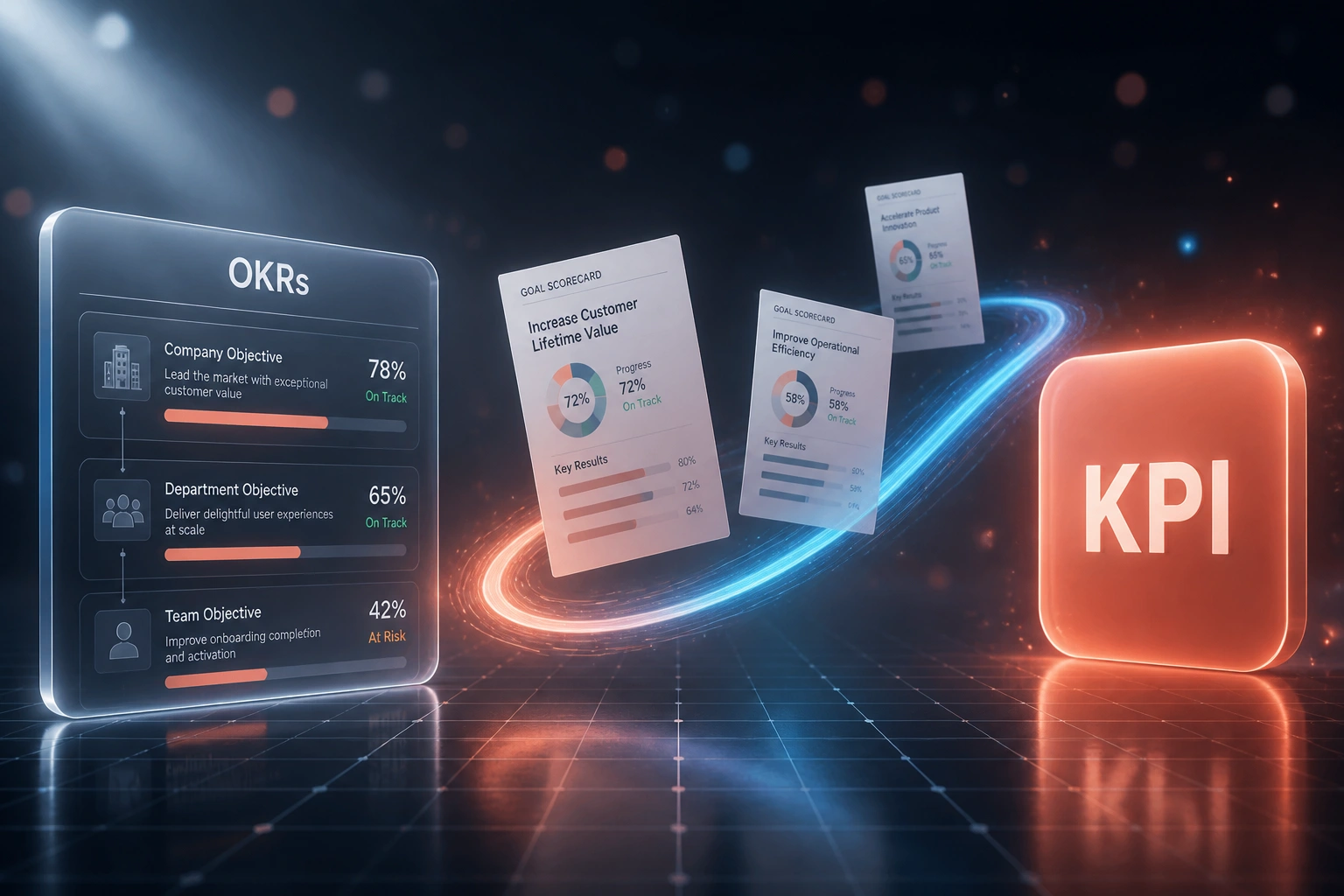
Company objective → department OKR → team KPI → live progress. Ownership stays clear at every layer.
Board Sets Company Goals
Leadership locks measurable company objectives for the quarter or year
Departments Cascade OKRs
Each department owns OKRs that roll into a parent company objective
Teams Attach KPIs
Team metrics and key results feed the department layer with named owners
Progress Syncs Automatically
CRM, finance, and project tools update scores so board packs stay live
Everything You Need for Performance Metrics That Cascade
Company-to-Team Cascade
Board objectives cascade into department OKRs and team KPIs with clear ownership at every level, so every scorecard traces back to a measurable business goal.
Live Progress from Source Systems
CRM, finance, project, and support tools refresh key results automatically. Leaders review exceptions, not rebuild the quarterly pack by hand.
Named Owners on Every Objective
Every objective and key result has a named owner, due date, and status. Accountability sits on people, not on a forgotten tab in a shared workbook.
Board-Ready Alignment Views
The MD and strategy lead see company goals, department OKRs, and team KPIs on one cascade. Department heads see only their branch without losing the link upward.
At-Risk Alerts Before Quarter End
Off-track key results and broken parent-child links notify owners the same week, not in the scramble before the board meeting.
Scheduled Board and Ops Digests
Weekly and monthly packs export from the live cascade so slides stop drifting from operational reality between planning cycles.
Platforms and Systems We Connect for OKR Management
From 14 Hours/Week to 2 Hours/Week
How a 90-person professional services firm stopped the quarterly OKR scramble and got board packs from a live company-to-team cascade.
The Spreadsheet Cascade
- Strategy lead chased four department heads for status every Friday
- Each team tracked KPIs in its own workbook with mismatched definitions
- Company objectives lived in a slide deck that nobody updated mid-quarter
- Board pack took three days to assemble and was already two weeks stale
- Off-track goals surfaced at quarter-end, when it was too late to course-correct
The Live Cascade
- Company objectives cascade into department OKRs and team KPIs with named owners
- CRM, project, and finance feeds update key results automatically
- Strategy lead reviews exceptions instead of rebuilding the pack
- Board and ops digests export from the same live alignment view
- At-risk objectives alert owners mid-quarter, while there is still time to act
Before vs After Cascading OKR Management
How It Works
From first conversation to live cascade in 3–5 weeks.
Map the Cascade
Company objectives, department OKRs, team KPIs, and which systems already hold the progress numbers today.
Agree Ownership and Definitions
Lock owners, parent-child links, and metric definitions so every KPI rolls into a measurable business goal.
Build and Parallel-Run
Connect source feeds, wire the cascade, and run alongside the spreadsheet pack until leadership trusts the numbers.
Go Live and Retire the Scramble
Hand over live alignment views, schedule digests, and switch off the quarterly copy-paste ritual.
Frequently Asked Questions
How is cascading OKR tracking different from a team performance dashboard?
A team performance dashboard measures deliverables, deadlines, and quality across departments for weekly ops. Cascading KPI and OKR tracking starts at board level: company objectives roll into department OKRs and team KPIs with ownership and automated progress sync. We build both; this page is about aligning every layer to measurable business goals.
Which systems can feed automated progress updates?
We typically connect CRM (HubSpot, Salesforce, Pipedrive), accounting (Xero, Sage), project tools (Asana, Jira, Monday.com), and helpdesk systems, then present the cascade in Lattice, Cascade, Weekdone, Perdoo, Power BI, or a custom view. If a tool has an API, we can include it.
Will departments still keep their own tools?
Yes. Teams keep working in the CRM, project board, and finance systems they already use. Progress syncs into the OKR cascade automatically. We run parallel testing before you retire the spreadsheet consolidation.
How do you stop departments inventing their own metrics?
During scoping we write the cascade contract: which company objectives exist, how department OKRs link to them, and which team KPIs count as evidence. Those rules live in the system with named owners, not in someone's memory or a fragile formula.
How long does a KPI and OKR tracking system take to build?
A focused company-to-department cascade across three to four source systems typically takes 3 to 5 weeks from scoping to go-live. Broader multi-layer builds with alerting, role views, and board digests usually sit closer to 5 to 8 weeks.
How much does cascading OKR tracking cost in South Africa?
Focused company-to-team cascades start from around R55,000. Multi-source builds with live feeds, ownership rules, alerting, and board digests typically range from R85,000 to R150,000. Strategy teams recovering 10+ hours a week usually see payback inside one or two quarters from hours alone.
Stop Letting Strategy Die in Spreadsheets
If company objectives, department OKRs, and team KPIs still live in disconnected workbooks, you are paying for misalignment every quarter.
Tell us how you set board goals today, which departments invent their own metrics, and which systems already hold the progress numbers. We will show you exactly how cascading KPI and OKR tracking would work for your business.