Lost Transaction History Rebuild: Reconstructing Records from Backups and Logs
You opened the ledger or CRM and found months of orders, payments, and movements missing after a crash, purge, or incomplete migration. Restoring the backup is not enough when the gap spans systems.
We forensically reconstruct a continuous, audit-ready transaction history from backups, audit logs, bank statements, and gateway event records.
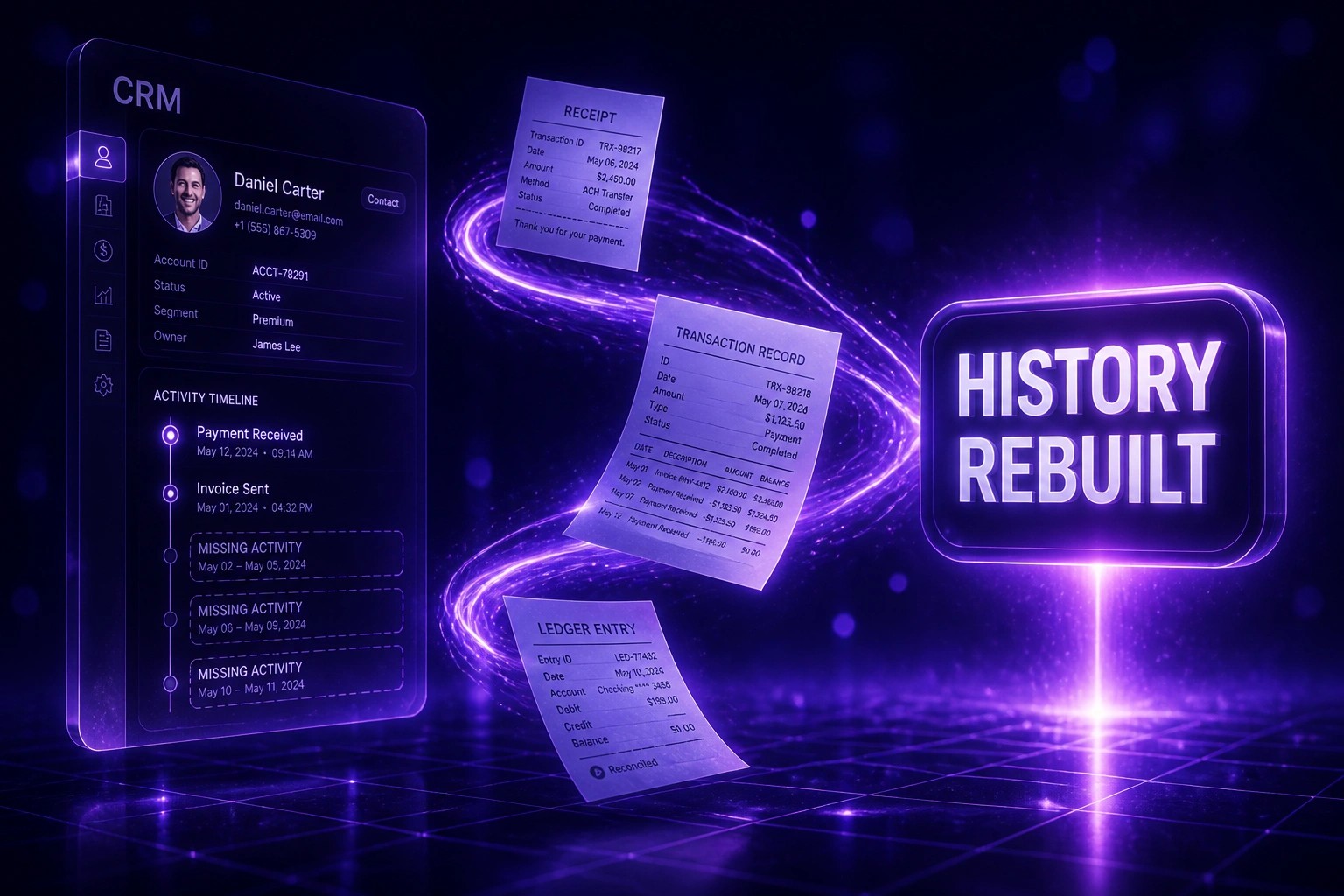
Sound Familiar?
These are the exact issues finance leads describe when transaction history disappears:
- Months of orders, payments, or ledger movements vanished after a crash, purge, or incomplete migration
- Restoring the last backup still leaves gaps across CRM, accounting, bank, and gateway systems
- Finance is matching bank statements and gateway exports line by line for weeks
- Payment gateway queries only reach recent months (PayGate, for example, limits status queries to six months)
- SARS, auditors, or board reporting need a continuous timeline you cannot currently produce
Companies Act section 24 requires accounting records for seven years, and SARS expects five years from return submission (and retention until any open audit concludes). Incomplete ledgers into audit or filing season turn a data incident into a compliance deadline.
What Data Reconstruction Actually Does
Inventory sources → cross-match → document gaps → deliver a continuous ledger timeline. No more spreadsheet archaeology alone.
Source Inventory
Backups, audit logs, bank statements, gateway exports, and CRM archives are catalogued by date range
Cross-Match Timeline
Orders, payments, fees, and ledger movements are aligned on date, amount, and reference
Gap Register
Residual holes get an evidence hierarchy, treatment, and documented rationale for auditors
Audit-Ready History
A continuous transaction history loads into accounting or the warehouse with source tags
Everything You Need for Backup Recovery That Holds Up
Multi-Source Forensic Merge
We stitch backups, audit logs, bank statements, and gateway event records into one continuous transaction history timeline.
Backup Gap Recovery
When a restore leaves holes, we identify what the backup never held and fill those months from secondary evidence, not guesswork.
Bank Statement Reconstruction
Deposits, fees, chargebacks, and transfers become dated ledger movements matched to invoices, orders, and customer records.
Gateway Event Backfill
PayFast, PayGate, Stripe, and similar processor exports rebuild payment status where the CRM or ledger was truncated.
Assumptions & Gap Register
Every residual gap is documented with evidence used, treatment applied, and rationale, so auditors can review the method.
Audit-Ready Export
A continuous, dated history lands in your accounting or data warehouse with source tags for every reconstructed line.
Sources and Platforms We Commonly Reconstruct From
From 22 Hours/Week of Matching to a Continuous Ledger
How a mid-size South African distributor rebuilt 11 months of truncated CRM and ledger history before SARS season.
The Manual Scramble
- Incomplete migration truncated 11 months of order and payment activity
- Finance spent 22 hours a week matching bank lines to partial CRM exports
- PayGate queries only covered six of the eleven missing months
- External catch-up quotes sat between R95,000 and R130,000 for books alone
- No defensible gap register for auditors or SARS queries
The Rebuilt Timeline
- Backups, bank statements, gateway events, and audit logs merged into one history
- 96% of lines evidence-matched; residual gaps logged with treatment rationale
- Continuous ledger timeline loaded with source tags on every reconstructed row
- Finance review shifted from archaeology to exception sign-off
- Audit pack ready ahead of filing deadlines
Before vs After Transaction History Rebuild
How It Works
From first conversation to an audit-ready timeline in roughly 3–6 weeks for a typical 6–12 month gap.
Map the Gap
Which months are missing, which systems still hold pieces, and what SARS or audit deadline you are racing.
Source Inventory Call
30-minute call to list backups, audit logs, bank portals, gateway exports, and what a restore alone cannot fix.
Rebuild & Validate
We reconstruct the timeline, cross-match sources, and walk finance through the gap register before sign-off.
Load & Hand Over
Continuous history is loaded into your ledger or warehouse, with monitoring so new truncations do not silently return.
Frequently Asked Questions
Is restoring a backup enough to rebuild lost transaction history?
Often no. Backups restore what that system held at a point in time. Gaps that span CRM activity, ledger movements, bank deposits, and gateway events need forensic reconstruction across those sources. We treat restore as one input, not the whole job.
How long does a transaction history rebuild take?
Industry catch-up for a single year of missing books commonly runs 4–8 weeks when documents arrive promptly. Multi-source rebuilds we run typically land in 3–6 weeks for a 6–12 month gap, depending on volume and how many systems hold fragments.
What if our payment gateway no longer shows older transactions?
That is common. PayGate documents a six-month window for querying transaction status via its API. We pull what the gateway still holds, then lean on bank settlements, merchant statements, CRM orders, and archived emails to cover older months.
Will the rebuilt history satisfy SARS and Companies Act retention?
Companies Act section 24 expects accounting records for seven years. SARS generally requires records for five years from return submission, and indefinitely while an audit or investigation is open. We produce an orderly, source-tagged timeline plus a gap register so you can show how incomplete periods were reconstructed.
Will this disrupt live operations while we rebuild?
No. Reconstruction work runs against exports and read-only access. Live CRM and accounting stay available. We only load reconstructed history after finance validates the timeline and gap treatments.
How much does a lost transaction history rebuild cost?
Scoped forensic rebuilds typically range from R40,000 to R90,000 depending on months missing, systems involved, and evidence quality. That sits well below multi-year external catch-up quotes in the R24,000–R129,000+ band for 12+ months of books alone, before urgency premiums. Most finance teams see payback inside one audit or year-end cycle.
Stop Hoping the Backup Will Fill Every Gap
If months of transaction history are missing across CRM, ledger, bank, and gateway systems, spreadsheet matching will not produce an audit-ready timeline in time.
Tell us which months are gone, which systems still hold fragments, and what deadline you are racing. We will show you how a forensic rebuild would work for your stack.