Migrate from VTiger CRM: Keep the Data, Leave the Debt
VTiger served well as an open-source option when control mattered more than polish. Then the interface aged, the API stayed session-bound and join-shy, custom modules became upgrade liabilities, and self-hosted PHP debt started owning your IT calendar. A VTiger alternative that owns your data model fixes that without throwing away contacts, deals, or history.
We migrate you to a modern CRM that preserves records and retires hosting debt.
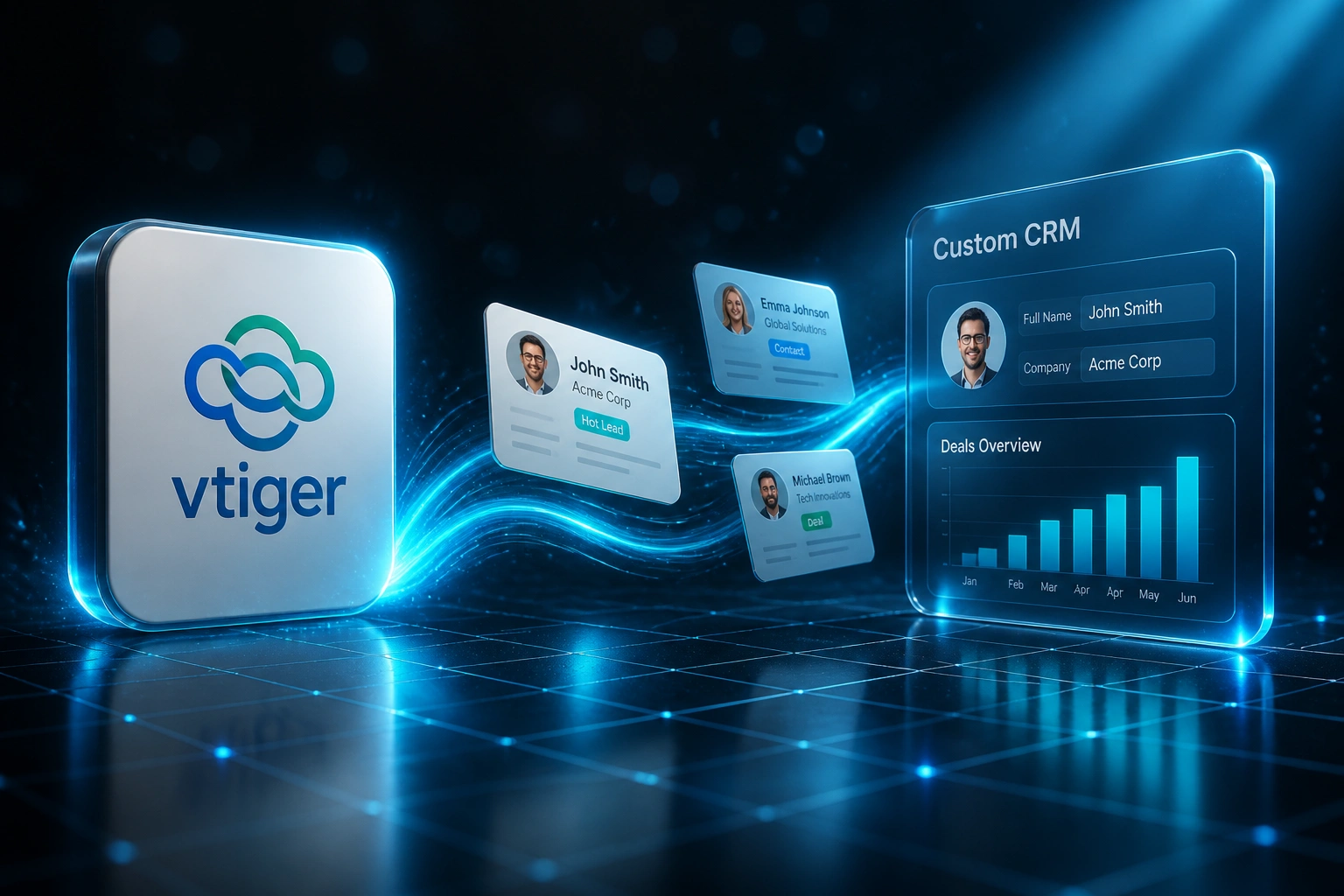
Sound Familiar?
These are the VTiger migration pains sales and ops directors bring us when open-source control stops being free:
- The open-source VTiger interface still feels a decade behind, so reps avoid updating deals until Friday
- Self-hosted installs burn 4–10 hours of IT time every month on patches, SSL, backups, and failed upgrades
- Custom PHP modules that once felt like an advantage now break on every PHP or VTiger version bump
- The REST API uses session-based auth with roughly 100 requests per minute on cloud, and queries cannot join modules
- Community Edition sits several major versions behind the cloud product, so you pay hosting debt for a feature set that stalls
If your Community Edition is more than three major versions behind, AeroLeads notes that upgrade complexity often exceeds the effort of migrating to a modern platform. Custom PHP modules compound that: every deferred upgrade deepens the debt you will eventually pay to leave VTiger.
What a VTiger Export Migration Actually Does
Audit the install → rebuild the CRM → move contacts and deals with history → retire the hosting debt.
Install Audit
We map edition, version gap, custom modules, integrations, and fields you cannot lose
Custom CRM Build
Objects, stages, and permissions shaped to how you sell, not VTiger's module model
Full Data Move
Accounts, contacts, deals, notes, and activities with associations and custom fields rebuilt
Leave VTiger
Team live on the new CRM, old instance read-only, PHP and hosting debt retired
Everything You Need to Leave VTiger Cleanly
Contacts, Deals, and History Intact
We export Accounts, Contacts, Potentials, Activities, and Notes in dependency order, then rebuild associations so open deal context survives day one.
Custom Fields and Modules Mapped
Custom fields, picklists, and the business logic trapped in PHP modules become first-class objects on the new platform instead of upgrade liabilities.
Modern UI Your Team Will Use
Reps stop fighting an aging interface. Pipeline updates happen in the moment, not in a Friday spreadsheet catch-up.
API Without Session Friction
Integrations to accounting, email, and WhatsApp run on modern auth and sane rate limits, not challenge-token sessions that expire mid-sync.
Hosting and PHP Debt Retired
No more VPS invoices, weekend patch windows, or three-day upgrade projects that still leave you two versions behind.
Reporting Without VTiger Export Fridays
Board and ops questions get answered inside the CRM. Leave the CSV export workflow behind with the aging UI.
VTiger Surfaces We've Migrated From
From Seven Hours of VTiger Workarounds to One
How a twelve-person B2B distributor left self-hosted VTiger Community Edition after custom module debt and Friday spreadsheet exports made another PHP upgrade the wrong investment.
The VTiger Ceiling
- Self-hosted Community Edition three major versions behind, with a VPS near R1,800 a month
- IT burned about eight hours a month on patches, failed upgrades, and SSL renewals (~R43K a year at R450/hr)
- Two custom PHP pricing modules broke on the last upgrade attempt and stayed half-patched
- Ops exported deals to spreadsheets every Friday because reports and the aging UI slowed the team
- API sync to accounting stalled on session expiry and single-object query limits
The Modern CRM
- Accounts, contacts, deals, notes, and activities migrated with associations and custom fields rebuilt
- Pricing rules became first-class objects instead of fragile PHP modules
- No more VPS invoice, weekend patch windows, or deferred Community Edition upgrades
- Pipeline review happens inside the CRM; Friday CSV exports ended
- VTiger went read-only for 30 days, then the server was decommissioned
Before vs After Leaving VTiger
How a VTiger Migration Works
From first conversation to VTiger decommissioned, typically 6 to 12 weeks for a focused move.
Audit Your VTiger
Edition, version gap, custom modules, integrations, and which fields and history you cannot lose.
Scope the Target CRM
30-minute call to map objects, stages, and integrations, then a fixed quote for migration plus build.
Export, Clean, and Load
We pull via API and CSV where needed, map custom fields, preserve activity history, and parallel-run until spot checks pass.
Cut Over and Leave VTiger
Team trains on the new CRM, the old instance goes read-only, and hosting plus PHP upgrade debt ends.
Frequently Asked Questions
When does leaving VTiger for a modern CRM make sense?
When the aging interface is slowing adoption, custom PHP modules break on every upgrade, or self-hosted IT time sits at 4–10 hours a month. Community Edition also lags several major versions behind the cloud product. If a carefully planned VTiger export into a modern platform costs less than another year of hosting labour and upgrade projects, leave. If a clean cloud edition still fits and your customisation debt is light, stay.
Will we lose contacts, deals, custom fields, and history?
No, when the migration is planned properly. We migrate Accounts, Contacts, Potentials (deals), Activities, and Notes, rebuild associations, and map custom fields so open deal context and history survive day one. DIY CSV alone often flattens relationships; we use the API where joins and paging matter.
How long does a VTiger migration take?
Most migrations we run take 6 to 12 weeks from scoping to cutover. Clean Community Edition installs with standard modules sit toward the shorter end. Accounts with years of activity history, heavy custom PHP modules, and multi-module workflows take closer to 3 to 4 months, phased so sales can work in the new system before every nice-to-have ships.
What does self-hosted VTiger really cost once IT labour is included?
At roughly R16.55 to the dollar (August 2026), a typical VPS runs about R660–R3,300 a month, but AeroLeads research puts fully-loaded self-hosted cost 40–70% above the server invoice once you add 4–10 hours of monthly IT. At R450 an hour, six hours a month is already R32,400 a year in labour alone, before upgrade projects that take 3–8 hours per major release. Cloud One Professional sits near R497 per seat per month on annual billing ($30), which is often cheaper than self-hosted once labour is honest.
How much does a custom CRM plus VTiger migration cost?
Focused builds with contacts, pipeline, and a full VTiger data migration typically land between R120,000 and R350,000. Rebuilding custom module logic, multi-branch workflows, and accounting sync push higher. Against R30K–R50K a year in hosting labour and upgrade friction, many clients see payback inside 12 to 18 months.
Can we keep VTiger running while the new CRM is built?
Yes. We parallel-run so sales keeps closing in VTiger while we validate the new CRM. Once open deals, custom fields, and history check out, VTiger goes read-only and the server can be decommissioned. You choose the cutover pace.
Stop Paying Upgrade Debt on an Aging CRM
If custom modules, PHP upgrades, and Friday VTiger exports already dominate the ops conversation, a structured migration to a modern platform is often cheaper within two budget cycles.
Tell us whether you run Community Edition or Cloud, how many custom modules you carry, and what you cannot lose (contacts, deals, history). We will show you a migration path and a Rand payback estimate.