MySQL to Cloud Database Migration: Stop Babysitting the VPS
Self-hosted MySQL on a VPS or colo needs constant monitoring, backup verification, and patch windows. That work lands on your founder or CTO, not a dedicated DBA, and every hour spent on mysqldump logs is an hour not spent on the product.
We migrate you to managed MySQL hosting with automatic backups, HA, and a validated cutover plan.
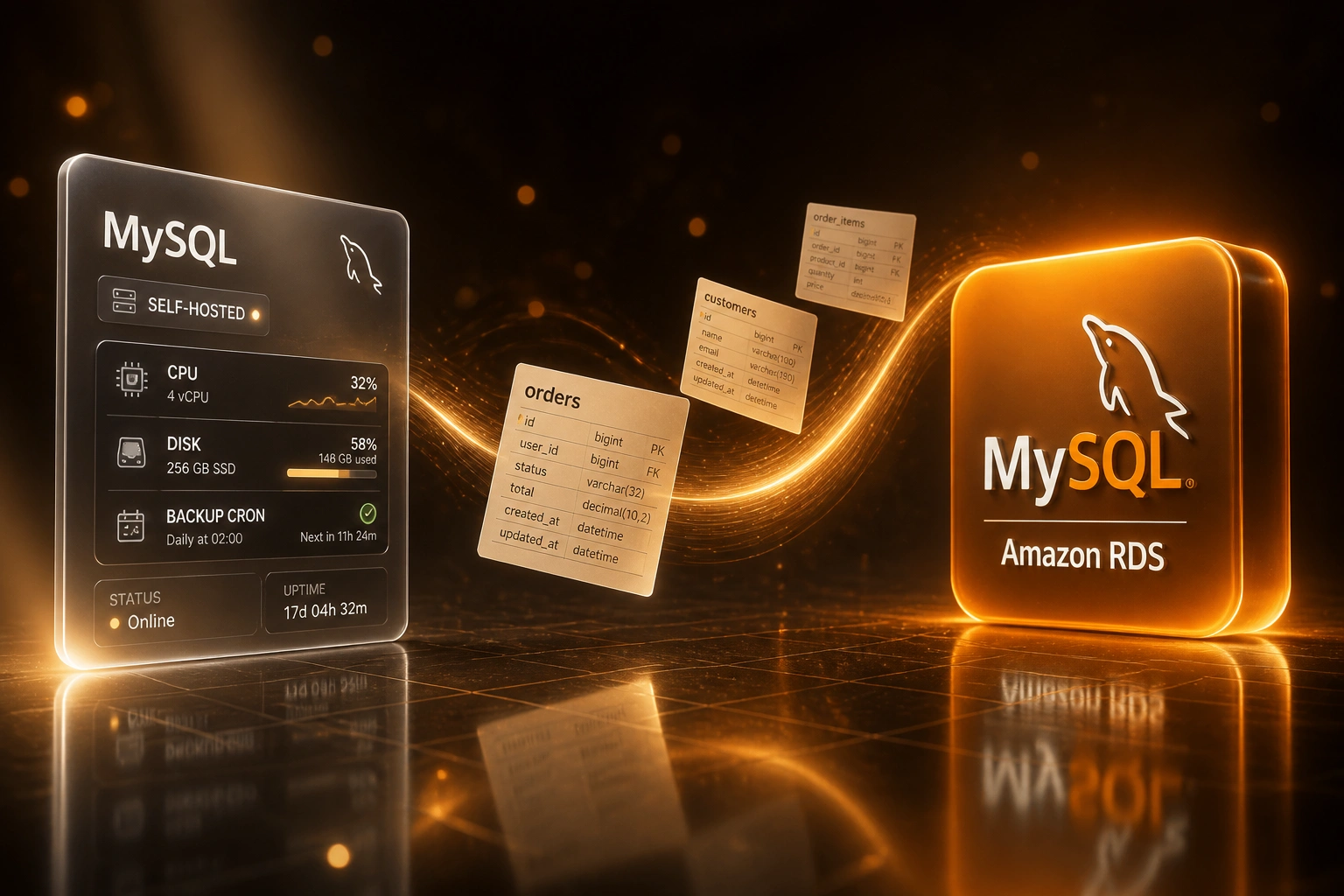
Sound Familiar?
These are the exact issues founders and CTOs face when MySQL still lives on a VPS:
- Your best engineer spends nights on MySQL disk alerts, cron backup logs, and patch windows instead of shipping product
- Nightly mysqldump jobs report success until the day restore fails: only 58% of servers met recovery SLAs in Veeam's last large-scale restore test
- No Multi-AZ failover: a VPS disk failure or colo outage takes the store or API offline with you as the on-call DBA
- Self-hosted TCO quietly exceeds managed MySQL once you count 10 hours a month of ops at senior engineer rates
- MySQL 5.7 reached end of life in October 2023, yet roughly one in four production servers still runs it without upstream security patches
MySQL 5.7 reached end of life on 25 October 2023, with no further community security patches. If your product database is still on 5.7 (or an unpatched 8.0 path toward April 2026 EOL), a managed MySQL cloud migration is the cleanest way to land on a supported version with backups and HA included.
What a MySQL Cloud Migration Actually Does
Assess → replicate → validate → cut over. Your apps keep selling; the VPS stops being your DBA.
Assess Self-Hosted MySQL
Version, schema size, users, binary logs, and every app that talks to the instance
Land on Managed MySQL
Schema and data move to Amazon RDS, Cloud SQL, or Azure Database for MySQL
Validate Integrity
Checksums, row counts, and parallel reads prove the cloud copy matches before anyone switches
Cut Over & Switch Off
Apps re-point, backups and HA are proven, and the old VPS MySQL can finally be retired
Everything You Need for a Reliable MySQL to RDS Move
Instance & Schema Assessment
We inventory your MySQL version, storage engines, table sizes, users, and dependent apps, then size the right Amazon RDS, Cloud SQL, or Azure Database for MySQL target.
Validated Cutover Plan
Replication or dump-and-load with checksums, row-count checks, and a rehearsed cutover window. You sign off before DNS or connection strings flip.
Automated Cloud Backups
Point-in-time recovery and retention replace fragile cron dumps. We prove a restore works before the old VPS is switched off.
High Availability Setup
Multi-AZ or equivalent managed failover so a single host failure no longer takes your catalogue or checkout offline.
Monitoring Hand-Off
CloudWatch, Cloud Monitoring, or Azure metrics replace home-grown Prometheus babysitting. Alerts go to the right people, not your founder's phone at 2am.
App Re-Pointing & Smoke Tests
Connection strings, read replicas, and reporting tools are updated and smoke-tested so product traffic lands cleanly on the managed instance.
MySQL Platforms We Migrate From and To
From 12 Hours/Month of MySQL Ops to Near Zero
How a 14-person e-commerce product company left a colo MySQL box for Amazon RDS Multi-AZ and gave engineering time back to the roadmap.
The Self-Hosted Burden
- MySQL 5.7 on a single colo VPS with cron mysqldump to the same disk
- CTO spent 10–12 hours a month on patches, disk pressure, and backup log checks
- No Multi-AZ: one host failure meant checkout and inventory APIs offline
- Restore had never been rehearsed end-to-end against a full catalogue
- Product work slipped whenever a weekend patch window ran long
The Managed MySQL Setup
- Amazon RDS for MySQL 8.x with Multi-AZ and automated backups enabled
- Point-in-time recovery tested before the colo instance was switched off
- Cutover window under 20 minutes after a week of parallel validation
- Monitoring alerts land in Slack, not on the founder's personal phone
- Engineering capacity returned to catalogue and fulfilment features
Before vs After MySQL Cloud Migration
How It Works
From first conversation to managed MySQL live in 3–6 weeks.
Tell Us Your MySQL Setup
Version, data size, backup posture, hosting (VPS, colo, bare metal), and which apps depend on it.
Free Scoping Call
30-minute call to choose RDS, Cloud SQL, or Azure Database for MySQL, estimate cutover risk, and set a timeline.
Migrate & Validate
We move schema and data in stages, run integrity checks, and keep the self-hosted source as fallback until you sign off.
Cut Over & Harden
Flip connections, confirm automated backups and HA, then decommission the old MySQL box on your schedule.
Frequently Asked Questions
How long does a MySQL to cloud database migration take?
A focused single-instance MySQL move to Amazon RDS, Cloud SQL, or Azure Database for MySQL typically takes 3–6 weeks from scoping to cutover. Smaller catalogues under 50 GB can finish in 2–3 weeks. Large multi-schema estates with heavy stored-procedure logic take closer to 6–10 weeks. We build validation and a rehearsed cutover into every plan.
Which managed MySQL platforms do you migrate to?
We regularly land self-hosted MySQL on Amazon RDS for MySQL, Amazon Aurora MySQL, Google Cloud SQL for MySQL, and Azure Database for MySQL. We pick the target based on your existing cloud footprint, latency needs, and budget, not a one-size default.
Will the cutover take our store or API offline?
We design for a short, planned maintenance window after parallel sync, not a multi-day outage. For e-commerce teams, that matters: even a mid-size online store can lose R18,500–R185,000 per hour of unplanned downtime. A validated cutover plan is how we keep that window measured in minutes, not hours.
What happens to backups and high availability?
Managed MySQL includes automated backups with point-in-time recovery, and Multi-AZ (or equivalent) failover typically completes in under a minute. We configure retention to match your recovery objectives and run a proven restore test before decommissioning the VPS. That closes the gap where only 58% of servers met recovery SLAs in Veeam's latest large-scale restore test.
We are still on MySQL 5.7. Can we migrate and upgrade?
Yes. MySQL 5.7 reached community end of life on 25 October 2023, and roughly 25% of production servers were still on it in 2024 surveys. We plan a migration path that lands you on a supported MySQL 8.x managed version, with compatibility checks for SQL modes, authentication plugins, and deprecated features before cutover.
How much does a MySQL cloud migration cost?
Focused single-instance migrations typically start from around R40,000. Multi-schema or multi-environment estates usually range from R75,000 to R160,000. Most product teams reclaim 10 hours a month of engineering time (around R177,000 a year at senior rates) and see payback well inside the first year once avoided downtime and DBA load are counted.
Stop Spending Product Time on Self-Hosted MySQL
If your founder or CTO is still the on-call DBA for a VPS MySQL box, you are paying for a problem managed cloud hosting already solved.
Tell us your MySQL version, roughly how big the database is, and whether you lean toward Amazon RDS, Cloud SQL, or Azure. We will show you a cutover plan that puts automatic backups and high availability under the product, not on your calendar.