Omnichannel Ticket Management Strategy: One Conversation, Every Channel
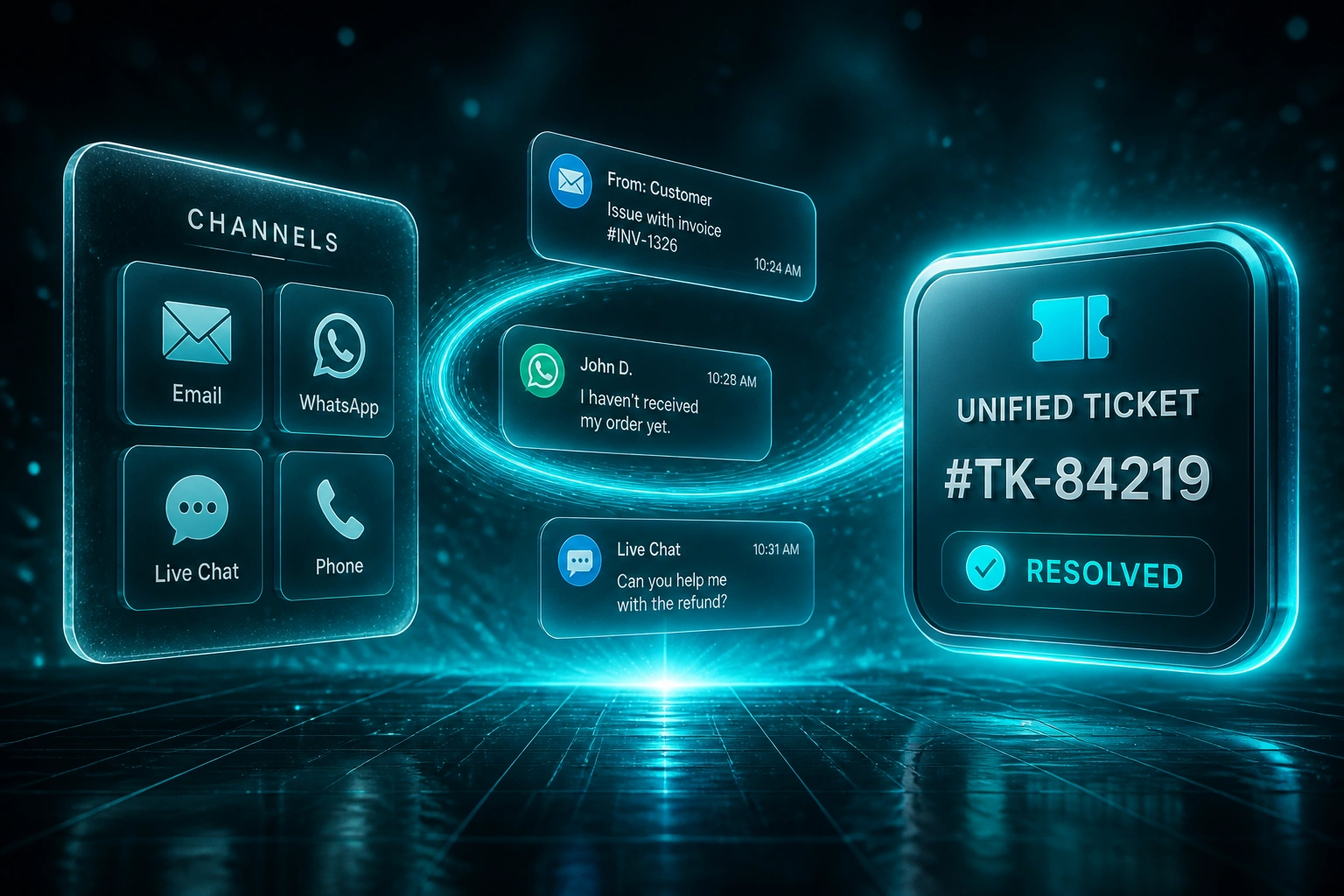
Your customer emails about an order, follows up on WhatsApp at lunch, then phones after work. If each hop opens a new ticket, they re-explain, your agents re-ask, and CSAT takes the hit. Channel switching is normal. Losing context is optional.
We design the unified ticketing model that keeps continuity across every hop.
Sound Familiar?
These are the exact issues Heads of Support bring us before they fix channel switching friction:
- Customers hop from email to WhatsApp to phone and re-explain the whole story every time
- Agents open three inboxes and still cannot see the same conversation history
- Each channel creates a new ticket, so reopen rates look fine while customers feel abandoned
- Phone agents waste minutes reconstructing context that chat and email already captured
- CSAT drops on channel switches even when individual agents handle their own queue well
Only 35% of companies deliver a fully connected cross-channel experience (Zendesk CX Trends), while 69% of customers expect previous-channel context to be available immediately. In South Africa, WhatsApp reaches about 96% of internet users and sits beside email and phone as a daily support path. Offering all three without a unified ticket model multiplies re-asking, not resolution.
What Omnichannel Ticket Continuity Actually Does
Customer hops channel → same ticket stays open → agent sees full history → one resolution, no re-telling.
Journey Starts Anywhere
Customer opens on email, WhatsApp, web chat, or phone. A single ticket is created with identity matched.
Channel Hop Appends
Next message lands on the same case. Continuity rules prevent a second ticket from splitting the story.
Agent Sees Full History
One workspace shows prior messages, notes, and attachments before the agent replies or picks up the call.
Resolve Once, Measure Once
Repeat contacts drop, AHT shortens, and CSAT reflects the whole journey instead of a lucky single channel.
Everything You Need for Unified Ticketing Continuity
One Ticket Across Channel Hops
Email, WhatsApp, chat, and phone append to the same case. The customer never starts a parallel thread that loses the story.
Conversation Continuity Rules
When a customer switches channel mid-journey, the open ticket stays live with full history, attachments, and prior agent notes.
Single Agent Workspace
Every agent sees one timeline before they reply. No tab-hopping between WhatsApp Business, Outlook, and the dialler notes.
Identity Matching Across Channels
Phone number, email, and WhatsApp handle resolve to one customer so a channel hop does not spawn a duplicate ticket.
SLA Continuity, Not Channel Clocks
First-response and resolution timers follow the customer journey. Switching from email to WhatsApp does not reset the clock.
Effort and Repeat-Contact Reporting
Track channel-switch rate, context carry, and repeat contacts on one dashboard so CX leadership can prove the model is working.
Platforms We Configure for Omnichannel Ticket Continuity
From Re-Asking to One Ticket Across Every Hop
How a Johannesburg CX desk cut repeat contacts 38% once email, WhatsApp, and phone stopped creating parallel tickets.
The Siloed Inboxes
- Email lived in Freshdesk, WhatsApp in a Business app, phone notes in a dialler
- Roughly one in three journeys hopped channel, and most opened a second ticket
- Agents spent 3–5 minutes reconstructing context the customer had already given
- Repeat contacts after channel switches sat near 29% of closed cases
- CSAT dipped whenever the journey crossed more than one channel
The Unified Ticket Model
- Every hop appends to one case with identity matched on phone and email
- Agents open a single timeline before they reply or take the call
- Re-asking dropped; average handle time fell by about four minutes on hop journeys
- Repeat contacts after channel switches fell to 18%
- CSAT on multi-channel journeys rose 12 points within 90 days
Before vs After Unified Ticketing
How It Works
From first conversation to live ticket continuity in 3–6 weeks.
Map Your Channel Hops
Where customers switch today, which inboxes are siloed, and how often agents re-ask for context already given.
Free Scoping Call
30-minute call with your Head of Support or CX lead to design the unified ticket model and continuity rules.
Build & Test
We configure ticket merging, identity matching, and agent workspace views, then run parallel for a week on live hops.
Go Live & Measure
Cut over to one conversation history. Dashboards track repeat contacts, AHT, CSAT, and context carry across channels.
Frequently Asked Questions
How is omnichannel ticket management different from multi-channel support?
Multi-channel means you offer email, WhatsApp, chat, and phone. Omnichannel ticket management means those channels share one ticket and one conversation history when the customer hops. Wiring channels into a helpdesk is necessary. Continuity rules and a single agent view are what stop customers from re-explaining.
Which helpdesks can run a true omnichannel ticket model?
We design and configure continuity on Zendesk, Freshdesk, Intercom, HubSpot Service Hub, Salesforce Service Cloud, and custom helpdesks. The strategy is platform-agnostic: one case per journey, identity matching, and an agent workspace that shows every prior message before the reply.
Will customers still be able to choose WhatsApp, email, or phone?
Yes. Customers keep switching channels for convenience. The change is on your side: the hop lands on the same ticket with full context, so agents continue the conversation instead of starting over.
How do you stop duplicate tickets when someone switches channel?
We match on phone, email, and messaging handles, then append new messages to the open case wherever possible. Merge rules catch the rest so two agents are not working the same issue in two silos.
How long does an omnichannel ticket management project take?
Most programmes take 3–6 weeks from scoping to go-live: hop mapping, ticket model design, identity rules, agent workspace setup, parallel testing, and cutover. A focused email-plus-WhatsApp continuity layer on an existing Zendesk or Freshdesk can be live in about three weeks.
How much does omnichannel ticket management cost?
Ticket continuity design and configuration typically ranges from R30,000 to R75,000 depending on channel count, identity complexity, and whether you already have a unified inbox. Against Gartner's finding that seamless transitions save about four minutes of agent time per journey, mid-size desks usually recover the build within 2–4 months.
Give Agents One View Across Every Channel Hop
If customers already switch between email, WhatsApp, and phone, siloed inboxes are taxing your CSAT and your agent hours. A true omnichannel ticket model fixes the continuity gap.
Tell us which channels you run, where history breaks today, and what your Head of Support measures. We will show you how unified ticketing would work on your desk, in Rand terms.