Validate Payment Amounts Before Processing to Prevent Errors
Wrong amounts leave the bank before anyone notices. Underpayments stall collections, overpayments create credit notes, and duplicate amounts against the same invoice trigger refunds and customer trust damage.
We build pre-processing amount validation that stops bad payments at the gate.
Sound Familiar?
These are the exact issues our clients faced before payment amount validation:
- Debit-order batches leave with amounts that do not match open invoice balances
- Underpayments stall collections while finance hunts the shortfall by hand
- Overpayments force credit notes, supplier refunds, and messy AR adjustments
- Duplicate payment amounts against the same invoice only surface at reconciliation
- Month-end is spent untangling amount mismatches instead of closing the books
From 13 April 2026, PASA shortens the debit-order dispute window to 60 days. Wrong amounts that leave unchecked create a tighter recovery window and more pressure on finance to catch errors before the batch, not after the bank has moved the money.
What Payment Amount Validation Actually Does
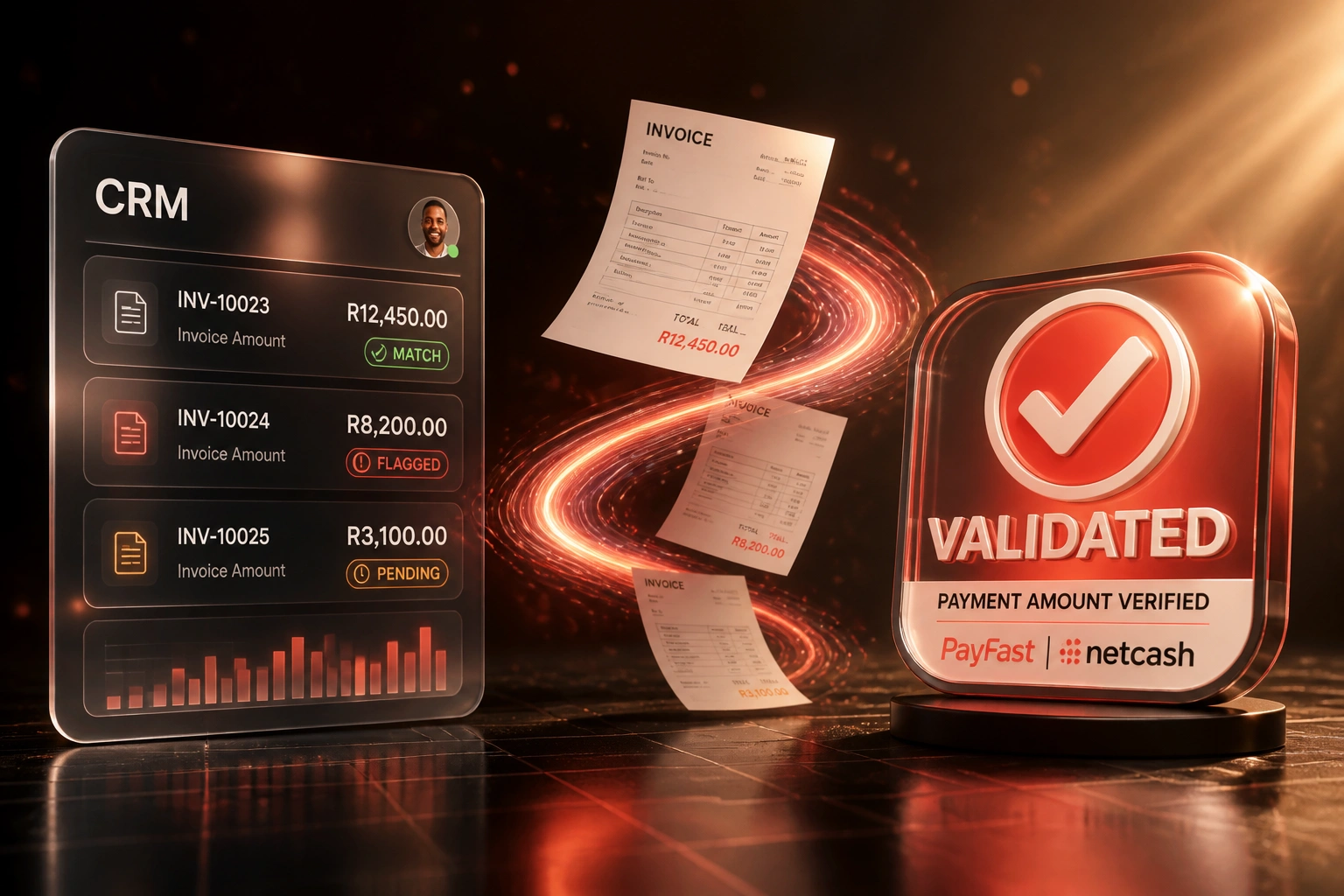
Invoice balance checked → mismatch held → clean amount released → ledger updated. Nothing wrong reaches the bank.
Payment Queued
A debit-order line, EFT payout, or gateway collection is ready with a proposed amount
Balance Compared
Amount is checked against the open invoice, schedule, and prior payments for that account
Gate Decision
Match proceeds into the batch. Over, under, or duplicate amounts go to a finance exception queue
Clean Settlement
Only validated amounts hit Netcash, PayFast, or the bank file. CRM and ledger stay aligned
Everything You Need for Payment Error Prevention
Invoice Balance Checks
Every payment amount is compared to the open invoice balance and expected schedule before it enters a Bankserv or gateway batch.
Over and Under Flags
Amounts above or below the expected figure are held with a clear reason code so finance reviews them before money moves.
Duplicate Amount Guard
A second payment for the same invoice and amount is blocked at the gate, not discovered weeks later on a vendor statement.
Schedule Alignment
Instalment and debit-order runs are checked against the agreed schedule so wrong-period amounts never hit the bank.
CRM and Ledger Sync
Validated amounts write back to the CRM deal and accounting invoice so sales and finance see the same balance.
Exception Queue for Ops
Only mismatches reach humans. Clean amounts pass straight into Netcash, PayFast, or your EFT batch with an audit trail.
Platforms We've Wired for Amount Validation
From 14% Amount Exceptions to Under 2%
How a mid-size SA membership business stopped wrong debit-order amounts leaving for Bankserv and cut reconciliation from 37 hours a month to 11.
The Manual Gate
- Finance spot-checked Netcash export amounts against Xero open balances in Excel
- About 14% of lines needed a correction after the fact: underpays, overpays, or repeats
- Overpayments meant credit notes and customer goodwill calls
- Underpayments stalled AR until someone noticed the shortfall
- Reconciliation ate roughly 37 staff hours every month
The Validated Gate
- Every line is compared to the open invoice and schedule before the batch leaves
- Mismatches land in a finance queue with reason codes; clean lines go straight out
- Amount exceptions dropped to under 2% of runs
- Wrong rands no longer clear the bank before anyone notices
- Reconciliation fell to about 11 hours a month on genuine exceptions only
Before vs After Amount Validation
How It Works
From first conversation to live amount validation in 2–4 weeks.
Map Your Payment Gates
Where amounts are set today, which batches leave for the bank, and how overpayments and underpayments currently get fixed.
Free Scoping Call
30-minute call to design pre-flight amount validation against open invoices, schedules, and your collection stack.
Build and Parallel-Test
We add the validation layer, then run it alongside your current batch for a week so finance can prove every catch.
Go Live and Monitor
Wrong amounts stop at the gate. Exception alerts and an audit trail keep CFOs and auditors comfortable.
Frequently Asked Questions
What is payment amount validation in plain English?
It is a pre-flight check that compares the amount you are about to collect or pay against the open invoice balance and expected schedule. If the figures do not match, the payment is held before it reaches the bank, a debit-order batch, or the gateway.
How is this different from idempotency or duplicate-charge protection?
Idempotency stops the same checkout attempt from charging twice at the gateway. Amount validation stops the wrong rand value leaving at all: overpayments, underpayments, and a second payment against an already-settled invoice balance. Most finance teams need both layers.
Which systems can you validate amounts against?
We typically read open balances from Xero, Sage, QuickBooks, or a custom ledger, and schedule data from your CRM or billing system. Validated amounts then feed Netcash, PayFast, PayGate, Ozow, or bank EFT batches. If your source of truth has an API or export, we can wire it in.
Will this slow down our debit-order runs?
Clean amounts pass through in seconds. Only mismatches pause for review. Teams usually find the batch leaves on time more often, because they stop rebuilding files after Bankserv or collector rejections caused by wrong figures.
How long does amount validation take to implement?
A focused pre-flight layer against one ledger and one collection channel typically takes 2 to 4 weeks from scoping to go-live. Multi-ledger setups covering debit orders, EFT supplier batches, and gateway payouts with CRM write-back usually take 4 to 6 weeks.
How much does payment amount validation cost?
Focused single-channel amount validation starts from around R25,000. Multi-channel coverage with schedule checks, CRM write-back, and finance exception queues typically ranges from R45,000 to R90,000. Teams stopping even a handful of material overpayments a year usually see ROI within 2 to 3 months.
Stop Letting Bad Payment Amounts Reach the Bank
If your team still discovers overpayments, underpayments, and duplicate amounts after the money has moved, you are paying for a problem that should never leave the gate.
Tell us how you collect or pay today, where invoice balances live, and which mismatches hurt most. We will show you exactly how pre-processing amount validation would work for your finance ops.