Build a Real-Time Payment Dashboard: One Cash Position Across Every Provider
Your finance team opens five payment portals every morning to piece together today's cash. Fragmented dashboards hide true liquidity, delay treasury decisions, and burn analyst hours that a unified view would reclaim.
We build the real-time payment dashboard that gives CFOs the full picture.
Sound Familiar?
These are the exact issues our clients faced before a unified payment dashboard:
- Finance logs into PayFast, Peach, Yoco, Ozow, and Stripe every morning just to estimate today's cash
- Settled, pending, and failed volumes live in five different formats with five different settlement clocks
- Nobody trusts the cash figure until bank deposits land, often one to two business days later
- Month-end close stretches by five to ten business days while analysts reconcile multi-gateway CSVs
- Treasury decisions wait on a spreadsheet that is already stale by the time it is finished
South African merchants routinely run PayFast, Peach, Yoco, Ozow, and Stripe side by side, each with its own settlement clock (T+1 to T+2, sometimes same-day for Instant EFT). Without a settlement-aware view, treasury either over-buffers idle cash or discovers a shortfall when the bank feed finally catches up.
What the Real-Time Payment Dashboard Actually Does
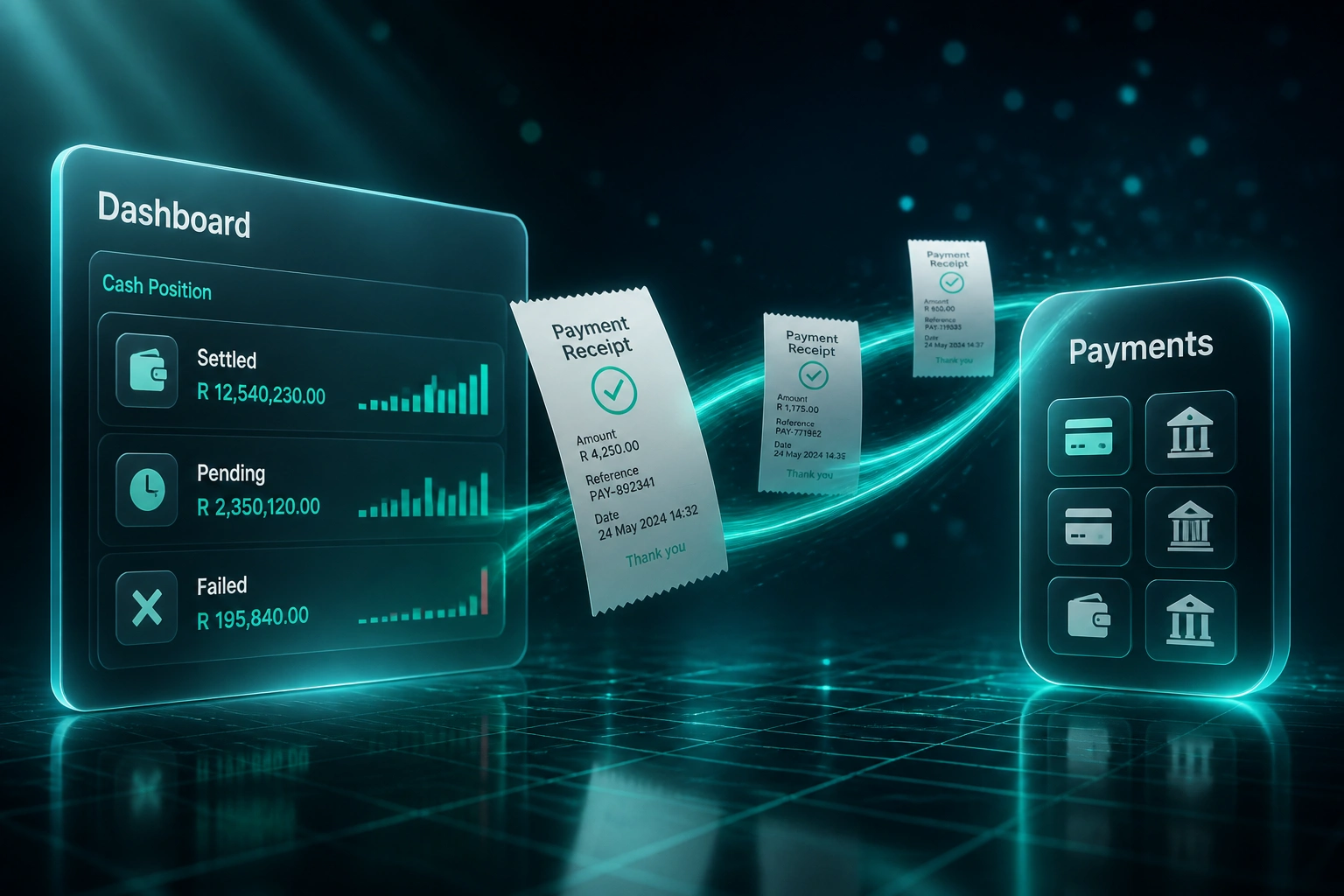
Providers settle → cash tiles update → exceptions surface → treasury decides. No morning portal tour.
Providers Push Activity
PayFast, Peach, Yoco, Ozow, Stitch, and Stripe report authorisations, settlements, and failures
Cash Tiles Normalise
Settled, pending, and failed volumes land in one vocabulary with settlement clocks attached
Exceptions Surface
Fee gaps, late settlements, and failed batches appear as a short list, not a full CSV rebuild
Treasury Acts Same Day
CFO and finance lead see live cash position and decide before the bank feed confirms it
Everything You Need for Real-Time Payment Analytics
Unified Cash Position
Settled, pending, and failed volumes from every gateway roll into one finance-facing view. Your CFO sees today's liquidity without opening five portals.
Settlement-Aware Totals
Totals respect each provider's settlement clock: T+1 Peach, T+2 Yoco, next-day Ozow, Stripe batches. Cash in transit is labelled as such, not mistaken for banked funds.
Live Provider Feed
PayFast, Peach, Yoco, Ozow, Stitch, Stripe, and Netcash push into the same dashboard. Add or swap a gateway without rebuilding the morning ritual.
Exception-First Review
Failed batches, fee mismatches, and settlement gaps surface as a short exception list. Analysts work exceptions, not full CSV exports.
Treasury-Ready Export
Push normalised cash tiles into Xero, Sage, or your treasury spreadsheet on a schedule. Month-end starts from a number the team already trusts.
Payment Analytics Layer
Volume by provider, failure rate, and funds in transit update through the day. Real-time payment analytics replace the end-of-day scramble.
Payment Providers We've Wired Into Cash Dashboards
From 72 Hours/Month to 14 Hours/Month
How a multi-gateway SA retailer stopped the five-portal morning ritual and recovered same-day cash visibility.
The Manual Cash Ritual
- Finance opened PayFast, Peach, Yoco, Ozow, and Stripe every morning
- Analysts exported CSVs and rebuilt cash position in a shared spreadsheet
- Settled vs pending vs failed was guessed from five reporting formats
- Month-end close waited on sequential reconciliations across providers
- Treasury buffered extra cash because the figure was never trusted until the bank landed
The Unified Dashboard
- One finance dashboard shows settled, pending, and failed across all five providers
- Settlement clocks keep funds in transit labelled correctly
- Analysts review a short exception list instead of rebuilding totals
- CFO opens one screen before the morning treasury call
- Close starts from a figure the team already trusts through the month
Before vs After a Unified Payment Dashboard
How It Works
From first conversation to live cash dashboard in 3–5 weeks.
Map Your Cash Blind Spots
Which providers you run, when settlement lands, and where finance still rebuilds cash position by hand.
Free Scoping Call
30-minute call to design the cash tiles, settlement rules, and who needs the live view each morning.
Build and Parallel-Test
We wire every gateway, run the dashboard beside your existing portal ritual, and prove the totals match before cutover.
Go Live and Monitor
Retire the five-tab morning routine. Alerts flag settlement drift so treasury acts before the bank feed surprises you.
Frequently Asked Questions
How long does a real-time payment dashboard take to build?
A focused dashboard covering three to five South African gateways typically takes 3 to 5 weeks from scoping to go-live. Broader setups that also push into Xero or Sage usually take 5 to 7 weeks.
How is this different from a payment status tracking API?
A status API answers whether a single payment is Pending, Paid, or Failed for portals and ops. A real-time payment dashboard answers the finance question: what is our cash position across every provider right now, including settlement-aware totals and funds in transit.
Will this replace our existing gateway portals?
No. Providers still settle and report as they always have. The dashboard sits above them so finance stops logging into five portals to reconstruct liquidity. Ops can still open a provider console when a dispute needs deep investigation.
Which payment providers can feed the dashboard?
We regularly connect PayFast, Peach Payments, Yoco, Ozow, Stitch, Stripe, and Netcash. If a provider exposes settlements, fees, and transaction state through an API or scheduled report, we can include it.
How do you handle different settlement times?
Each provider keeps its own settlement clock. The dashboard separates settled cash from pending and failed volumes, so a T+2 Yoco batch never looks like money already in the bank. That distinction is what makes the cash figure usable for treasury decisions.
How much does a real-time payment dashboard cost?
Dashboards covering three gateways with settlement-aware cash tiles start from around R35,000. Multi-provider setups with accounting export and alerting typically range from R55,000 to R95,000. Teams spending 60+ hours a month on multi-gateway cash prep usually see ROI within 2 to 3 months.
Stop Rebuilding Cash Position Across Five Portals
If your finance team still opens PayFast, Peach, Yoco, Ozow, and Stripe every morning to understand liquidity, you are paying for a problem a real-time payment dashboard already solves.
Tell us which providers you run, how settlement lands today, and who needs the live cash figure. We will show you exactly how a unified dashboard would work for your business.