Build a Reliable Webhook Queue for Payment Events
Payment providers fire webhooks that your systems sometimes miss or fail to process. Silent gaps mean paid customers without access, missing invoices, broken reconciliation, and angry support tickets.
We build the webhook retry queue with dead-letter handling so every payment event is processed or escalated.
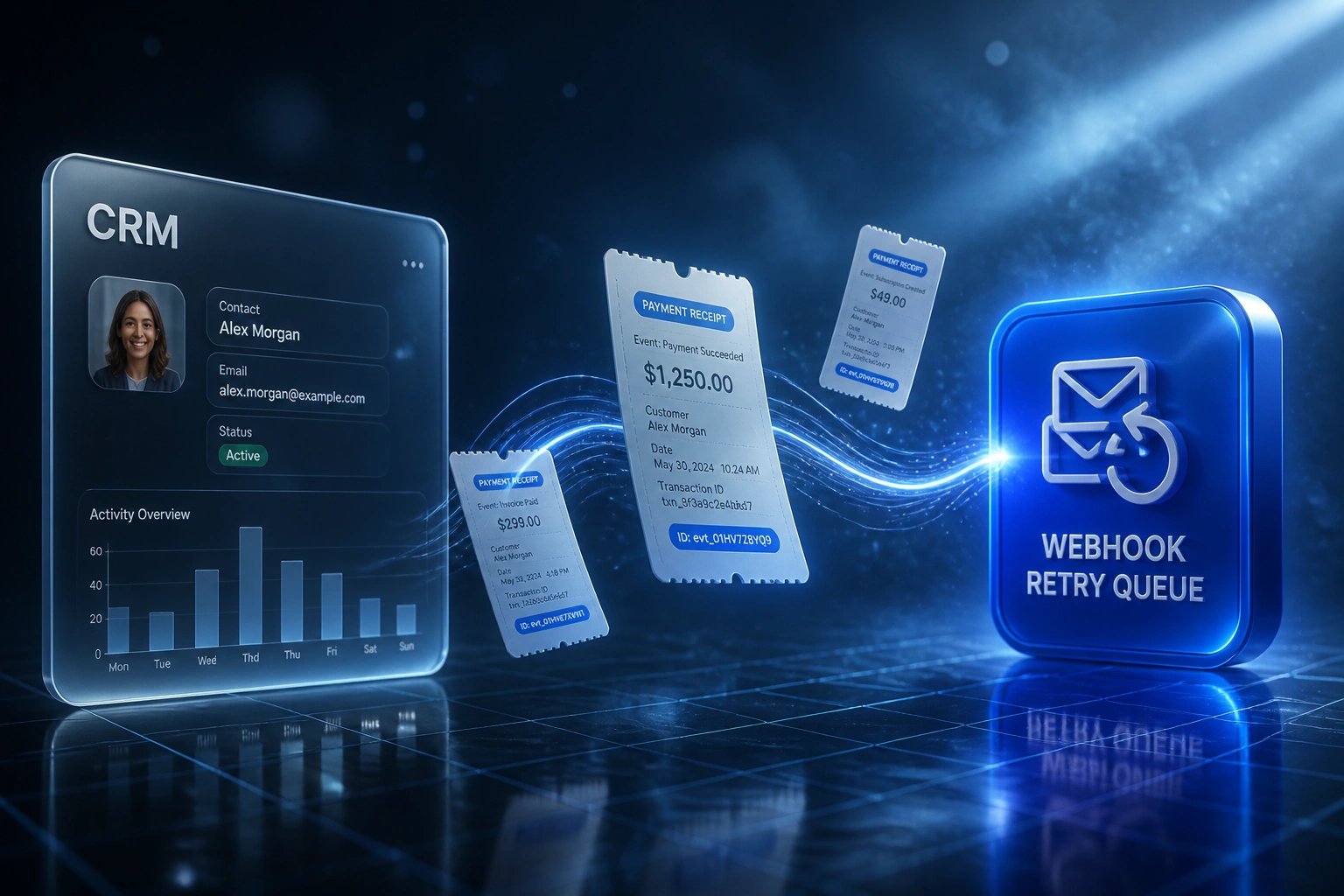
Sound Familiar?
These are the exact issues our clients faced before a durable webhook retry queue:
- A customer paid, but their account still shows unpaid and support only hears about it days later
- Subscription renewals succeed at the gateway while CRM and billing status never update
- Finance spends evenings matching gateway settlements to invoices after silent webhook gaps
- Debit-order and payment.succeeded events vanish after the provider stops retrying
- Nobody knows which payment events failed until month-end reconciliation blows up
After about three days of continuous failures, Stripe can automatically disable your webhook endpoint. New payment events stop arriving until someone notices and re-enables it. A short outage becomes a week of missing invoices, wrong subscription status, and angry customers.
What a Webhook Retry Queue Actually Does
Payment fires → event captured → status updated → exceptions escalated. No silent gaps.
Payment Event Arrives
Stripe, PayFast, or Netcash fires a payment or debit-order webhook to your system
Captured Into the Queue
The event is stored durably and acknowledged quickly, so a slow CRM update cannot drop it
Retried Until It Sticks
Invoice, deal, or subscription status updates with safe retries and no duplicate outcomes
Dead-Letter Escalation
Anything still stuck alerts ops for review, so payment gaps never vanish quietly
Everything You Need for a Reliable Webhook Queue
Durable Event Capture
Every inbound payment webhook is stored the moment it arrives, before CRM or accounting work runs. A brief outage cannot erase a paid event.
Automatic Retry Schedule
Failed updates retry on a safe schedule until the invoice, deal, or subscription status sticks. Temporary downtime stops being permanent data loss.
Exactly-Once Outcomes
Retries never double-invoice, double-fulfil, or double-allocate. Each payment event produces one business outcome, even when the provider sends it again.
Dead-Letter Escalation
Events that still cannot process after safe retries land in a dead-letter queue with an alert. Ops reviews the exception instead of discovering a silent gap weeks later.
Multi-Gateway Coverage
Stripe, PayFast, Netcash, Peach, Ozow, and Yoco payment events share one reliability layer. Ops sees one exception list, not five half-working inboxes.
Reconciliation Safety Net
A scheduled check compares gateway history to what you stored. Anything that never arrived is replayed before month-end, so status drift never compounds.
Payment Gateways We've Built Webhook Queues For
From 8 Hours/Week to 1 Hour/Week
How a 35-person B2B SaaS stopped losing payment events after deploys and closed silent gaps that left paid customers without access.
The Fragile Process
- Stripe and PayFast webhooks updated CRM and billing directly during busy deploys
- Failed deliveries only surfaced when customers emailed asking why access never unlocked
- Finance spent evenings matching gateway settlements to invoices after silent gaps
- One sustained outage window left a backlog of payment.succeeded events with no ops trail
- Month-end reconciliation turned into a scavenger hunt across three systems
The Reliable Process
- Every payment webhook is captured into a durable queue before CRM or ledger work runs
- Safe retries update subscription status and invoices without double-applying events
- Dead-letter alerts escalate stuck events for ops review the same day
- Scheduled reconciliation catches anything the provider never delivered
- Finance reviews exceptions instead of reconstructing history from scratch
Before vs After a Webhook Retry Queue
How It Works
From first conversation to a live webhook retry queue in 2–4 weeks.
Map Your Payment Events
Which gateways fire what, where CRM and ledger must update, and where silent gaps already hurt customers.
Free Scoping Call
30-minute call to design durable capture, retry, dead-letter, and escalation for your payment stack.
Build and Replay-Test
We build the webhook queue, replay real historical payment events, and prove nothing is lost or double-applied.
Go Live and Monitor
Cut over with dead-letter alerts and ongoing reconciliation so every payment event is processed or escalated.
Frequently Asked Questions
How long does a payment webhook retry queue take to set up?
A focused webhook queue for one primary gateway typically takes 2 to 4 weeks from scoping to go-live. Multi-gateway setups covering Stripe, PayFast, Netcash, and Peach with dead-letter handling and CRM or ledger sync usually take 4 to 6 weeks.
We already receive payment webhooks. Why do we still lose events?
Providers only retry for a limited window. Stripe retries failed deliveries for up to three days in live mode, then can disable the endpoint after sustained failures. PayPal retries up to 25 times over three days. If your system is down, overloaded, or returns errors across that window, payment events stop arriving and nobody gets an ops-ready trail.
How is a retry queue different from ordinary webhook handling?
Ordinary handlers try to update CRM or accounting while the provider waits. A durable webhook queue stores the payment event first, acknowledges quickly, then retries the business update on its own schedule. When retries are exhausted, the event escalates to a dead-letter queue instead of disappearing.
Will this disrupt checkout or existing billing?
No. Customers keep paying the same way. We harden how your systems ingest and recover payment events behind the scenes, run parallel validation on historical events, and only switch off fragile handlers once accuracy is proven.
What happens when a payment event still cannot be processed?
It lands in a dead-letter queue with an alert for ops or finance review. Nothing silent disappears. A scheduled reconciliation pass also catches events that never arrived within the provider retention window, so month-end stops being a scavenger hunt.
How much does a payment webhook retry queue cost?
Focused single-gateway webhook queues with dead-letter handling start from around R25,000. Multi-gateway layers with CRM and accounting sync, retries, and reconciliation typically range from R45,000 to R90,000. Most teams spending 6+ hours a week chasing payment-status gaps see ROI within 2 to 3 months.
Stop Losing Payment Events to Silent Failures
If paid customers still wait for access, invoices lag the gateway, or finance only finds mismatches at month-end, you are paying for a reliability problem that already has a proven fix.
Tell us which payment providers you use, where CRM and accounting must stay in lockstep, and where silent gaps already hurt. We will show you exactly how a webhook retry queue with dead-letter handling would work for your business.