Predictive Support: Detect Customer Issues Before They Escalate
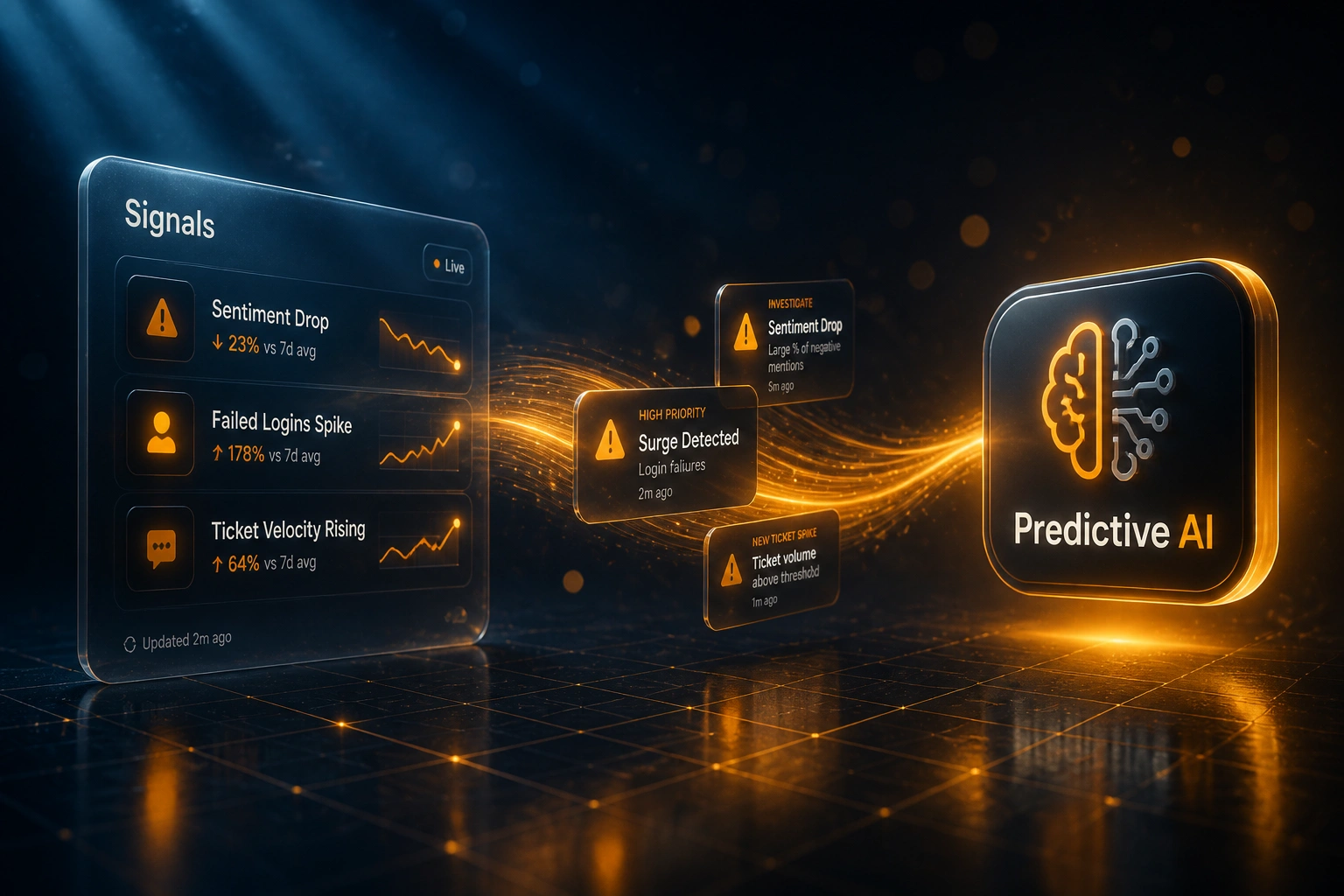
If your team waits for the ticket, you are already late. Early customer signals (failed logins, sentiment drops, ticket spikes, SLA breaches) appear days before the complaint. Without AI alerting, that window becomes firefighting, escalations, and churn prevention that starts too late.
We build the predictive support layer that spots frustration early and triggers proactive outreach.
Sound Familiar?
These are the exact issues Heads of CS and Support Directors bring us:
- Support only learns about a problem when the ticket (or the complaint) already arrives
- Failed logins, sentiment drops, and ticket spikes sit in separate tools with no AI alerting
- Escalations eat 3–5× the cost of a first-tier contact, and CSAT falls hard when they happen
- CSMs spend hours hunting customer signals instead of reaching out with proactive service
- By the time churn prevention starts, frustration has already turned into a cancellation risk
Escalation rates of 12–18% are still common across support operations, and each escalated contact costs several times a first-tier fix. Teams that only measure queue clearance keep funding firefighting instead of predictive support.
From Customer Signals to Proactive Outreach
Behaviour shifts → AI alerting → owner acts → escalation avoided. No waiting for the angry ticket.
Signals Appear
Failed logins spike, sentiment dips, ticket velocity rises, or an SLA is about to breach
AI Flags Risk
Predictive support scores the pattern and raises a high-confidence alert with context
Owner Reaches Out
CSM or support lead gets a playbook brief and contacts the customer the same day
Issue Defused
Frustration is handled before the complaint, cutting escalations and protecting retention
Everything You Need for Predictive Support
Early Warning Signal Detection
We wire product, support, and CRM events into one predictive support model: failed logins, ticket velocity, sentiment dips, SLA breaches, and usage drops.
AI Alerting Before the Complaint
When customer signals cross a threshold, the right CSM or support lead gets an alert with context, not a blank ticket after the customer has already escalated.
Proactive Outreach Playbooks
Signal → assigned owner → suggested message or call brief. Proactive service happens in hours, not after a week of firefighting.
Escalation Cost Controls
Route at-risk accounts to senior handlers before they hit tier-2 or tier-3 queues, where complaint handling costs 3–5× a first-tier contact.
Helpdesk and CRM Write-Back
Alerts, outreach notes, and outcomes land in Zendesk, Intercom, Freshdesk, HubSpot, or Salesforce so everyone sees the same story.
Churn Prevention Feedback Loop
Closed interventions feed the model. You see which signals actually predicted escalations, and which outreach saved the relationship.
Systems We've Wired for Predictive Support
From Firefighting Escalations to Same-Day Outreach
How a 45-person South African SaaS company cut escalations from 14% to 6% and recovered R890,000 in year one with predictive support.
The Reactive Process
- Support learned about friction only when the ticket or complaint arrived
- Login failures, NPS dips, and ticket spikes lived in three separate tools
- CSMs spent roughly a day a week hunting accounts that already felt ignored
- Average time from first warning sign to outreach: nine days
- Escalation rate stuck near 14%, with complaint handling draining senior capacity
The Predictive Process
- Customer signals feed a shared early-warning model every hour
- High-severity AI alerting assigns an owner with a proactive outreach brief
- Most at-risk accounts hear from CS within 48 hours of the first signal
- Escalations fell to 6%, and inbound ticket volume dropped 24%
- Senior agents spend less time on heated recoveries and more on retention work
Before vs After Predictive Support
How It Works
From first conversation to live predictive support in 3–6 weeks.
Map Your Signals
Which behaviours precede complaints today: login failures, sentiment, ticket spikes, SLA breaches, usage cliffs.
Free Scoping Call
30-minute call to rank signal sources, define alert thresholds, and design the proactive outreach path.
Build & Pilot
We connect your tools, tune AI alerting on historical escalations, and run a pilot with your CS leads for two weeks.
Go Live & Refine
Switch on live predictive support. Weekly reviews tighten thresholds so noise drops and true early warnings rise.
Frequently Asked Questions
How is predictive support different from churn prediction or a health score?
Churn models rank who is likely to leave. Health scores summarise account wellness for expansion and save playbooks. Predictive support watches early frustration signals (ticket spikes, sentiment drops, failed logins, SLA breaches) and triggers proactive outreach before a complaint or escalation lands. It is issue detection and intervention, not a churn list.
Which systems can feed the early warning model?
We typically pull from your helpdesk (Zendesk, Intercom, Freshdesk), CRM or Service Cloud, product analytics, login and auth logs, and CS platforms such as Gainsight. If the event has an API or warehouse table, we can use it as a customer signal.
Will this flood my team with false alarms?
No. We calibrate thresholds against your past escalations and complaints, start with a high-confidence pilot, and tune weekly. The goal is fewer, sharper AI alerts that a Support Director can act on, not a noisy dashboard nobody trusts.
How quickly does proactive outreach need to happen?
Research on at-risk intervention shows teams that respond within 48 hours see roughly a 34% higher save rate than those that wait a week. We design playbooks so high-severity signals reach an owner the same day, with templates ready for proactive service.
Will this disrupt our current support workflows?
No. Agents keep working in the same helpdesk and CRM. Predictive support adds early warnings and suggested outreach beside those tools. We run parallel for a pilot period before you treat alerts as operational SOP.
How much does predictive customer issue detection cost?
Focused signal-to-alert builds typically start around R25,000. Broader multi-source predictive support with playbooks and CRM write-back usually lands between R40,000 and R90,000. Most mid-size CS teams recover that within one to two quarters through fewer escalations and protected renewals.
Stop Waiting for the Ticket That Means You Are Late
If your CS and support teams still discover frustration after the customer complains, you are paying escalation premiums on problems that customer signals already revealed.
Tell us which helpdesk and product analytics you use, where early warnings hide today, and which accounts hurt most when they escalate. We will show you how predictive support and proactive service would work for your stack.