Product Catalogue Cleanup: Deduplicating and Normalising Your Item Data
Your quotes, invoices, and stock counts disagree because the same product lives as three SKUs with different names and units. SKU deduplication and item normalisation recover trustworthy pricing and inventory before you sync anything else.
We repair the messy catalogue itself, then hand you one clean master.
Sound Familiar?
These are the exact catalogue symptoms our distributor and retail clients brought us:
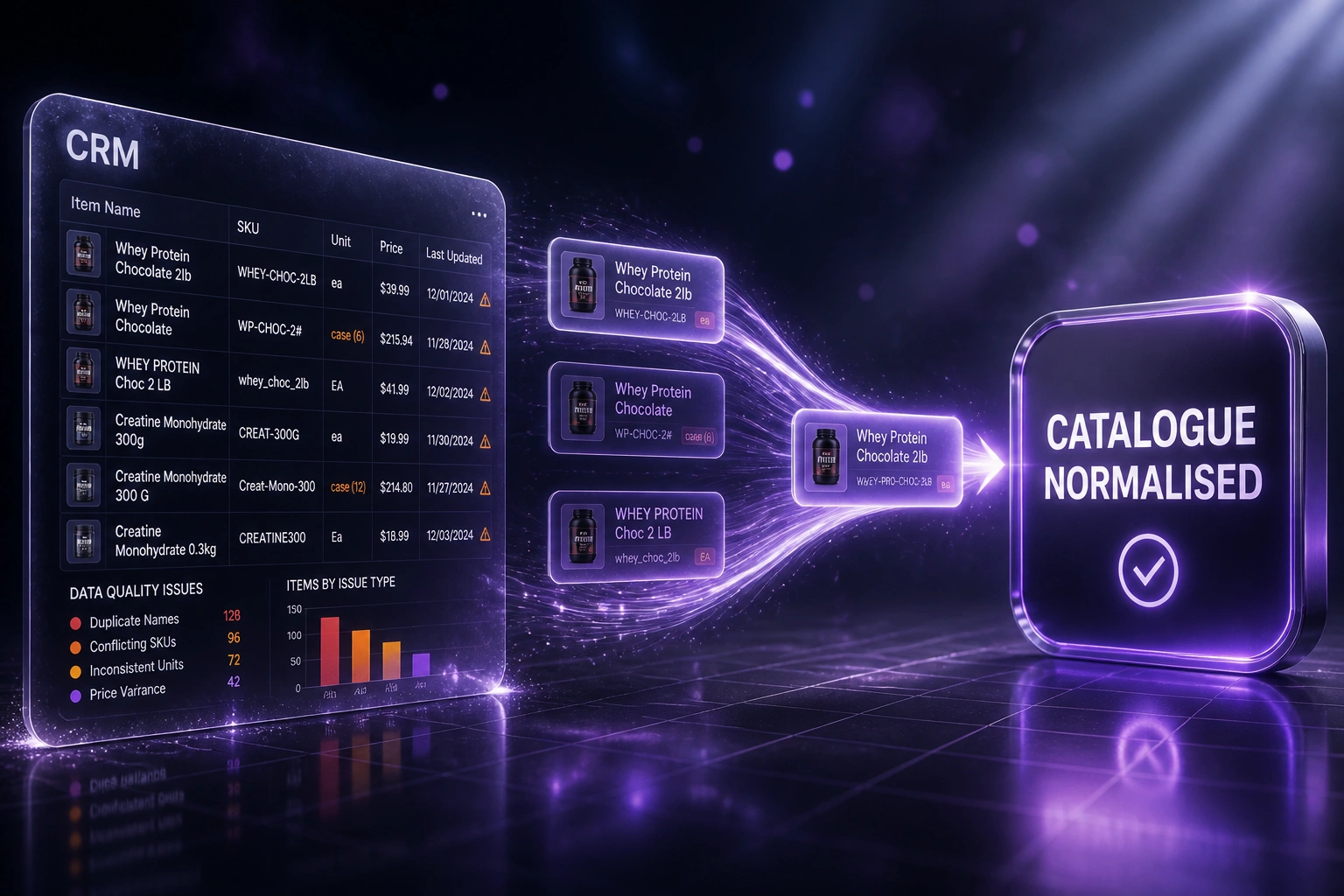
- The same product exists as three SKUs with different names, units, and list prices
- Quotes, invoices, and stock counts disagree because inventory is split across duplicates
- Sales and warehouse argue over which code is "the real" item when a customer reorders
- Marketplace and ecommerce listings get rejected for incomplete or conflicting attributes
- Ops spends days every month merging spreadsheets instead of fulfilling orders
Ecommerce expansion, ERP upgrades, and marketplace listing rules all demand a clean item master. Duplicate SKUs and incomplete attributes get rejected at the gate, and syncing dirty catalogues into a new channel only multiplies the damage.
What Catalogue Repair Actually Does
Profile the mess → cluster duplicates → normalise attributes → write one golden master.
Export Item Masters
Pull products from ERP, CRM, spreadsheets, and channel feeds into one profile
Cluster & Deduplicate
Near-match on barcode, MPN, name, and unit so true duplicates surface
Normalise Attributes
Names, units, prices, and tax codes reconciled into golden records
Write Clean Master
Aliases preserved, systems updated, quotes and stock finally agree
Everything You Need for Catalogue Repair
SKU Deduplication
We cluster near-matches by barcode, manufacturer part number, name similarity, and unit of measure, then merge each cluster into one canonical SKU.
Attribute Normalisation
Names, units, pack sizes, VAT treatments, and descriptions are standardised so every channel reads the same fields the same way.
Golden Record Build
Best attributes from every duplicate are survivorship-merged into one master item with reconciled cost, price, and identifiers.
Conflict Resolution Rules
When two records disagree on price or unit, explicit rules decide the winner and log the decision so finance and ops can audit later.
Alias & Legacy Mapping
Old SKUs stay as aliases so historical quotes, open orders, and warehouse labels still resolve to the new master without breaking fulfilment.
Clean Master Export
We write the normalised catalogue back to your ERP, CRM, ecommerce, or spreadsheet master, ready for ongoing sync or marketplace feeds.
Systems We've Cleaned Catalogues For
From 18,400 Messy SKUs to 14,100 Golden Records
How a Gauteng distributor stopped phantom stockouts and got quotes, invoices, and warehouse counts to agree.
The Fragmented Catalogue
- Same valve and case-pack items existed under three or four codes each
- Sales quoted ea while warehouse picked case, so stock looked short
- Finance invoices used a twin SKU with a stale list price
- Ops spent 14+ hours a week reconciling catalogue disputes
- Takealot and Shopify feeds kept failing attribute checks
The Normalised Master
- 3,200 duplicate clusters merged into one golden SKU each
- Units, names, VAT, and prices standardised across the master
- Legacy codes kept as aliases so open orders still fulfilled
- Quotes, invoices, and stock counts finally shared one truth
- Marketplace listings accepted on the first clean feed
Before vs After Catalogue Repair
How It Works
From first export to a clean live master in 3–6 weeks, depending on catalogue size.
Export & Profile
We pull your item master from ERP, CRM, and channel feeds, then score duplicate rate, missing attributes, and unit conflicts.
Free Scoping Call
30-minute call to agree survivorship rules, which system owns the master, and how aliases should behave after merge.
Deduplicate & Normalise
We cluster, merge, and normalise attributes, then review edge cases with your ops lead before anything goes live.
Write Back & Handover
Clean master loads into your systems with alias maps. Optional recurring cleanup catches new duplicates from supplier feeds.
Frequently Asked Questions
What is product catalogue cleanup and item normalisation?
It is a structured repair of your item master: finding duplicate SKUs, resolving conflicting names and attributes, and producing one golden record per real product. Sync tools then have a clean catalogue to keep aligned. Repair first; sync second.
How is this different from CRM-accounting catalogue sync?
Catalogue sync keeps two systems aligned over time. Catalogue repair fixes the messy data inside the master itself: three SKUs for one product, ea vs case confusion, and stale prices on twin records. Syncing dirty data just spreads the mess faster. We clean the catalogue, then sync if you need it.
Will merging SKUs break open quotes or warehouse labels?
No. We keep retired codes as aliases mapped to the golden SKU, so historical quotes, open orders, barcodes, and pick lists still resolve. Merges are reversible and logged so you can unwind a bad consolidation without data loss.
Which systems can you clean and write back to?
We routinely work with Xero, Sage, Pastel, QuickBooks, Shopify, WooCommerce, HubSpot, and custom or on-prem ERPs. If you can export an item list (or give API access), we can profile, repair, and write a clean master back.
Is this a one-off project or ongoing?
Most clients start with a one-time catalogue repair before an ecommerce launch, ERP upgrade, or marketplace listing push. Many then add a light recurring scan so new supplier feeds do not recreate duplicates. We scope both options on the call.
How much does product catalogue cleanup cost?
Focused deduplication and normalisation for a mid-size catalogue typically starts from around R25,000. Larger masters with multi-system write-back, alias mapping, and recurring scans usually range from R40,000 to R90,000. Payback often lands inside one to three months once phantom stockouts and catalogue firefighting stop.
Stop Quoting From a Broken Item Master
If the same product still exists as three SKUs, syncing systems will not save you. Catalogue repair recovers trustworthy pricing and stock first.
Tell us roughly how many SKUs you carry, which systems hold the item list, and where quotes and stock disagree most. We will show you what deduplication and normalisation would look like for your catalogue.