Product Listing Automation: One Catalogue, Every Channel
Your merchandising team spends hours copy-pasting SKUs into Shopify, Takealot, Amazon, and WooCommerce. Attributes drift, listings get rejected, and new products go live on one channel weeks before the others.
We build the catalogue sync that launches products everywhere in hours, not days.
Sound Familiar?
These are the exact issues our clients faced before catalogue sync:
- Ops copy-pastes titles, descriptions, and attributes into Shopify, then starts again for Takealot and Amazon
- New SKUs go live on one channel while marketplace loadsheets wait days for approval or rejection
- Inconsistent attributes and missing mandatory fields trigger listing rejections and silent suppressions
- Image sets, category trees, and variant options drift between channels after every catalogue update
- Seasonal launches miss the peak window because listing work still sits in a spreadsheet queue
Marketplace content rules keep tightening, and Takealot catalogue review alone can take 1–14 days (typically 3–5 business days). Seasonal windows drive 40–50% of annual volume for many categories. A listing stuck in rework is revenue you never get back.
What Product Listing Automation Actually Does
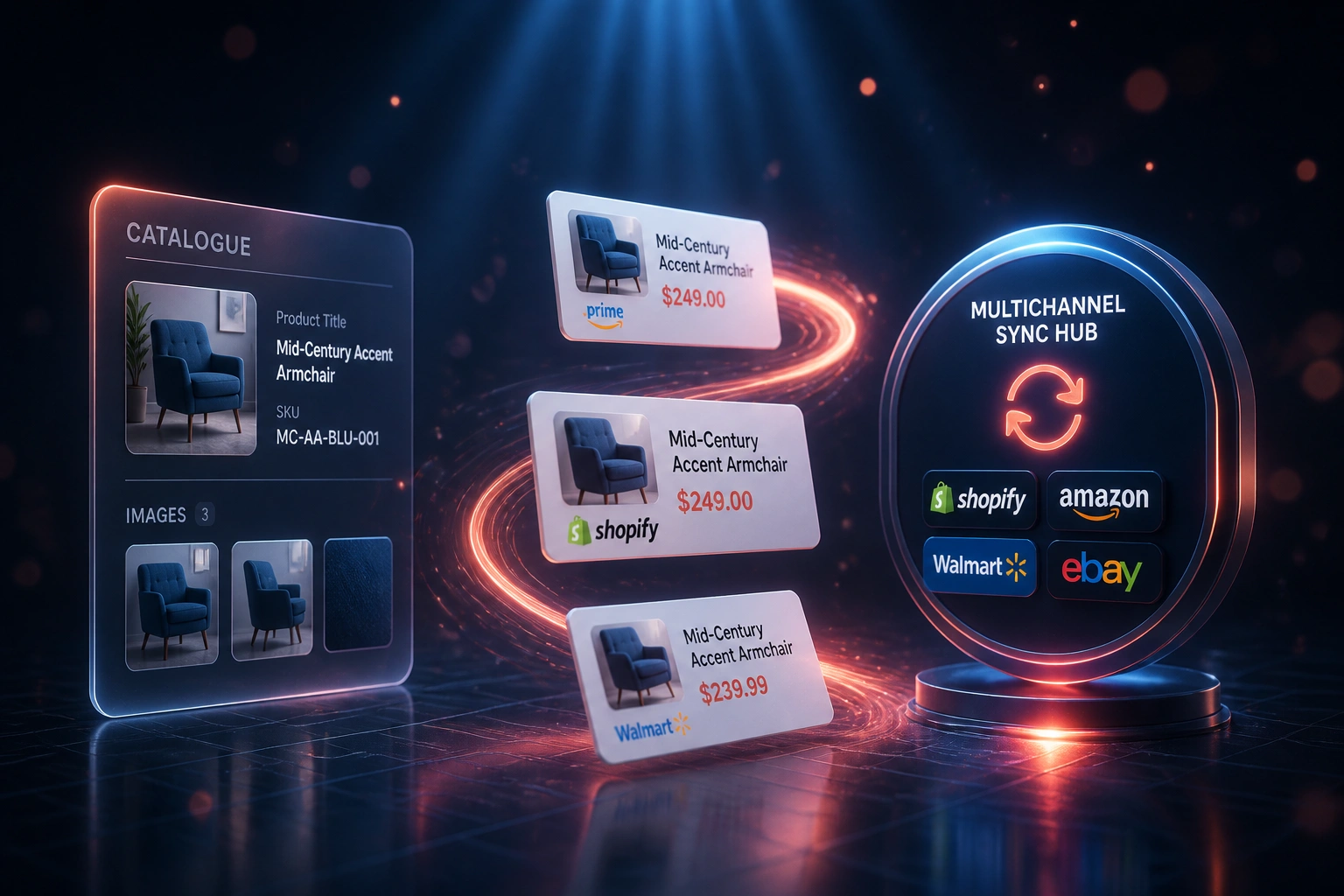
Master catalogue updates → channel-ready listings → create or update everywhere. No human retyping titles and attributes.
Product Ready in Master
Merchandising finalises title, images, attributes, and category in the catalogue or PIM
Channel Mapping Runs
Each marketplace receives the fields, image set, and taxonomy it expects
Listings Created or Updated
Shopify, Takealot, Amazon, WooCommerce, and more receive the same product truth
Errors Write Back
Rejections and missing fields return to the master so you fix once and republish
Everything You Need for Reliable Catalogue Sync
Master Catalogue Push
Titles, descriptions, images, attributes, and categories live in one source. Publish once and every connected channel receives a channel-ready listing.
Channel Field Mapping
Shopify metafields, Takealot loadsheet columns, Amazon browse-node attributes, and WooCommerce taxonomies map from the same master record without retyping.
Listing Create & Update
New products create listings everywhere. Description, image, or attribute changes flow out as updates so storefronts stay consistent.
Pre-Publish Validation
Required attributes, image rules, character limits, and category constraints are checked before push, so fewer listings bounce back rejected.
Variant & Bundle Handling
Size, colour, and kit variants keep a single parent SKU in the master while each channel receives the structure it expects.
Rejection Feedback Loop
Marketplace rejection reasons write back to the master record so merchandising fixes once and republishes cleanly.
Channels We've Connected for Catalogue Sync
From 12 Hours/Week to Under 2 Hours/Week
How a mid-size multichannel retailer stopped copy-pasting listings and cut new-SKU time-to-live from days to hours.
The Manual Process
- Merchandising built each SKU in Shopify, then rebuilt it for Takealot and Amazon
- Roughly 25 minutes per listing, multiplied by every channel that needed the same product
- Missing attributes and image rule breaks meant round-trips through marketplace review
- New ranges often live on the own-brand site a week before marketplaces caught up
- Ops spent evenings chasing which channel still had the old description
The Automated Process
- One master catalogue holds titles, images, attributes, and categories
- Publish once: Shopify, Takealot, and Amazon receive channel-mapped listings
- Pre-publish checks catch mandatory-field gaps before marketplace review
- New products launch across channels the same day the master is approved
- Rejection reasons write back so merchandising fixes once and republishes
Before vs After Multichannel Listing Automation
How It Works
From first conversation to live catalogue sync in 3–5 weeks.
Tell Us Your Catalogue
Where product masters live today, which channels you sell on, and where listing rejections hurt most.
Free Scoping Call
30-minute call to map attributes, images, category trees, and channel-specific validation rules.
Build & Test
We build the catalogue sync, push sample listings, and validate create and update flows before go-live.
Go Live & Monitor
Switch off multichannel copy-paste. Monitoring catches failed pushes and marketplace rejections early.
Frequently Asked Questions
How long does product listing automation take to set up?
A standard catalogue sync across three to five channels takes 3–5 weeks from scoping to go-live. Simple one-way listing pushes from a clean master can be live within two weeks. Complex setups with deep attribute mapping, variants, and marketplace validation take closer to 5–7 weeks.
Which sales channels can you push listings to?
We have built product listing automation for Shopify, Takealot Seller Portal, Amazon, WooCommerce, custom own-brand sites, eBay, and PIM or ERP catalogue sources. If a channel accepts product create and update via API or structured feed, we can syndicate to it.
Is this the same as inventory sync?
No. Inventory sync keeps stock quantities aligned. Product listing automation pushes catalogue content: titles, descriptions, images, attributes, categories, and variants. Most sellers eventually want both, and we can stage them so listings land first and stock fan-out follows.
How do you reduce Takealot and Amazon listing rejections?
We encode each channel's required attributes, image rules, and category constraints into pre-publish checks. Incomplete or non-compliant records never leave the master until merchandising fixes them. Rejection reasons that do come back update the master so the next push is clean.
Will this disrupt our current listing process?
No. We run parallel pushes while your team keeps the existing process as a safety net. Only after create and update accuracy is proven do we switch off manual multichannel entry. Seasonal calendars stay intact.
How much does product listing automation cost?
Simple one-way catalogue pushes start from around R20,000. Multichannel create-and-update sync with custom attribute mapping, validation, and rejection feedback typically ranges from R30,000 to R70,000. Teams listing 50+ new or updated SKUs a month usually recover the investment within 2–4 months from labour and faster launch windows alone.
Stop Copy-Pasting Product Listings Across Channels
If your team is still rebuilding the same SKU for Shopify, Takealot, and Amazon by hand, you are spending money on a problem that catalogue sync already solves.
Tell us where your product masters live, which channels you sell on, and where listing rejections or delayed launches hurt most. We will show you exactly how product listing automation would work for your catalogue.