RAG for Business Data: Build AI That Answers from Your Own Documents
Your policies, contracts, and SOPs already exist. Finding the right clause still means digging through SharePoint and email. Wrong-version decisions and ungrounded chatbot answers cost more than the search time alone.
We build retrieval-augmented generation so your team queries internal knowledge in natural language, with citations.
Sound Familiar?
These are the exact issues our clients faced before document RAG:
- Policy answers still live in SharePoint folders nobody can navigate
- Contract clauses get dug out of email threads and old PDF attachments
- Teams act on outdated SOP versions because search returns the wrong file
- Board packs and internal knowledge stay unsearchable when leaders need them fast
- Generic chatbots invent answers instead of citing your actual documents
Coveo's 2025 EX Relevance Report found employees waste about three hours a day searching for information, and 49% have seen AI hallucinations. Ungrounded chatbots on top of a broken document corpus multiply the risk. Retrieval-augmented generation with citations is how you keep answers tied to the files you actually approved.
What Document RAG Actually Does
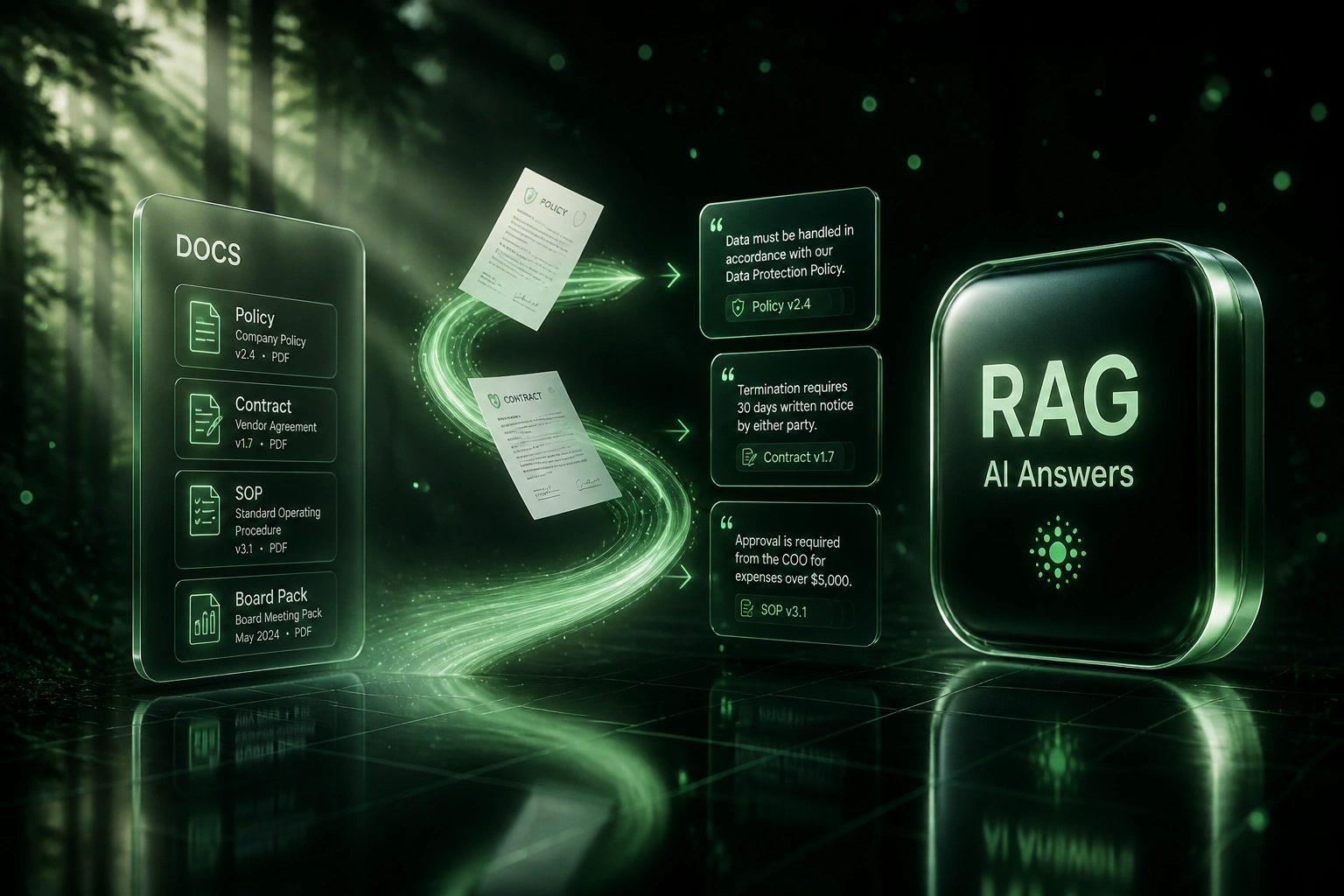
Question asked → relevant passages retrieved → cited answer returned. No folder archaeology.
Ask in Plain Language
Ops, HR, or compliance asks a question in Teams, Slack, or an intranet chat
Retrieve From Your Corpus
The system searches policies, contracts, SOPs, and board packs your team can access
Answer With Citations
A short answer appears with links to the source pages or clauses
Decide With Confidence
Your team verifies the citation, acts on current policy, and stops guessing
Everything You Need for Reliable Knowledge Retrieval
Natural Language Document Search
Ask "what is our leave notice period?" and get an answer grounded in your policies, contracts, and SOPs, not a folder hunt.
Cited, Grounded Answers
Every reply links back to the source page or clause. Your team verifies before they act, which cuts hallucination risk.
Live Index Over Your Corpus
We index SharePoint, Google Drive, OneDrive, Confluence, and file shares so retrieval-augmented generation stays current as documents change.
Permission-Aware Retrieval
Answers respect existing folder and group access. Finance sees contracts they own; the shop floor does not see board packs.
Policy and Contract Briefs
Generate a short brief before a decision: relevant clauses, effective dates, and owners, from a single question.
Teams, Slack, or Intranet Chat
Put knowledge retrieval where people already work. Ask from Microsoft Teams, Slack, or an internal portal.
Document Sources We've Connected
From 6 Hours/Week to 1 Hour/Week
How a 90-person South African professional services firm stopped SharePoint archaeology and cut wrong-policy decisions.
The Manual Process
- Ops and compliance dug through SharePoint libraries and email attachments for every policy question
- Average lookup took 35–45 minutes across folders, versions, and "final_v3" filenames
- Outdated SOP versions were used at least twice a quarter, triggering rework and risk reviews
- New joiners interrupted veterans for answers that already lived in documents
- Leadership hesitated to try chatbots after seeing invented policy wording
The RAG Process
- Ask in Teams → cited answer from the live policy or contract within about 90 seconds
- Every reply links to the source page so reviewers confirm before acting
- Wrong-version incidents dropped to zero in the first quarter after go-live
- Onboarding questions no longer interrupt the same three veterans
- Board-pack and SOP queries share the same grounded interface
Before vs After Document RAG
How It Works
From first conversation to live document RAG in 4–8 weeks.
Tell Us Your Corpus
Where policies, contracts, SOPs, and board packs live, and which questions burn the most time.
Free Scoping Call
30-minute call with your COO or knowledge lead to map sources, access rules, and success metrics.
Build & Test
We index your documents, tune answer quality on real questions, and run a parallel week against SharePoint search.
Go Live & Monitor
Roll out to ops and compliance teams. We monitor citation coverage, answer quality, and hours recovered.
Frequently Asked Questions
What is RAG over business documents, in plain language?
Retrieval-augmented generation (RAG) means the AI finds the relevant pages in your own document corpus first, then writes an answer from those pages. It does not guess from the open internet. For you, that means natural-language questions over policies, contracts, SOPs, and board packs, with links back to the source.
How is this different from SharePoint search or a generic chatbot?
SharePoint search returns a list of files. A generic chatbot often invents policy wording. Document RAG retrieves the right passages, then answers in plain language with citations. Your team stops scrolling folders and stops trusting ungrounded AI.
How is this different from CRM RAG or a help-centre knowledge base?
CRM RAG searches notes, deals, and emails. Help-centre search covers published articles for support. This page is about your internal document corpus: policies, contracts, SOPs, and board packs. Same technique, different source of truth.
Will answers invent clauses that are not in our documents?
We design for grounded answers: every claim links to a retrieved passage. When the system cannot find evidence, it says so instead of filling the gap. Sensitive decisions still get a human check against the cited source.
How long does a document RAG project take?
Most builds take 4–8 weeks from scoping to go-live: source access, indexing, permission mapping, answer quality tuning, and a parallel test week. Narrow pilots over policies and SOPs only can be live in about three weeks.
How much does RAG over business documents cost?
Pilots start from around R40,000. Production document RAG with permissions, Teams or Slack access, and ongoing indexing typically ranges from R60,000 to R120,000. Most ops teams of 10+ people recover the project cost within 2–4 months from search time alone.
Stop Digging Through SharePoint for Policy Answers
If your team still hunts folders for contracts and SOPs, or trusts chatbots that invent clauses, you are paying for a problem we already solve with retrieval-augmented generation.
Tell us where your documents live, which questions burn the most time, and who owns knowledge governance. We will show you how cited answers would work for your corpus.