RAG for Customer Support: AI Answers Grounded in Your Knowledge Base
Generic chatbots invent answers. RAG support retrieves approved articles from Confluence, Zendesk Guide, Notion, and product docs first, then generates grounded answers with citation trails, so customers get evidence, not improvisation.
We build the retrieval AI that answers only from what your team already approved.
Sound Familiar?
These are the exact issues support directors bring us before we replace inventing bots with retrieval AI:
- Generic chatbots invent policies and product steps that never appear in your knowledge base
- Agents spend evenings rewriting bot answers because customers were told the wrong thing
- Help articles live in Confluence, Zendesk Guide, Notion, and PDFs, but the bot never sees the latest version
- Customers ask "where did you get that from?" and the reply has no citation trail
- First-contact resolution stalls because low-confidence answers escalate late, after trust is already damaged
In April 2025, Cursor's AI support bot invented a single-device policy that did not exist, sparking cancellations and a public apology. Air Canada was already ordered in 2024 to honour a bereavement policy its chatbot invented. Meanwhile Zendesk and Intercom price AI by outcome (roughly R16–R33 per resolution). If your bot can invent policy, or per-resolution fees climb while knowledge stays stale, grounded RAG support with citations is the safer architecture.
What RAG Support Automation Actually Does
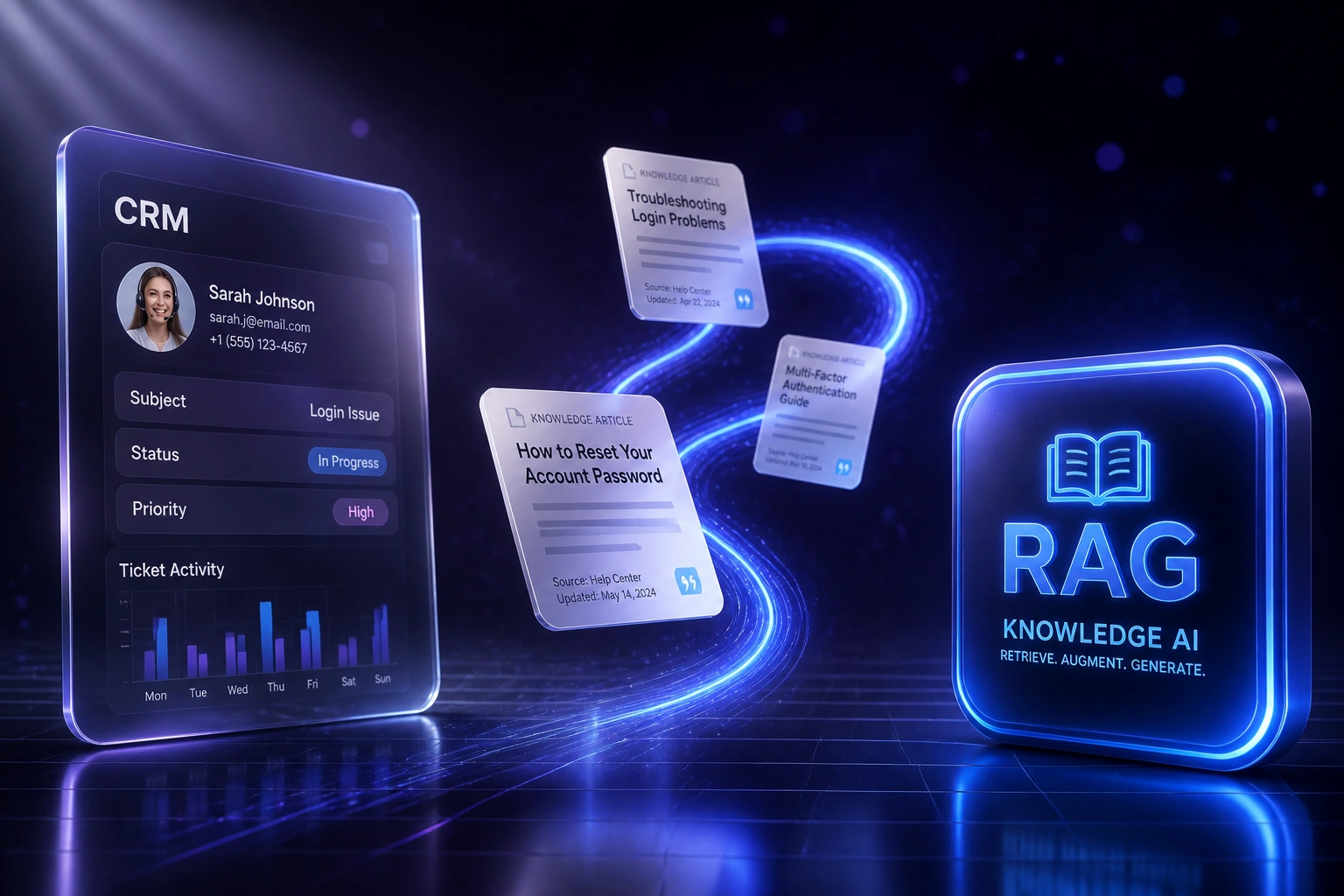
Question arrives → relevant articles retrieved → grounded answer with citations → escalate only when evidence is thin.
Customer Asks
Chat, email, or in-app help receives the question in natural language
Retrieve Evidence
Semantic search pulls the top matching articles from your live knowledge base
Grounded Answer
The model drafts only from retrieved passages and shows the citation trail
Escalate or Close
High confidence closes with sources; low confidence hands off with gap notes
Everything You Need for Knowledge Base AI That Stays Honest
Retrieval Before Generation
Every customer question first searches approved articles and docs. The model answers only from that evidence, so grounded answers replace free-form invention.
Citation Trails on Every Reply
Each answer links the help article, Confluence page, or PDF section it used. Support directors and customers can verify the source in one click.
Knowledge-Base Sync
When product docs change in Zendesk Guide, Notion, Confluence, or SharePoint, the retrieval index refreshes so support automation stays current without a retrain.
Confidence-Based Escalation
If retrieval scores are weak or sources conflict, the bot hands off to a human with the question, candidate articles, and gap notes. No confident hallucination.
Multi-Source Document Corpus
We index help centres, SOPs, release notes, and product PDFs into one retrieval layer so RAG support covers what agents already trust.
Grounded Deflection Analytics
Track citation coverage, retrieval hit rate, grounded deflection, and hallucination escalations so CX leads prove RAG support ROI monthly.
Knowledge Sources We've Indexed for Support
From 18% Inventing-Bot Deflection to 52% Grounded
How a Johannesburg SaaS support director cut hallucination complaints, lifted first-contact resolution, and recovered R1.8M in agent time in year one.
The Inventing Bot
- Six agents handling ~1,100 tickets a month in Zendesk for a B2B SaaS product
- Off-the-shelf LLM chatbot answered from general knowledge, not the help centre
- Useful deflection stuck near 18%; agents rewrote wrong answers daily
- No citations: customers and managers could not verify what the bot claimed
- Product docs updated in Confluence and Guide, but the bot never saw the changes
The RAG Knowledge Layer
- Retrieval over Confluence, Zendesk Guide, and release-note PDFs before every reply
- Every auto-answer shows the article titles and links used as evidence
- Low-confidence questions escalate with candidate sources and a gap note for authors
- Knowledge-base sync refreshes the index when Guide or Confluence pages change
- Agents focus on complex cases; Tier-1 FAQs close with grounded answers overnight
Before vs After Grounded Answers
How It Works
From first conversation to live grounded answers in 4–8 weeks.
Tell Us Your Setup
Where the knowledge lives, ticket volume, hallucination pain points, and which helpdesk agents work in today.
Free Scoping Call
30-minute call with your support director or CX lead to map sources, citation rules, and escalation thresholds.
Build & Test
We index the corpus, wire RAG into chat or email, and shadow live questions for a week against human gold answers.
Go Live & Monitor
Switch on grounded answers with citations. Dashboards track retrieval quality, deflection, and knowledge gaps.
Frequently Asked Questions
How is RAG for customer support different from a normal AI chatbot?
A generic chatbot generates fluent text from the model's training data and can invent policy. RAG support retrieves relevant articles from your knowledge base first, then generates answers only from that evidence, with citations. The architecture is built to reduce hallucination and keep answers current when docs change.
What deflection rates should we expect from RAG versus FAQ bots?
Industry benchmarks put well-tuned LLM-with-RAG support bots in the 40–65% deflection range, versus roughly 15–30% for rule-based FAQ bots (Chatbotscape, 2026). We measure grounded containment with CSAT, not customers who gave up without escalating.
Which knowledge sources can you connect?
We routinely index Zendesk Guide, Confluence, Notion, SharePoint, Google Drive, Helpjuice, and product PDF packs. If agents already trust a source, we bring it into the retrieval layer with sync so updates flow through without a full rebuild.
What happens when the bot is not confident?
Low retrieval scores, conflicting articles, or out-of-scope questions escalate to a human with the transcript, candidate sources, and a short gap note. That is how we keep grounded answers honest instead of inventing a reply to protect a deflection metric.
How long does a RAG-powered support AI take to launch?
Most RAG support builds take 4–8 weeks from scoping to go-live: corpus audit, indexing, citation UX, helpdesk write-back, confidence thresholds, and a parallel shadow week. Narrow FAQ coverage on a clean Zendesk Guide can be live faster; multi-source Confluence-plus-PDF corpora take longer.
How much does RAG-powered customer support cost?
Custom RAG support with knowledge-base sync and citations typically ranges from R45,000 to R95,000 depending on source count and channels. SaaS human tickets often cost R410–R570 each; Zendesk and Intercom outcome AI fees run about R16–R33 per resolution. Teams clearing a few hundred tickets a month usually recover the build within a few months once grounded deflection replaces inventing bots and per-resolution SaaS fees.
Stop Letting Support Bots Invent Policy
If your customers are getting fluent answers that never appear in the knowledge base, you are paying for risk, not support automation.
Tell us where the approved articles live, what the bot gets wrong today, and how tickets enter Zendesk or Intercom. We will show you how RAG support with citations and knowledge-base sync would work for your CX team.