Returns Processing Automation: From RMA Request to Restock
Manual returns handling is slow and frustrating for customers. Agents dig through inboxes for return requests while refund processing lags and sellable stock sits in a tote. Automated RMA workflows speed up refunds, exchanges, and restocking.
We build the RMA workflow that requests, labels, refunds, and restocks without the ticket pile.
Sound Familiar?
These are the exact issues ecommerce ops and CX leads faced before returns automation:
- Customers email "how do I return this?" and agents look up orders, write RMAs, and reply by hand
- Refunds sit in a queue for a week while stock sits in a returns tote waiting for inspection
- Courier return labels are created one at a time in a separate portal, then pasted into tickets
- Exchanges need a second order built manually, so sellable stock stays offline longer than it should
- "Where's my refund?" tickets pile up every Monday after Black Friday and festive peaks
Peak-season return waves and SA consumer rights stack at the same time. IMM Graduate School data shows returned goods during peaks can occupy up to 20% of warehouse capacity in apparel and footwear. Online shoppers also expect a clear ECT Act seven-day cooling-off path and CPA defective-goods handling. Manual RMA queues buckle exactly when volume and compliance pressure peak.
What the RMA Workflow Actually Does
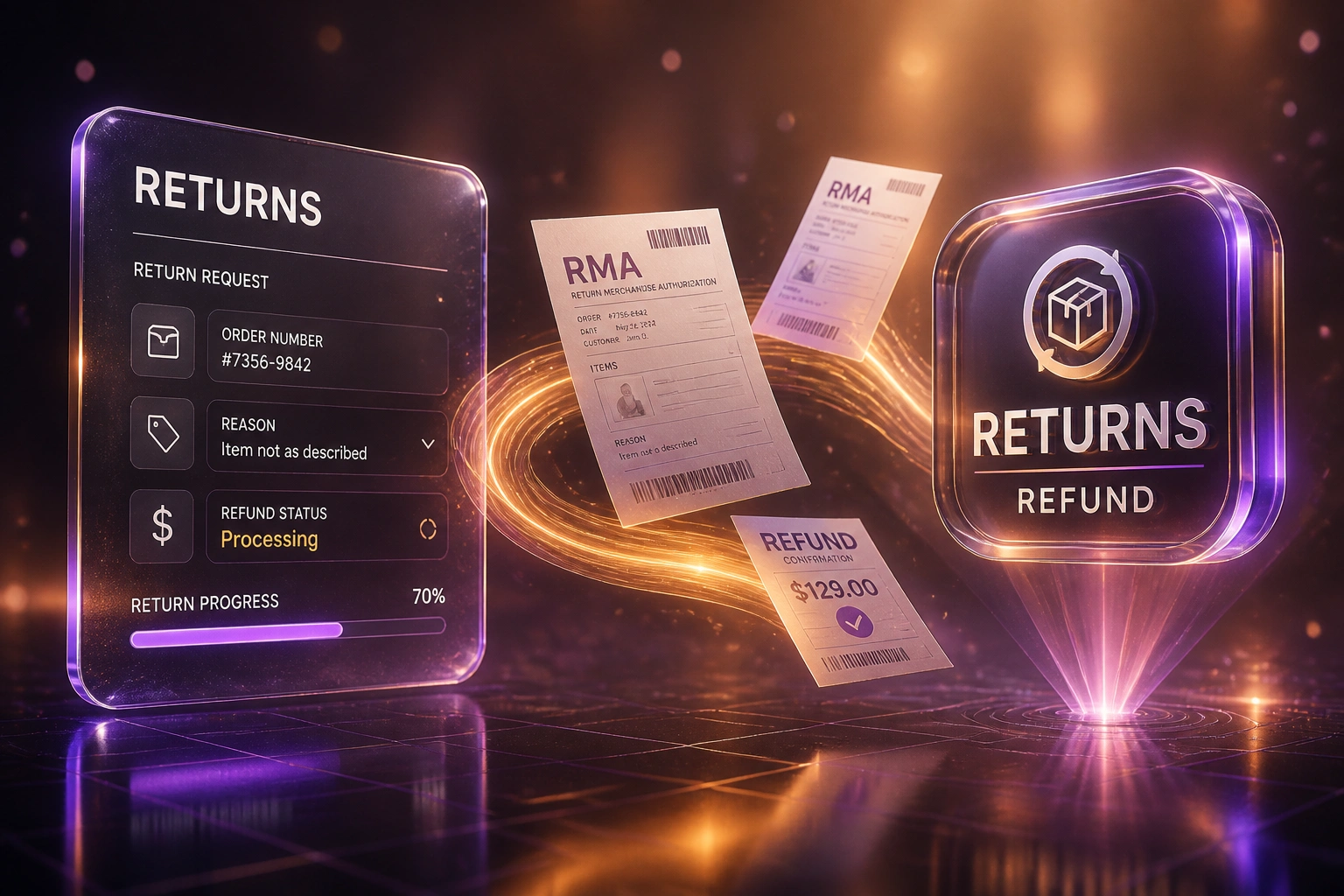
Return requested → approved → labelled → refunded or exchanged → restocked. No inbox between steps.
Return Requested
Customer opens an RMA in a self-service portal tied to their Shopify or WooCommerce order
Approved & Labelled
Rules approve eligible returns; a courier return label generates and reaches the customer automatically
Refund or Exchange
On receipt (or at approval), refunds push to the payment gateway; exchanges reserve replacement stock
Restocked
Inspected units write back as sellable or quarantine stock, so inventory recovers without a spreadsheet
Everything You Need for Automated Returns and Refund Processing
Self-Service Return Portal
Customers start an RMA from a branded portal: order lookup, reason codes, and photo upload. No email thread to open the case.
Automated Approval Rules
Window, condition, and reason rules approve eligible returns instantly and flag edge cases for a human review queue.
Courier Return Labels
Approved RMAs trigger a return waybill from The Courier Guy, Aramex, Pargo, or your carrier API, then email the label to the customer.
Refund & Exchange Processing
On receipt or at approval (your choice), refunds push to PayFast, Stripe, or Shopify Payments. Exchanges reserve replacement stock automatically.
Warehouse Restock Sync
Inspected units write back as sellable, quarantine, or write-off in Shopify, WooCommerce, or your WMS so inventory recovers fast.
Status Updates & Ticket Deflection
Each RMA stage emails or WhatsApps the customer. "Where's my refund?" volume drops because status is proactive, not reactive.
Systems We've Wired Into Returns Workflows
From 11 Days to 3 on Refund Cycle Time
How a Cape Town apparel brand cut "where's my refund" tickets by 70% and got returned stock sellable again in days, not weeks.
The Manual Process
- CX opened every return from email or WhatsApp and typed an RMA by hand
- Average 11 days from return request to refund landing in the customer's account
- Courier return labels created one-by-one in a separate portal
- Returned totes sat uninspected while "where's my refund?" tickets stacked up
- Exchanges meant building a second order manually in Shopify
The Automated Process
- Customers start RMAs in a branded portal with reason codes and photos
- Eligible returns auto-approve; courier labels email within minutes
- Refunds push to PayFast or Shopify Payments on warehouse receipt
- Inspected units restock as sellable or quarantine without a spreadsheet
- "Where's my refund?" tickets fell about 70% within the first peak cycle
Before vs After Returns Automation
How It Works
From first conversation to live RMA workflow in 3–5 weeks.
Map Your Returns Flow
How RMAs start today, which tools issue labels and refunds, and where tickets and restock delays hurt most.
Free Scoping Call
30-minute call to design approval rules, label handoff, refund timing, exchange logic, and warehouse restock.
Build & Test
We build the RMA workflow, test against live returns, and run parallel so CX can compare before cutover.
Go Live & Monitor
Switch off manual RMA tickets. Dashboards track cycle time, ticket volume, restock speed, and refund accuracy.
Frequently Asked Questions
How long does returns processing automation take to set up?
A standard Shopify or WooCommerce RMA portal with courier labels and automated refunds takes 3–5 weeks from scoping to go-live. A portal-only flow with manual refund approval can be live in about two weeks. Multi-channel Takealot plus custom WMS restock and exchange logic takes closer to 5–7 weeks.
How is this different from order fulfilment automation?
Fulfilment automation runs outbound pick, pack, and ship. Returns processing automation runs the inbound RMA workflow: request, approve, return label, refund or exchange, and restock. Many brands eventually need both; they solve opposite halves of the same order lifecycle.
Which platforms and carriers can we connect?
We have connected Shopify, WooCommerce, Takealot seller orders, PayFast, Stripe, Shopify Payments, The Courier Guy, Aramex South Africa, Pargo, and custom WMS or warehouse tools. If a system exposes orders, refunds, labels, or stock movements, we can include it.
Will automation disrupt CX while we roll it out?
No. We run parallel so agents can see portal RMAs beside the old email process before cutover. Go-live is usually mid-week outside a promo peak, with CX leads trained on the exception queue first.
How do you handle South African cooling-off and CPA returns?
Approval rules encode your ECT Act seven-day cooling-off window and CPA defective-goods paths separately from goodwill policy returns. POPIA-aware handling keeps customer data in the systems you already trust, with clear status history for disputes.
How much does returns processing automation cost?
A self-service portal with approval rules and refund sync starts from around R35,000. Full RMA automation with courier labels, exchanges, and warehouse restock typically ranges from R45,000 to R85,000. Brands processing a few hundred returns a month often see ROI within 2–4 months from labour hours, ticket deflection, and faster restock alone.
Stop Running Returns From an Inbox
If your CX team still opens every RMA by hand and refunds lag a week behind, you are spending ticket hours and customer goodwill on a problem that already has a proven fix.
Tell us how returns start today, which couriers and payment gateways you use, and where refund delays and restock bottlenecks hurt most. We will show you exactly how an automated RMA workflow would run for your brand.