Time Tracking Compliance with SA BCEA: Audit-Ready Labour Law Records
If overtime and hours still live in spreadsheets, you already know the risk: BCEA non-compliance fines, Department of Employment and Labour inspections you cannot answer, and CCMA disputes you lose because the records are incomplete. HR directors and business owners across South Africa feel that as legal liability, not admin inconvenience.
We build the BCEA-aware time tracking that turns that liability into evidence.
Sound Familiar?
These are the exact issues our clients faced before BCEA time tracking compliance:
- Ordinary hours, overtime, and Sunday premiums live in Excel with no single source of truth
- Nobody can prove whether staff stayed inside the 45-hour ordinary week or the 10-hour OT cap
- Public-holiday and Sunday double-time rates are applied inconsistently, or missed entirely
- Department of Employment and Labour inspectors ask for attendance registers first, and yours are incomplete
- CCMA overtime claims turn into back-pay awards because missing records leave you unable to prove the hours
Labour inspectors may enter without warrant or prior notice, and attendance registers are routinely the first document requested. Underpayment attracts Schedule 2 fines of 25% to 200% of the amount due, plus interest. Spreadsheet timesheets are now an enforcement and CCMA risk, not just an HR chore.
What BCEA Time Tracking Compliance Actually Does
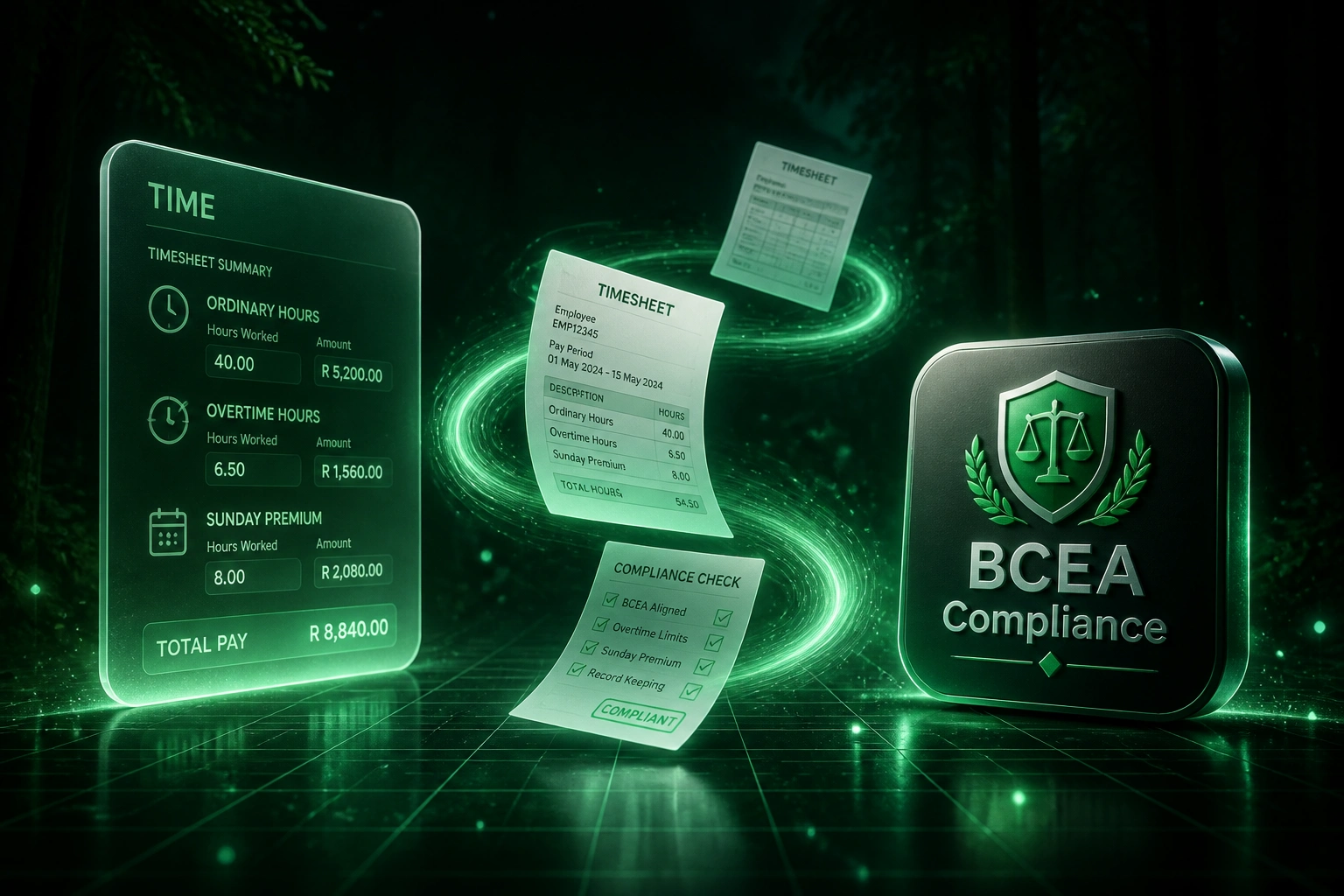
Hours clock → BCEA rules apply → Section 31 ledger updates → inspection pack ready.
Hours Captured
Clock-in, biometric, or app punches land as ordinary, overtime, Sunday, and holiday hours
BCEA Rules Applied
45-hour ordinary week, 10-hour OT cap, 1.5× and double-time premiums matched automatically
Section 31 Ledger
Name, occupation, time worked, and pay retained for three years from the last entry
Audit Pack Ready
DoL inspection or CCMA claim? Export the labour law time records in one click
Everything You Need for South Africa Time Tracking Compliance
BCEA Hours Caps Encoded
Ordinary hours capped at 45 per week, overtime at 10 hours per week, and the 12-hour daily ceiling enforced before payroll locks.
Sunday and Public Holiday Premiums
Double-time where Sunday is not an ordinary day, 1.5× where it is, and double for public-holiday work. Applied from the clock, not by memory.
Section 31 Record Ledger
Name, occupation, time worked, and remuneration retained for three years from the last entry, ready for an unannounced inspection.
Inspection-Ready Export Packs
One-click packs for labour inspectors: attendance registers, OT authorisations, Sunday and holiday hours, and payslip reconciliation.
Earnings Threshold Awareness
Working-time rules apply below the BCEA earnings threshold (R269,600.90 from 1 May 2026). Above-threshold staff are flagged so you do not over- or under-apply Chapter 2.
CCMA Dispute Evidence
When a wage or overtime claim arrives, you export the clock source, rate applied, and approval trail instead of reconstructing three years of spreadsheets.
Platforms We've Connected for BCEA Compliance
From 11 Hours/Week to 2 Hours/Week
How a 95-person Gauteng manufacturer replaced spreadsheet timesheets with BCEA-aware tracking, closed a DoL inspection gap, and cut CCMA overtime exposure.
The Manual Process
- Supervisors emailed Excel timesheets; HR re-keyed ordinary and OT hours into payroll
- Sunday and public-holiday premiums applied inconsistently across three shifts
- Nobody could show whether the 10-hour weekly OT cap had been breached
- Two years of attendance registers incomplete when a labour query arrived
- One CCMA overtime referral settled with back-pay because records could not prove hours
The Automated Process
- Clock punches feed BCEA caps and premiums before payroll locks
- Section 31 ledger retains name, occupation, hours, and pay for three years
- Sunday and holiday double-time applied from the calendar, not by memory
- Inspection pack exported in minutes when DoL requested attendance registers
- CCMA claims answered with clock source, rate applied, and approval trail
Before vs After BCEA Time Tracking Compliance
How It Works
From first conversation to live BCEA compliance tracking in 2–4 weeks.
Tell Us Your Setup
How you capture hours today, where BCEA risk sits, and what a labour inspector would find if they arrived tomorrow.
Free Scoping Call
30-minute call to map clock → BCEA rules → Section 31 ledger → inspection export for your sites.
Build & Test
We encode BCEA limits and premiums, wire the three-year ledger, and run parallel against your spreadsheets for two pay cycles.
Go Live & Monitor
Switch off spreadsheet timesheets. Monitoring keeps cap breaches and missing records visible before every cut-off.
Frequently Asked Questions
How is this different from overtime calculation or OT rules automation?
Overtime calculation applies 1.5× and 2× maths to approved hours. OT rules engines flag threshold breaches for manager review. This build is the compliance layer around both: statutory ordinary-hours and overtime caps, Sunday and public-holiday premiums, Section 31 three-year record-keeping, and inspection-ready exports for the Department of Employment and Labour and the CCMA. Most SA employers need the full stack.
What BCEA time tracking rules do you encode?
We encode the 45-hour ordinary week, daily ordinary limits (nine hours on a five-day week, eight on a longer week), the 10-hour weekly overtime cap, the 12-hour daily ceiling, overtime at one and one-half times the ordinary wage, Sunday and public-holiday premiums, and Section 31 record fields with three-year retention from the last entry.
How long does BCEA time tracking compliance take to set up?
A standard build with clock capture, BCEA rule packs, and Section 31 ledgers takes 2–4 weeks from scoping to go-live. Single-site employers with clean punch data can be live in about two weeks. Multi-site builds with bargaining-council overlays and custom inspection packs typically take 4–6 weeks.
What happens when a labour inspector arrives?
You export a Section 31 pack showing each employee's name, occupation, time worked (ordinary and overtime separated), remuneration, Sunday and public-holiday hours, and retention covering the requested period. That is what inspectors ask for first under the BCEA, instead of a folder of incomplete spreadsheets.
Does this help if we face a CCMA overtime claim?
Yes. In wage and overtime disputes the employer bears the onus of proving hours worked. Incomplete or missing attendance registers are routinely treated against the employer. An automated ledger with clock source, rate applied, and approval trail is the evidence that turns a liability into a defensible record.
How much does BCEA time tracking compliance cost?
Focused Section 31 compliance builds with BCEA caps, premiums, and inspection exports start from around R25,000. Multi-site builds with threshold splits, bargaining-council overlays, and CCMA evidence packs typically range from R40,000 to R70,000. Most clients recovering admin time and reducing fine and back-pay exposure see ROI within two to three months.
Stop Gambling with Spreadsheet Time Records
If a labour inspector or CCMA commissioner asked for three years of hours tomorrow, would your Excel files hold up? That is the question BCEA compliance answers before the knock on the door.
Tell us how you capture hours today, which payroll you use, and where inspection or dispute risk hurts most. We will show you exactly how BCEA-aware time tracking would work for your business.