SA Customs Tariff Code Repair: Correcting HS Codes for Import and Export
Wrong or outdated HS codes in your ERP, WMS, and product catalogue drive SARS queries, duty disputes, and port storage while brokers reclassify the same SKUs every shipment. Spreadsheet patches never keep customs tariff data current.
We validate against SARS customs schedules and repair the master once, so clearance stops paying for the same HS code mistakes.
Sound Familiar?
These are the exact issues import/export leads and CFOs bring us before customs tariff cleanup:
- Clearance stalls while brokers reclassify the same SKUs that already sat in your ERP last month
- Outdated HS codes in the product master still drive duty rates after SARS tariff schedule amendments
- Duty underpayments surface on post-clearance audit, with VAT, interest, and penalties stacked on top
- Port storage clocks run at R500–R2,000 a day while SARS queries a wrong tariff heading
- Ops and finance pay for the same HS code consultation on every shipment instead of fixing the master once
Wrong HS classification is the most common cause of customs delays and penalties in South Africa. SARS can recover underpaid duty and VAT with interest; recent High Court matters have seen multi-million Rand demands (one hardware importer faced about R3.6 million in underpaid duty, VAT, interest, and a 10% VAT penalty). Gazette tariff amendments keep landing (including AfCFTA phase-downs from 1 January 2025). Clean the product master before the next bill of entry cycle.
What SA Customs Tariff Cleanup and HS Code Repair Actually Does
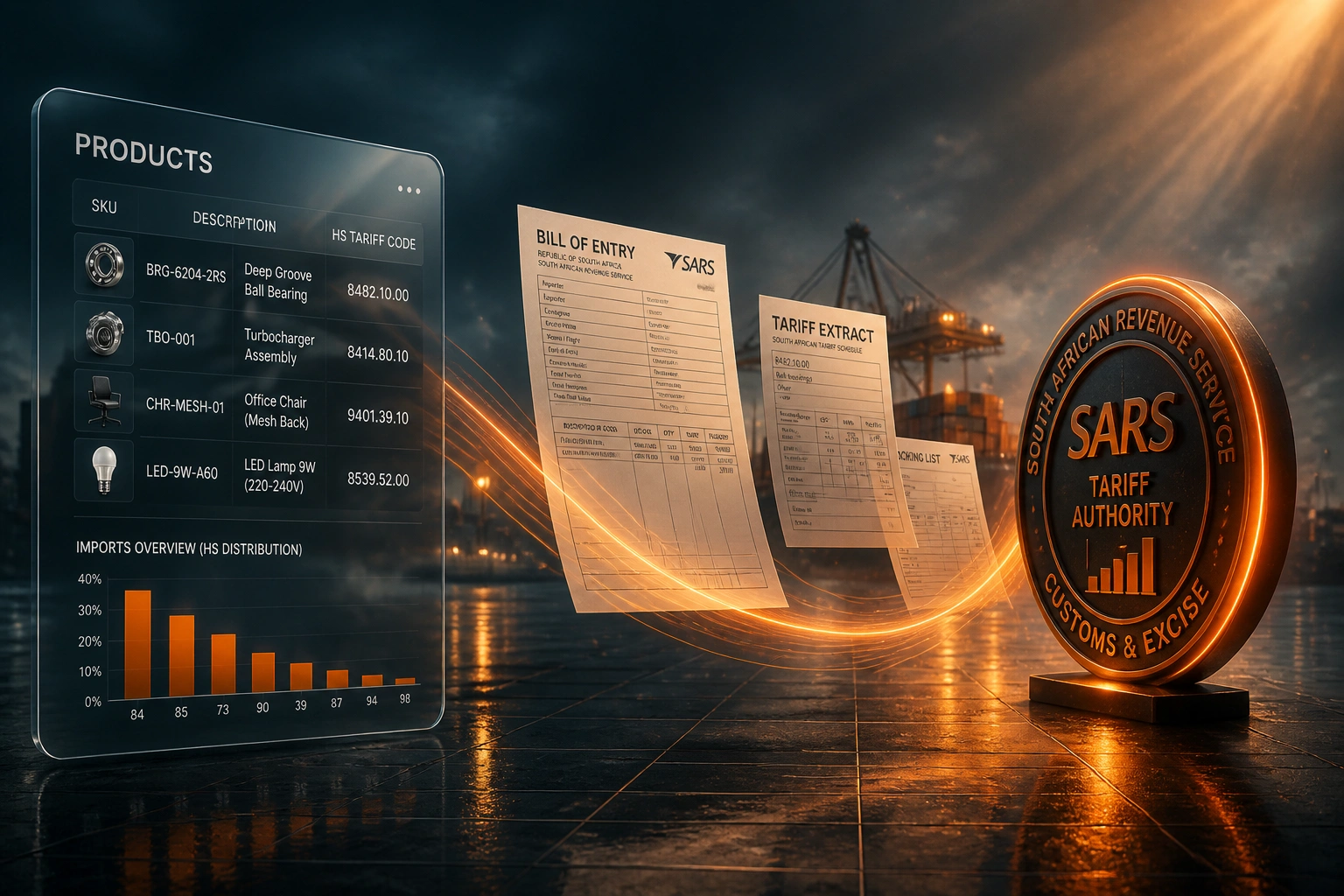
Extract HS fields → validate against SARS schedules → repair safe matches → write clean codes back.
Extract Product HS Fields
We pull SKU, description, and tariff codes from ERP, WMS, PIM, or shipping exports
Validate Against SARS Schedules
Codes checked against current tariff book headings, duty bands, and known obsolete lines
Repair & Quarantine
Safe corrections applied automatically; ambiguous or contested headings flagged for review
Clean Codes in Production
Corrected HS data writes back so declarations, packing lists, and duty calcs stop drifting
Everything You Need for Reliable Customs Tariff Cleanup
SARS Schedule Validation
Every HS field is checked against current South African tariff schedules. Obsolete headings, truncated codes, and schedule gaps are flagged before the next bill of entry.
Product Master Repair
Safe corrections write back to ERP, WMS, and catalogue HS fields. Ambiguous classifications quarantine with a reason code for logistics or customs review.
Shipping Data Alignment
Packing lists, commercial invoices, and declaration extracts inherit the corrected tariff codes so brokers stop inventing a new heading per shipment.
Duty Risk Flagging
Where competing headings imply different duty bands, anti-dumping exposure, or permit needs, we surface the conflict before cargo hits the quay.
Exception Quarantine
Unresolvable rows stay visible with the schedule mismatch. Your team only reviews what cannot be corrected safely from the published tariff book.
Ongoing Schedule Gate
Optional point-of-entry checks stop new SKUs from landing with blank or obsolete HS codes after the next SARS Gazette amendment.
Systems We've Cleaned HS Codes In
From R14k/Week in Broker Reclass to Exceptions Only
How a Durban importer stopped paying brokers to reclassify the same SKUs and cut SARS clearance holds after a SARS tariff master repair.
The Manual Process
- Logistics lead emailed the broker a new HS guess whenever SARS queried a line
- About 40 SKUs a week were reclassified at R250–R500 each, with no write-back to ERP
- Roughly 12% of active product HS codes were obsolete or mismatched to the schedule
- Flagged shipments sat 5–14 days while storage ran R500–R2,000 a day
- Finance could not trust landed-cost models because duty bands drifted per shipment
The Validated Process
- Full 2,400-SKU extract validated against current SARS tariff schedules
- Safe repairs wrote back to ERP and shipping templates; contested headings queued
- Outdated HS rate dropped below 1% on the next declaration week
- Clean shipments cleared in 24–48 hours; broker reclass limited to true exceptions
- Optional schedule gate blocks new SKUs with blank or obsolete tariff codes
Before vs After SARS Customs Tariff Cleanup
How It Works
From first conversation to clean HS codes in 2–4 weeks.
Tell Us Your Setup
Where HS codes live today, which systems feed bills of entry, and where clearance delays hurt most.
Free Scoping Call
30-minute call to sample your product master, estimate outdated rates, and design the SARS schedule repair pass.
Validate & Repair
We validate against current SARS tariff schedules, repair safe matches, and quarantine ambiguous headings for review.
Go Live & Monitor
Clean HS codes write back to ERP and shipping data. Optional gates keep new SKUs aligned after schedule changes.
Frequently Asked Questions
What is an HS tariff code in South African customs?
Commercial imports and exports must be classified under the Harmonised System as expanded in the Schedules to the Customs and Excise Act. South Africa declares beyond the international six digits, and the heading chosen sets the duty rate, import VAT base, permit needs, and rebate eligibility. Wrong codes mean wrong duty and VAT, plus clearance risk.
How is master-data repair different from asking the broker each time?
Brokers typically charge R250–R500 per HS consultation and R2,000–R5,000 per clearance. Paying that to reclassify the same SKU every shipment never fixes the ERP. We correct the product and shipping master against current SARS schedules once, so declarations inherit clean codes and brokers handle exceptions only.
Will this disrupt live clearances or ERP operations?
No. We run a dry-run validation first, then write back only confirmed repairs. Quarantined headings stay visible for logistics or customs review. Clearances continue while we clean; we do not freeze your books or stop shipping.
Which systems can you write corrected HS codes into?
We have repaired tariff fields in SAP Business One, Sage/Pastel, Syspro, custom ERPs, WMS exports, and product CSV or PIM pipelines. If the system holds an HS or tariff field and exposes an API or import path, we can update it.
How long does a customs tariff code repair project take?
A standard ERP or WMS extract takes 2–4 weeks from scoping to write-back. Smaller catalogues with a clear HS field can be live within a week. Multi-system cleanups with ongoing schedule gates take closer to 4–6 weeks.
How much does SA customs HS code repair cost?
Batch validation and repair projects typically start from around R15,000. Multi-system repair with exception workflows and ongoing entry gates usually sit between R25,000 and R60,000. Importers burning R14,000+ a week on repeated broker reclassification often see payback within one to two shipping cycles from storage, broker fees, and staff time recovered.
Stop Paying Brokers to Reclassify the Same SKUs
If your ops or finance team is still patching HS codes shipment by shipment, you are spending Rand on a problem that systematic SARS schedule validation already solves.
Tell us where the tariff codes live, which systems feed bills of entry, and where clearance delays hurt most. We will show you the outdated rate in your own data and what repair would look like.