FICA Compliance Automation: ID&V, CDD Packs, and Examiner-Ready Evidence
If your FICA verification still runs on email and shared drives, your compliance officer is assembling packs by hand while clear clients wait days to onboard. Incomplete CDD files are the finding supervisors keep raising, and reconstructing evidence after an inspection notice is already too late.
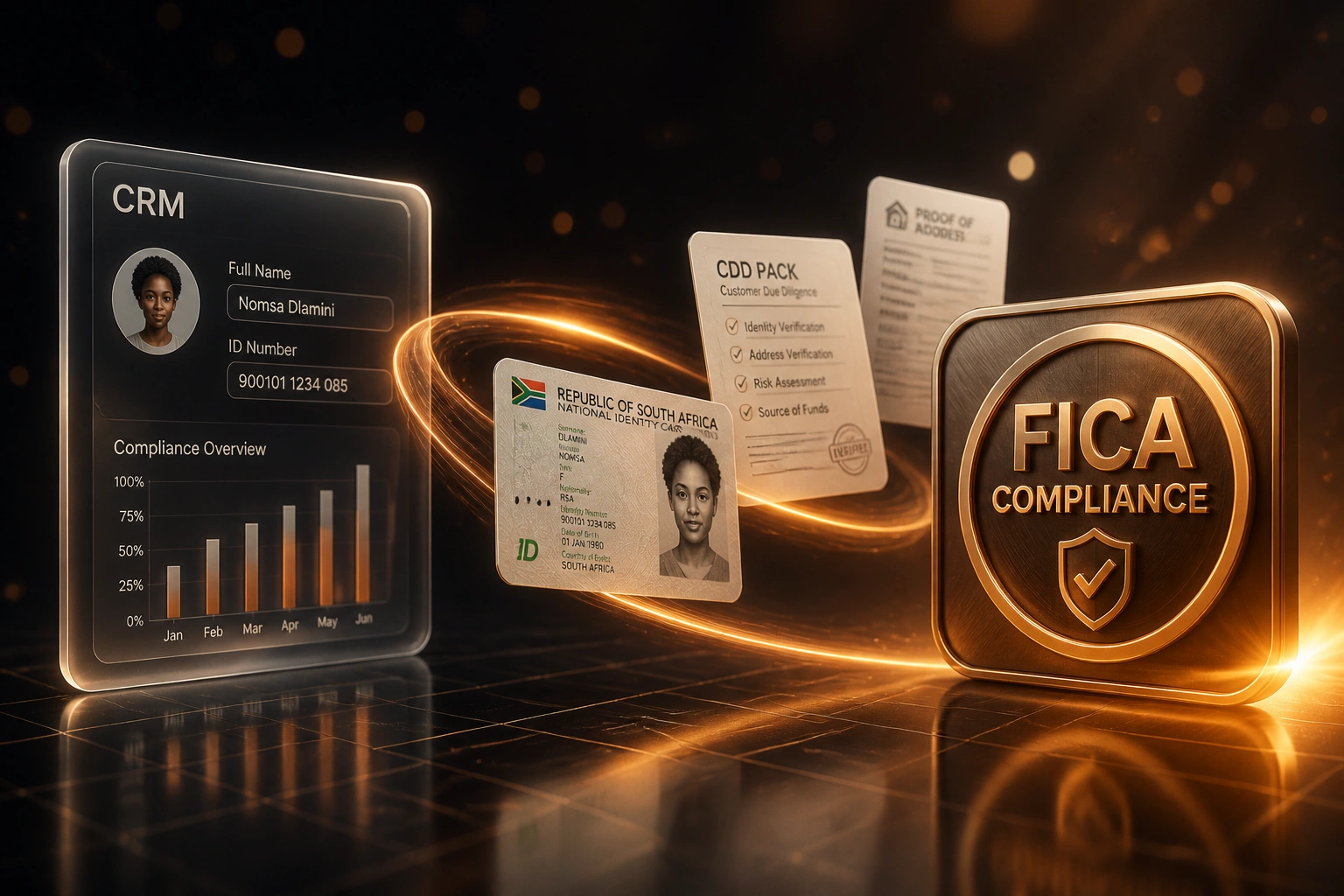
We automate the full FICA programme so packs are complete, CRM status matches the file, and you can prove what happened at onboarding.
Sound Familiar?
These are the exact issues compliance officers and MLROs describe before FICA compliance automation:
- FICA packs still live in email threads and shared drives, so nobody knows which file is complete until an examiner asks
- Compliance officers spend most of the week chasing missing IDs, proof of address, and beneficial ownership rather than assessing risk
- Clear clients wait days while incomplete packs clog the queue, and sales blames compliance for lost deals
- CRM status says "onboarded" while the CDD evidence folder is still missing timestamps, screening results, or senior approvals
- Inspection prep means reconstructing history from inboxes instead of exporting an examiner-ready evidence pack
FSCA on-site inspections rose 67% year on year in 2024/25, with 100 FICA inspections focused on RMCPs and CDD. The FIC has also flagged widespread RMCP failures. Incomplete onboarding evidence cannot be cured retrospectively once an inspection notice lands.
What FICA Compliance Automation Actually Does
Client starts → ID&V and CDD pack complete → CRM updated → examiner-ready evidence retained. No shared-drive archaeology.
Client Starts Onboarding
Documents and particulars captured through a guided journey instead of email attachments
ID&V and CDD Pack
Identity verified, screening run, risk scored, and the CDD pack assembled against your RMCP
CRM Write-Back
Verified fields, risk rating, and evidence links land in the CRM or core system sales already uses
Audit Trail Retained
Timestamps, approvals, and documents ready for FIC or FSCA sampling without inbox archaeology
Everything You Need for End-to-End FICA Verification
End-to-End ID & V
Identity and verification run as one programme step: document capture, Home Affairs corroboration, AVS where required, and liveness when your RMCP demands it.
CDD Pack Assembly
Section 21 customer due diligence packs assemble automatically: identity, address, nature of relationship, source of funds or wealth, and beneficial ownership in one case file.
Risk Routing & EDD Escalation
Your RMCP rules score each client, release low-risk files, and escalate PEPs or high-risk cases to the MLRO with the evidence already attached.
CRM & Core Write-Back
Verified fields, risk rating, and evidence links write back to HubSpot, Salesforce, Dynamics, or your core system so sales and compliance share one status.
Sanctions & PEP Screening
Screening runs at onboarding and can continue for ongoing due diligence, with hit evidence retained for the five-year record-keeping period.
Examiner-Ready Audit Trails
Every step is timestamped: who verified what, when screening ran, who approved, and where the documents live. Ready for FIC or FSCA file sampling.
Systems We've Connected for FICA Write-Back
From Nine Days to Same-Day Clear Clients
How a mid-size financial services provider stopped assembling FICA packs from email and shared drives, and got examiner-ready evidence into the CRM.
The Manual Process
- Compliance officers built each FICA pack from email attachments and a shared Drive folder
- Average nine days from application to a file marked complete for clear individual clients
- About 75 minutes of staff time assembling and chasing each pack
- Roughly 28% of sampled files were incomplete on internal pre-inspection reviews
- CRM showed "onboarded" while evidence folders still lacked screening timestamps
The Automated Process
- Guided capture, ID&V, screening, and CDD pack assembly run as one programme
- Clear, low-risk clients complete the same day with evidence already attached
- Compliance reviews exceptions instead of rebuilding packs from inboxes
- Incomplete files on internal sampling dropped below 3%
- CRM status, risk rating, and evidence links stay aligned for sales and the MLRO
Before vs After FICA Compliance Automation
How It Works
From first conversation to a live FICA programme in 6–10 weeks for most builds.
Tell Us Your Setup
Which accountable-institution schedule you fall under, how FICA packs move today, and where incomplete files or inspection risk hurt most.
Free Scoping Call
30-minute call to map ID&V, CDD pack contents, risk rules, CRM write-back, and the evidence trail your supervisors expect.
Build & Test
We build the programme workflows, test with real client profiles, and validate exception queues with your compliance officer or MLRO.
Go Live & Monitor
Switch off email-and-Drive pack assembly. Monitoring keeps verification, screening, write-back, and evidence export reliable as volumes grow.
Frequently Asked Questions
How is this different from a single KYC onboarding form?
This is the full FICA compliance automation programme: identity and verification, CDD pack assembly, risk routing, sanctions and PEP screening, CRM write-back, and examiner-ready evidence. A single form collects documents. The programme makes sure every required step happened at the right time, and that you can prove it.
Does automation replace our FICA obligations as an accountable institution?
No. You remain accountable under the FIC Act. The board or senior management still owns the RMCP. We automate the operational steps your programme already requires so packs are complete, consistent, and evidence-ready, without relying on email and shared drives.
How long does FICA compliance automation take to implement?
A focused programme covering ID&V, CDD packs, risk routing, screening, and CRM write-back typically takes 6–10 weeks from scoping to go-live. Narrower single-product journeys can be live in about 4–6 weeks. Multi-system builds with custom EDD queues and core banking write-back take closer to 10–14 weeks.
Will this help if we get a FIC or FSCA inspection notice?
Yes. Inspectors sample client files and test whether practice matches the RMCP. Automated packs retain timestamps, screening evidence, approvals, and document versions so you can produce what was done at onboarding, rather than reconstructing it after the notice arrives. Timing failures cannot be cured retrospectively.
Which systems can receive the verified FICA status?
We have written verified identity fields, risk ratings, and evidence links into HubSpot, Salesforce, Microsoft Dynamics, custom CRMs, loan origination systems, wealth platforms, core banking, and practice management tools. If your system has an API or a secure import path, we can connect it.
How much does end-to-end FICA compliance automation cost?
Programme builds typically start from around R60,000 for a focused individual-client flow with CDD packs and CRM write-back. Fuller builds with EDD escalation, multi-system write-back, and ongoing screening evidence usually sit in the R90,000–R180,000 range. Most institutions onboarding 30+ clients a month recover the build cost within 3–5 months from compliance time and fewer incomplete files alone.
Stop Running FICA on Email and Shared Drives
If your compliance team is still assembling packs by hand while supervisors ramp up CDD inspections, you are spending money on a problem that accountable institutions have already solved with automation.
Tell us which products you onboard, how FICA packs move today, and what an examiner would find if they sampled fifty files next month. We will show you exactly how an end-to-end FICA compliance programme would work for your institution.