Scheduled Web Scraping Pipelines: Fresh Data on Autopilot
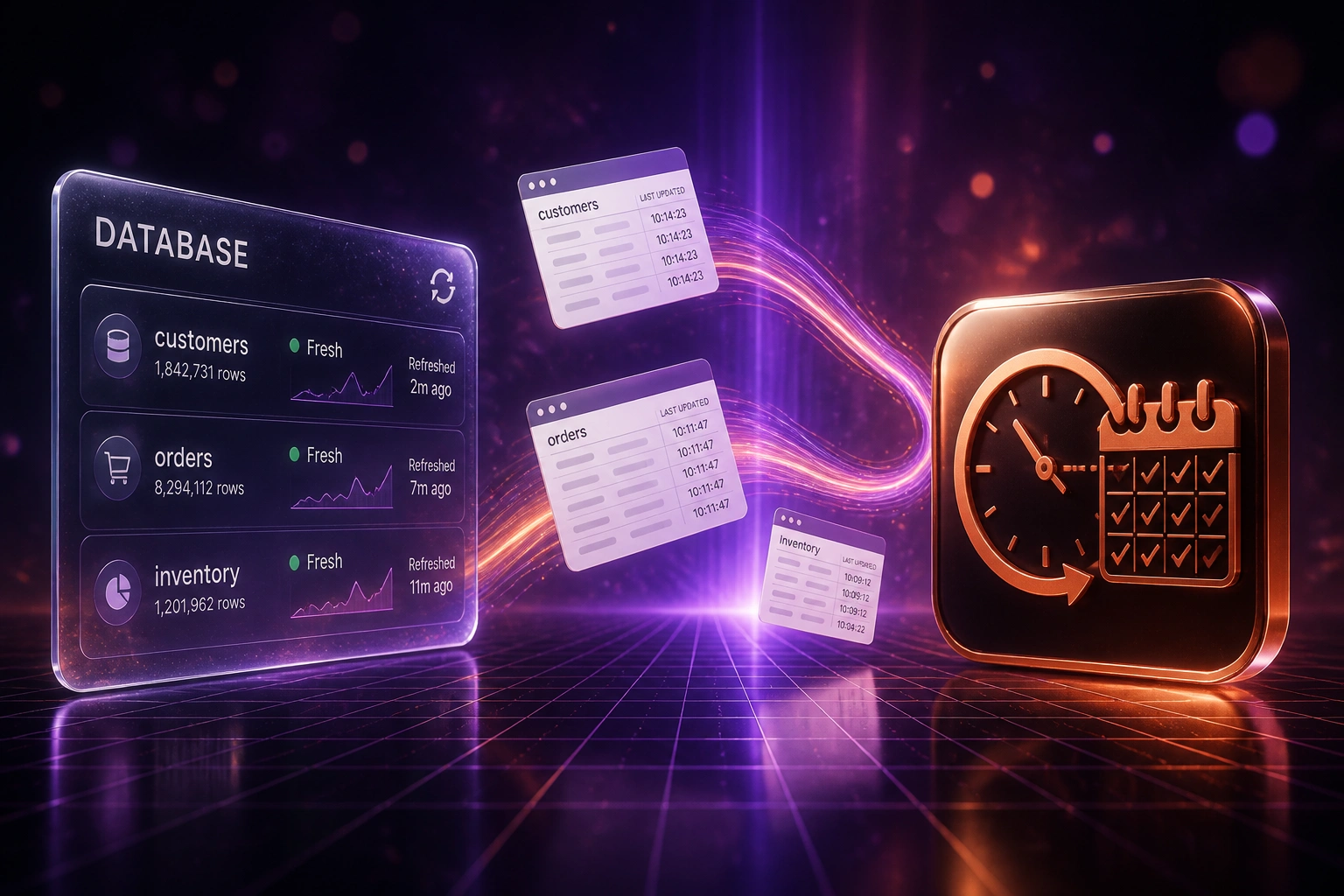
One-off scrapes go stale within weeks. Your team still re-runs a recurring web scraper by hand on Fridays, while dashboards quietly drift out of date. A scheduled scraping pipeline re-scrapes on a cadence, detects material changes, and upserts fresh rows into your database without the babysitting.
We build automated scraping pipelines that keep sources fresh and alert you when something that matters moves.
Sound Familiar?
These are the exact issues our clients faced before they replaced ad-hoc scrapes with scheduled pipelines:
- Last quarter's one-off scrape still powers this week's dashboard, so decisions rest on weeks-old numbers
- Someone on the team still re-runs the scraper manually every Friday afternoon
- When a source redesigns its page, the job keeps "succeeding" while writing empty or wrong fields
- Nobody gets alerted when a competitor price, listing, or catalogue actually changes
- Fresh rows never upsert cleanly into the database: you get duplicate dumps and conflicting versions
For competitive and algorithmic use cases, daily-only scraping is now widely treated as inadequate (ScrapingAnt freshness SLAs, 2024–2026). Platforms like Apify already ship first-class Schedules with cron expressions, yet most teams still bolt a weekend script onto a laptop. That gap is where data goes stale and Friday re-runs begin.
What a Scheduled Scraping Pipeline Actually Does
Cadence fires → sources re-scrape → changes diff → database upserts. No Friday-afternoon manual re-runs.
Schedule Fires
Cron-style cadence runs each source on the interval your freshness SLA needs
Sources Re-Scraped
Structured extract captures the fields your ops, product, or research team actually uses
Changes Detected
New snapshot diffs against the last run; only material moves raise alerts
Database Upserted
Fresh rows land via upsert or your data API; retries cover transient failures
Everything You Need for a Reliable Automated Scraping Pipeline
Cron-Style Scheduling
Hourly, daily, or weekly cadences per source, matching how fast each site actually changes, not a one-size-fits-all cron.
Change Detection
Each run diffs against the last snapshot. Material moves trigger alerts; noise and unchanged pages stay quiet.
Incremental Database Upserts
Changed records update in place. New rows insert. Unchanged data stays put, so your warehouse stays fresh without full reloads.
Failure Retries & Health Checks
Transient blocks and timeouts retry with backoff. Persistent scraper breaks raise alerts before silent empty data reaches the board pack.
Material Change Alerts
Price, stock, listing, or content shifts over a threshold land in Slack, email, or your ops channel the same day they happen.
Multi-Source Orchestration
One pipeline covers catalogues, directories, marketplaces, and research sites, with per-source cadence, schema, and destination mapping.
Platforms and Destinations We Wire Into Pipelines
From 8 Hours/Week to 45 Minutes
How a 35-person product and ops team retired Friday re-scrapes and kept every watched source under 24 hours fresh.
The Manual Process
- Analyst re-ran six scrapers from a laptop every Friday afternoon
- CSV dumps overwritten into Sheets; no upsert keys, frequent duplicates
- Two sources had been returning empty price fields for nine days before anyone noticed
- Competitive moves spotted mid-week were already stale by the next board pack
- No alerts when listings or catalogue pages actually changed
The Scheduled Pipeline
- Daily cron-style runs on Apify Schedules plus a custom upsert into PostgreSQL
- Change detection flags material price and stock moves into Slack
- Health checks catch empty-field runs within an hour, not a week later
- Ops reviews alerts; analysts spend time on decisions, not CSV paste work
- Same pipeline feeds a thin REST data API for internal tools
Before vs After a Scheduled Scraping Pipeline
How It Works
From first conversation to live scheduled pipelines in 2–4 weeks.
Tell Us Your Sources
Which sites, how stale the data can get, and which database or API should receive the refresh.
Free Scoping Call
30-minute call to set cadences, change thresholds, upsert keys, and alert rules that match how your ops team works.
Build & Validate
We wire the scheduled scrapers, run parallel against your last manual dump, and prove diffs and upserts before go-live.
Go Live & Monitor
Pipelines run on cadence. You review material-change alerts; we watch scrape health, retries, and freshness SLAs.
Frequently Asked Questions
How is a scheduled scraping pipeline different from running a script on cron?
A cron script re-runs extraction. A pipeline also diffs runs, upserts only what changed, retries failures, and alerts when scrapers go silent or when material fields move. That is the difference between a Friday afternoon re-run and a system that keeps your database fresh without babysitting.
How often should a recurring web scraper run?
Match cadence to how fast the source changes and how much staleness costs you. Competitive pricing and inventory often need daily or sub-daily runs. Catalogues and directories may be fine weekly. We set per-source schedules so you are not paying for unchanged pages on a high-frequency loop.
What happens when a website redesign breaks the scraper?
Silent empty results are the real risk: the job "succeeds" while writing nothing useful. Our pipelines monitor field completeness and run health, retry transient failures, and alert when selectors or anti-bot blocks need a human fix, so gaps show up in hours, not weeks.
Can change detection cut our scraping costs?
Yes. Naive hourly re-scrapes of 100 pages can burn tens of thousands of API credits a month, and most runs return identical content. Diffing and threshold alerts mean you spend compute on real moves, and you can pair lighter change checks with deeper extracts only when something actually changed.
How long does a scheduled scraping pipeline take to build?
A focused pilot on a handful of sources with daily cadence and database upserts is typically live within 1 to 2 weeks. Multi-source automated scraping pipelines with change alerts, retries, and warehouse delivery usually take 2 to 4 weeks from scoping to go-live.
How much does a scheduled web scraping pipeline cost?
Focused recurring scrapers into a database or Sheets start from around R25,000. Multi-source pipelines with change detection, failure retries, and warehouse or API delivery typically range from R40,000 to R80,000. Teams already burning 6–8 hours a week on manual re-runs, plus platform fees in the R3,000+ per month range for production schedules, usually see payback within 2 to 4 months.
Stop Re-Running Scrapes by Hand
If your product, ops, or research team still treats scraping as a one-off script, you are paying for stale data and Friday babysitting. Scheduled pipelines with change detection solve that.
Tell us which sources matter, how fresh the data needs to be, and where it should land (database, warehouse, or a data API). We will show you the cadence, diff rules, and upsert design that fit your operation. Pair this with our data-to-API work when internal tools need a clean feed.