School ERP and Accounting Integration: Unified Financial Management
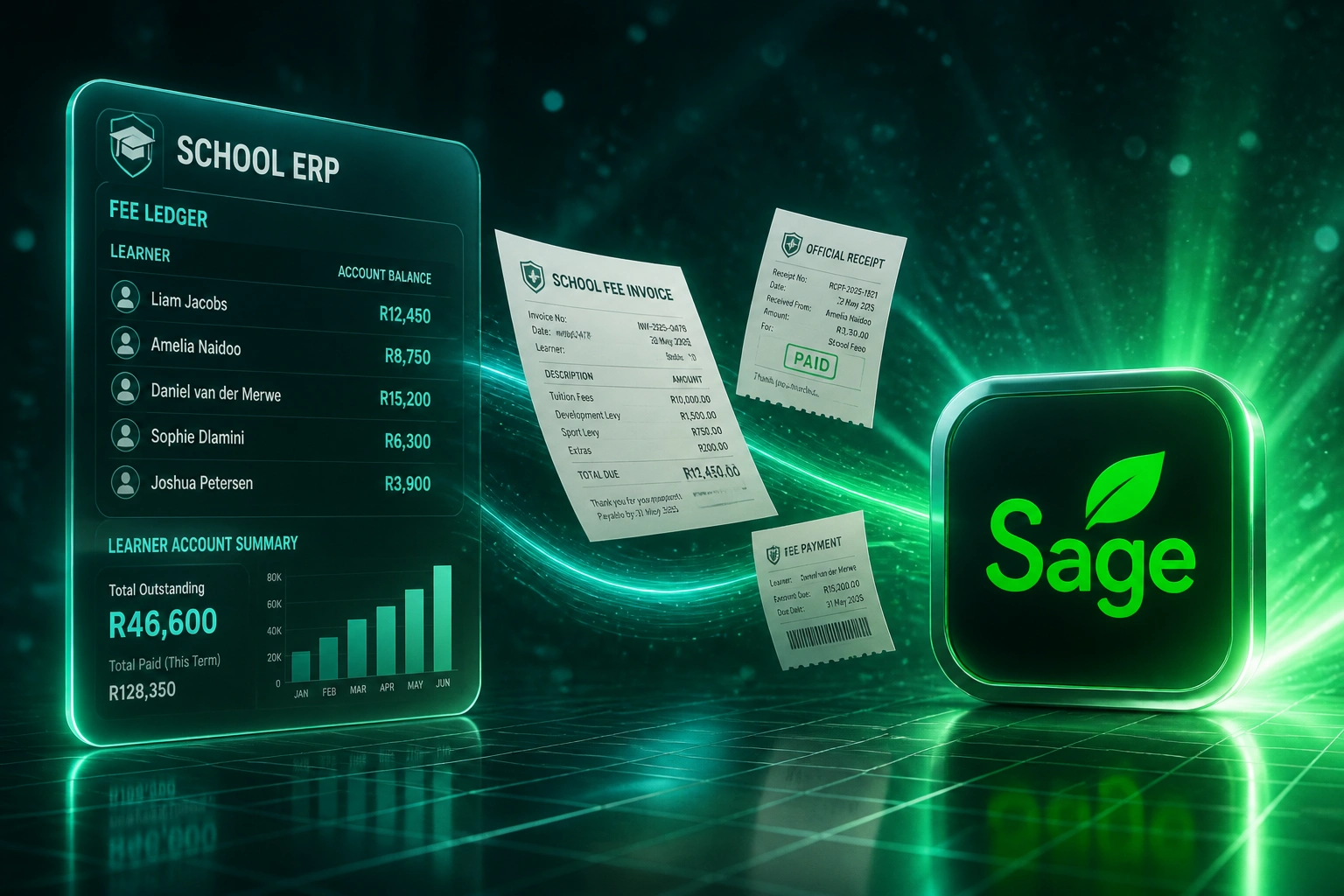
Your school fee system and the formal accounting pack live in two worlds. Every month staff retype fee receipts, payroll, and expenses into Sage, Xero, or Pastel, delaying board packs and creating audit risk.
We build the school accounting integration that unifies both ledgers.
Sound Familiar?
These are the exact issues bursars, finance officers, and SGB treasurers brought to us before a school ERP accounting sync:
- Fee receipts sit in Edupac or SA-SAMS while Sage, Xero, or Pastel stays days behind
- Finance staff retype every fee batch, expense claim, and payroll run into the accounting pack
- Month-end reconciliation eats 3–5 days before the SGB pack is even drafted
- Dual ledgers drift: learner balances and the formal GL never quite match
- Auditors and the board treasurer chase journals that should have posted automatically
Edupac and similar school ERPs expose APIs for external systems, but there is no native Sage, Xero, or Pastel bridge for most SA schools. Fee collection tools may post into the ERP; the formal accounting pack still waits for someone to retype journals. Dual-ledger workflows commonly absorb 1–2 people just keeping the books aligned.
What School ERP Accounting Integration Actually Does
Fee receipt lands → journal posts → payroll and expenses sync → board pack reconciles. No bursar copying between ledgers.
Activity in School ERP
Fee receipt, expense claim, or payroll run is finalised in Edupac, SA-SAMS, or your school admin ERP
Mapped into Accounting
Account codes, VAT, and cost centres map automatically into Sage, Xero, or Pastel
Exceptions Reviewed
Duplicates and code mismatches queue for the bursar; clean posts go straight through
Board Pack Ready
Month-end close shrinks because fee income, expenses, and payroll already match
Everything You Need for a Reliable Education Finance System Sync
Automated Fee Posting
Fee receipts and adjustments leave the school ERP and land as journals in Sage, Xero, or Pastel with the right account codes, VAT treatment, and cost centres.
Expense & Supplier Sync
Approved supplier invoices and petty-cash claims push from the ERP finance module into the formal ledger, so AP is not rekeyed at month-end.
Payroll Journal Sync
Salary runs map to payroll control accounts and statutory deductions once, then post cleanly so the bursar is not rebuilding journals from payslips.
Bidirectional Balance Checks
Learner fee ledgers and the accounting pack stay aligned. Exceptions surface for review instead of silent drift between two books of record.
Smart Error Handling
Duplicate detection, account-code validation, and automatic retries. Your team only gets alerted when a human decision is needed.
Consolidated Board Reporting
Trial balance, fee income, and payroll costs reconcile faster, so Fincom and SGB packs go out on the timetable the treasurer expects.
Systems We've Connected for School Accounting
From 16 Hours/Week to 2 Hours/Week
How a Gauteng independent school stopped dual-ledger retyping between Edupac and Sage Pastel, and got SGB packs out on schedule.
The Dual-Ledger Process
- Bursar exported fee batches from Edupac and retyped journals into Sage Pastel
- Payroll and supplier expenses followed the same manual path every month
- Roughly one in three rekeyed batches needed a correction before the pack was signed off
- Month-end stretched 4–5 working days before Fincom could see a trial balance
- SGB treasurer received last week's figures dressed up as current
The Unified Process
- Fee receipts post into Sage with mapped income and levy codes within minutes
- Payroll and approved expenses sync as reviewed journals, not spreadsheet dumps
- Exception queue catches code mismatches; clean posts need no retyping
- Month-end close drops to a half-day review and variance check
- Board packs use the same numbers the bursar already trusts in the ERP
Before vs After School ERP Integration
How It Works
From first conversation to live school ERP accounting sync in 2–6 weeks.
Tell Us Your Setup
Which school ERP, which accounting pack (Sage, Xero, or Pastel), and where dual-ledger pain hurts most.
Free Scoping Call
30-minute call with your bursar, finance officer, or SGB treasurer to map fee posting, expenses, and payroll flows.
Build & Test
We build the sync, map account codes, and run parallel for a month-end cycle so figures match before go-live.
Go Live & Monitor
Switch off retyping. Monitoring catches failed posts and code mismatches before the next board pack is due.
Frequently Asked Questions
How is this different from a school fee collection or DebiCheck system?
Fee collection tools focus on getting parents to pay. School ERP and accounting integration focuses on what happens after money and journals exist in the school system: posting fee receipts, expenses, and payroll into Sage, Xero, or Pastel so the bursar is not running two ledgers by hand. Collection channels can feed the ERP; this page is about unifying the formal books.
Which school ERPs and accounting packs can you connect?
We have worked with Edupac, SA-SAMS finance modules, d6 Finance, and custom school admin ERPs on one side, and Sage, Sage Pastel, and Xero on the other. If your ERP exposes an API, export, or database view, we can usually bridge it to the accounting pack your auditors already know.
Will this replace Edupac, SA-SAMS, or our Sage Pastel licence?
No. The school ERP stays the operational fee and learner ledger. Sage, Xero, or Pastel stays the formal accounting pack for management accounts and audit. The integration keeps both accurate without staff copying between them.
How do you handle VAT, account codes, and payroll control accounts?
During scoping we map fee income, levies, expenses, and payroll lines to the chart of accounts your accountant already uses. VAT treatment and cost centres follow your existing policy. Failed or ambiguous posts queue for review rather than inventing journals.
How long does a school ERP to accounting integration take?
A focused one-way fee-posting sync can be live in 2–3 weeks. Bidirectional setups covering fees, expenses, and payroll journals typically take 4–6 weeks, including a parallel month-end test with your bursar and accountant.
How much does school ERP accounting integration cost?
Simple one-way fee posting starts from around R15,000. Bidirectional sync with expense and payroll journals typically ranges from R25,000 to R60,000. Schools recovering 10–15 bursar hours a week usually see payback inside one or two terms against the labour cost of dual-ledger work.
Stop Retyping Between Your School ERP and Accounting Pack
If your bursar is still copying fee receipts, payroll, and expenses into Sage, Xero, or Pastel by hand, you are paying for a dual-ledger problem that integration already solves.
Tell us which school ERP you run, which accounting pack the board expects, and where month-end hurts most. We will show you exactly how automated fee posting and consolidated reporting would work for your school.