Self-Hosted CRM: Control Your Data and Costs
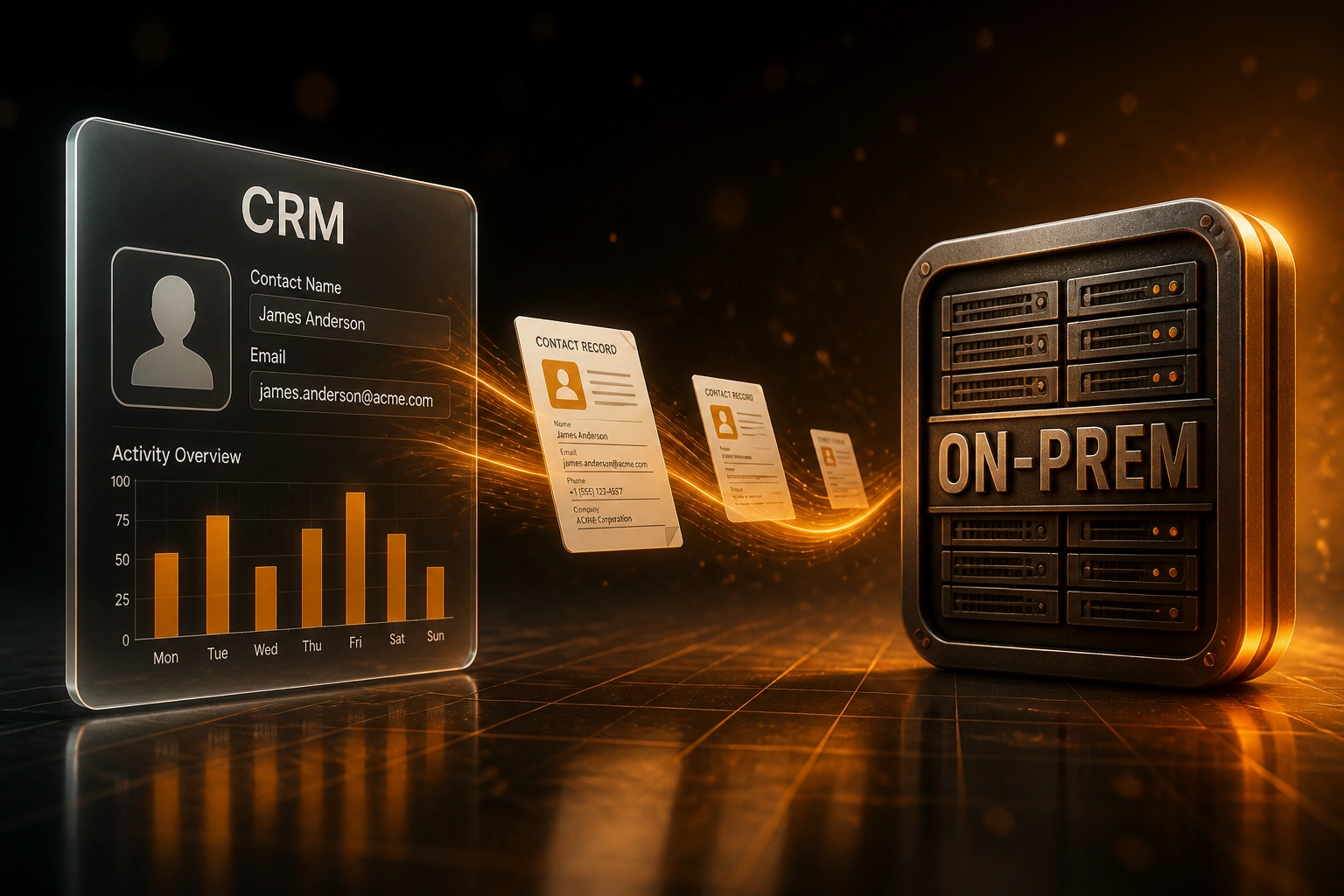
If you handle sensitive client data in law, finance, healthcare, or government supply chains, a US SaaS CRM can mean per-seat fees that never stop climbing and customer records you cannot point to on a map. Boards and compliance leads are asking harder questions about crm data control.
We deploy self-hosted and on-premise CRM that keeps data on your infrastructure, caps licence cost, and still connects to accounting and payments.
Sound Familiar?
These are the exact issues CEOs and compliance leads bring us before they leave cloud SaaS CRM:
- Per-seat SaaS fees climb every renewal, and adding three users feels like a budget decision
- Client records sit in a US or EU CRM cloud with no clear answer for the board or Information Officer
- POPIA section 72 transfer paperwork piles up every time a vendor renews its DPA
- Custom fields, API limits, and reporting sit behind Enterprise tiers you did not plan to buy
- Leaving the vendor later means 80–200 staff hours of migration and weeks of lost productivity
Salesforce raised Enterprise and Unlimited list prices by about 6% in August 2025, its first broad hike in years. On 18 Enterprise seats that is roughly R37,500 more per year before add-ons. Meanwhile South Africa’s National Policy on Data and Cloud (2024) tightens expectations for in-country storage on government-related data, and POPIA section 72 still demands documented safeguards for every offshore CRM transfer.
What a Self-Hosted CRM Project Actually Delivers
Choose the stack → migrate on your terms → connect finance → stop paying per seat forever.
Choose Your Stack
SuiteCRM, EspoCRM, or a custom CRM sized to your process and residency rules
Host Where You Decide
On-premise, private cloud, or a South African region with backups you control
Connect Finance Tools
Deals sync to Xero or Sage; payments from PayFast or cards write status back
Cap Cost, Keep Control
Licence spend flattens; client data stays under your Information Officer’s remit
Everything You Need for On-Premise CRM Data Control
On-Premise or SA-Hosted CRM
SuiteCRM, EspoCRM, or a custom CRM runs on your servers or a South African region you control. Customer data never defaults to a US SaaS estate.
Flat Licence Cost
Open-source and self-hosted stacks remove per-seat SaaS fees. Hosting and support stay predictable as your headcount grows.
POPIA-Ready Data Control
You decide residency, backups, retention, and access. Cross-border transfers become a deliberate choice, not a vendor default.
Accounting & Payment Sync
Won deals still create invoices in Xero or Sage, and PayFast or card settlements still write payment status back to the CRM.
Full Customisability
Fields, workflows, and modules bend to law, finance, healthcare, or government-supplier processes without waiting for a SaaS roadmap.
No SaaS Vendor Lock-In
You hold the database. Exports, backups, and migrations stay under your control instead of a proprietary schema and renewal cliff.
Stacks We Deploy and Integrate
From R625,000/Year in Seats to R78,000 Hosted
How an 18-seat professional practice left Salesforce Enterprise, kept client data on its own servers, and still invoiced from Xero the same week deals closed.
The SaaS Spiral
- 18 Salesforce Sales Cloud Enterprise seats at list pricing near R2,900 each per month
- Roughly R625,000 a year in licences before add-ons, sandboxes, or support packs
- August 2025 list-price hike added about R37,500 more per year with no new capability the firm needed
- Client matters lived in US regions; POPIA transfer evidence took weeks for every tender questionnaire
- Finance still retyped won matters into Xero because the native path never fitted SA VAT cleanly
The Self-Hosted Stack
- SuiteCRM on South African infrastructure with role-based access and nightly backups
- Hosting plus managed support capped near R78,000 a year, flat as headcount grows
- Deal-won sync creates draft invoices in Xero; payment status writes back without a US CRM middleman
- Information Officer can show where every contact record lives without a vendor ticket
- No per-seat cliff when three new fee-earners join mid-year
Before vs After Self-Hosted CRM
How It Works
From first conversation to live self-hosted CRM in 4–8 weeks.
Map Control & Cost
Where data must live, which seats you pay for today, and which SaaS features you actually use.
Free Scoping Call
30-minute call with your CEO, COO, or compliance lead to choose self-hosted vs hybrid and set residency rules.
Deploy, Migrate & Connect
We stand up the CRM, move contacts and deals, and wire accounting and payment integrations with parallel testing.
Go Live & Cap Cost
Switch off the per-seat spiral. Monitoring, backups, and sync alerts keep the stack under your control.
Frequently Asked Questions
What is a self-hosted CRM, and how is it different from Salesforce or HubSpot?
A self-hosted or on-premise CRM runs on infrastructure you control: your office servers, a private cloud, or a South African hosting region you choose. Salesforce Sales Cloud Enterprise lists at about R2,900 per user per month, and HubSpot Sales Hub Professional at about R1,500 per seat per month (USD list prices converted at roughly R16.50 to the dollar). Self-hosted options such as SuiteCRM and EspoCRM charge no per-seat licence, so cost stays tied to hosting and support rather than headcount.
Does POPIA require CRM data to stay in South Africa?
No blanket localisation rule applies to every private business. POPIA section 72 allows cross-border transfers when safeguards are in place, typically a binding operator agreement with POPIA-like protections. In practice, boards and Information Officers still prefer crm data control they can evidence. Government suppliers also face the National Policy on Data and Cloud (2024), which pushes in-country storage for certain government and national-security data. Self-hosted CRM makes residency a design choice instead of a US SaaS default.
Will we still connect to Xero, Sage, and payment gateways?
Yes. Self-hosted does not mean isolated. We build the same deal-to-invoice and payment-status syncs we deliver for cloud CRMs, so finance still gets automated invoices and sales still sees who has paid, without customer data living entirely inside a foreign SaaS CRM.
How long does a move to self-hosted CRM take?
Most engagements take 4–8 weeks from scoping to go-live. A clean SuiteCRM or EspoCRM deploy with one accounting sync can land in about four weeks. Larger Salesforce or HubSpot exits with custom objects, history, and several integrations take closer to 8–12 weeks. Mid-market CRM data moves commonly absorb 80–200 staff hours when the work is done poorly; we plan extraction, cleansing, and dual-run so your team is not stuck in spreadsheet hell.
What about security, backups, and load shedding?
We design role-based access, encryption in transit, scheduled backups, and monitoring as part of the build. Hosting can sit in a South African region with UPS and failover patterns suited to local power risk. You retain admin rights and audit logs instead of trusting a vendor portal alone.
How much does a self-hosted CRM project cost?
A focused SuiteCRM or EspoCRM deployment with one accounting or payment integration typically starts from around R45,000. Full migrations off Salesforce or HubSpot with bidirectional syncs, custom modules, and residency controls usually range from R80,000 to R160,000. Against Salesforce Enterprise at roughly R625,000 a year for 18 seats, most clients recover the project cost inside the first renewal cycle.
Stop Renting Your CRM One Seat at a Time
If per-seat SaaS fees and offshored client records are becoming a board and compliance problem, a self-hosted CRM is a commercial decision, not a developer hobby project.
Tell us how many seats you pay for today, where sensitive data must live, and which accounting or payment tools finance already trusts. We will show you a self-hosted or on-premise path with clear Rand numbers and a residency plan your Information Officer can defend.