Service Contract Renewals: Automate Tracking So Revenue Does Not Slip Away
Every lapsed maintenance SLA, support retainer, or managed service agreement is recurring revenue you already earned the right to renew. When expiry tracking lives in a spreadsheet, that revenue slips away quietly while ops is busy delivering the work.
We build service contract systems that track expiry, surface renewal value at risk, and trigger sales and ops renewal workflows before contracts lapse.
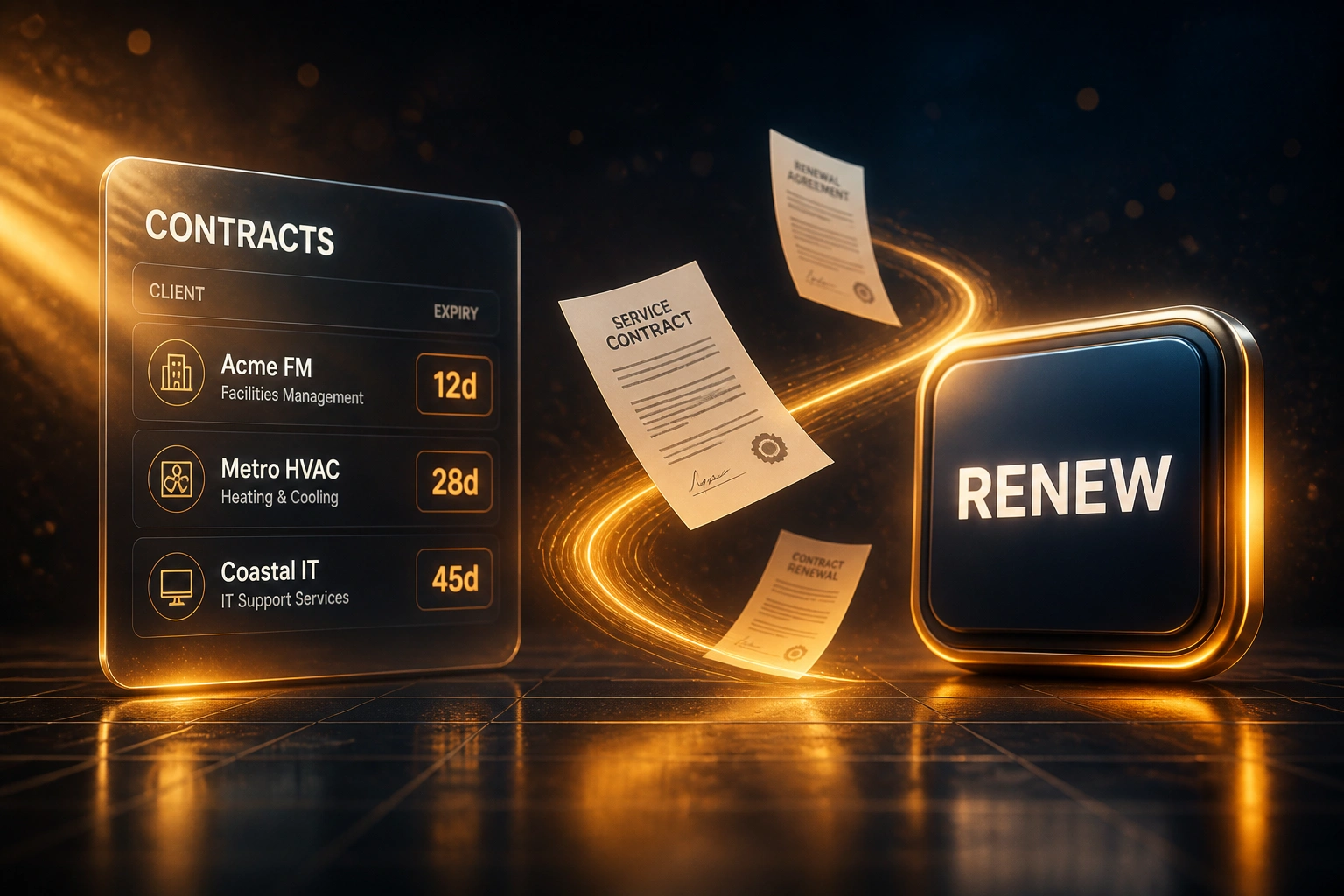
Sound Familiar?
These are the exact issues COOs and services directors bring us before we build renewal tracking:
- Expiry dates for maintenance SLAs, support retainers, and managed service agreements live in a shared spreadsheet nobody trusts
- Account managers discover a service contract has lapsed only when the client stops paying or asks why cover ended
- Renewal value at risk is invisible to leadership until the monthly revenue report drops
- Notice windows of 30 to 90 days pass without a sales or ops workflow firing, so auto-renewal or silent churn decides for you
- Ops spends 15 or more hours a week chasing dates, owners, and documents instead of protecting recurring revenue
Across 79,000 service agreements, Level CFO found formal renewal rates stuck below 3% while annual cancellation runs at 14%. Most books hope the client calls. The math says they mostly do not. Replacing lost B2B customers costs 5 to 7 times more than retaining them.
What Service Contract Automation Actually Does
Expiry approaches → renewal workflow opens → owner acts → recurring revenue stays. No silent lapse.
Expiry Hits the Register
Service contract end dates and notice deadlines feed a living register with client and ACV
Alerts Fire Early
90, 60, and 30 day alerts open against the notice window, not the day cover ends
Sales & Ops Workflow
Owned renewal tasks land in CRM or PSA with value, history, and a proposed next step
Revenue Protected
Decision logged before lapse: renew, reprice, or exit on purpose, never by accident
Everything You Need for Reliable Contract Automation
Central Expiry Register
Every service contract (maintenance SLA, support retainer, managed service agreement) lands in one register with client, value, expiry, and notice deadline.
Tiered Renewal Alerts
90, 60, and 30 day alerts fire against the notice deadline, not just the end date, so sales and ops still have runway to act.
Renewal Workflow Tasks
Each approaching expiry creates owned tasks for the account owner, with contract value, days remaining, and the next commercial action.
Value-at-Risk Dashboard
Leadership sees rand value of service contracts approaching expiry, sorted by ACV, so high-value retainers get protected first.
Sales & Ops Handoff
Renewal packs sync into CRM or PSA with usage notes, SLA history, and proposed uplift so the conversation starts prepared, not panicked.
Escalation Before Lapse
Open renewal tasks escalate to a services director when the 60 or 30 day window closes with no decision logged.
Systems We've Connected for Renewal Tracking
From 15 Hours/Week to 2 Hours/Week
How a Gauteng managed services company stopped silent SLA lapse and recovered R1.8 million in service revenue in year one.
The Spreadsheet Chase
- 140 maintenance SLAs, support retainers, and managed service agreements tracked in one shared sheet
- Ops lead spent 15 hours a week checking dates, chasing owners, and updating rows after staff turnover
- Formal renewals sat under 3%: most agreements either auto-renewed blindly or lapsed without a conversation
- Leadership only saw revenue leakage when monthly recurring figures dipped
- High-value commercial retainers got the same attention as small site visits
The Automated Register
- Central register with notice deadlines, ACV, and owners for every service contract
- 90 / 60 / 30 day alerts open renewal workflows in the CRM with proposed uplift and SLA history
- Formal renewal rate moved from under 3% to 42% on the expiring cohort
- Value-at-risk view prioritises R100k+ retainers first so the book compounds instead of leaking
- Services director gets escalations only when a decision is still open inside the notice window
Before vs After Renewal Tracking
How It Works
From first conversation to live renewal tracking in 2–4 weeks.
Tell Us Your Book
How many service contracts you hold, where expiry dates live today, and which renewals already slipped last year.
Free Scoping Call
30-minute call to map notice windows, alert tiers, ownership rules, and how renewals should hand off to sales and ops.
Build & Test
We load your register, wire expiry tracking and renewal workflows, and validate alerts against real contracts before go-live.
Go Live & Monitor
Switch off the spreadsheet chase. Monitoring confirms every approaching expiry has an owner, a task, and a next action.
Frequently Asked Questions
How is this different from generic contract renewal reminders or full CLM?
Generic reminder tools fire calendar alerts. Full CLM covers drafting, negotiation, and e-sign. This system is built for service contracts: maintenance SLAs, support retainers, and managed service agreements. It tracks expiry, surfaces renewal value at risk, and triggers sales and ops renewal workflows so recurring service revenue does not silently lapse.
How far ahead should service contract renewal tracking start?
Most B2B service agreements need action 60 to 90 days before expiry, and Common Paper found 84% of auto-renewing commercial agreements use a 30-day non-renewal notice window. We configure alerts against your real notice deadlines so the team acts before the window closes, not after.
Which systems can feed the expiry register?
We have pulled service contract data from HubSpot, Salesforce, Pipedrive, ConnectWise, Autotask, shared spreadsheets, and custom PSA tools. If the contract value, client, and expiry date exist somewhere, we can centralise them and drive the renewal workflow from that register.
Will this disrupt how our services directors and account managers work?
No. They keep working in the CRM or PSA they already use. The change is that expiry tracking and renewal tasks appear automatically with owners and deadlines, instead of a Friday discovery that a retainer ended on Monday.
What happens if nobody acts on a renewal alert?
Escalation rules push open 60-day and 30-day tasks to a services director or COO with the contract value and days remaining. High-value agreements can also page Slack or Teams so revenue at risk never stays silent.
How much does a service contract renewal tracking system cost?
Expiry registers with tiered alerts and owned renewal tasks typically start around R25,000. Setups with value-at-risk dashboards, CRM or PSA handoff, and multi-tier escalations usually sit between R35,000 and R60,000. Most mid-market service books recover that cost by protecting a single retained agreement.
Stop Letting Service Contracts Lapse Quietly
If your maintenance SLAs and support retainers still live in a spreadsheet, you are spending money to earn revenue you then forget to renew.
Tell us how many service contracts you hold, where expiry dates live today, and which renewals slipped last year. We will show you exactly how automated tracking and renewal workflows would work for your book.