SETA WSP Reporting Automation: Simplify Workplace Skills Plan Submissions
Every year your Skills Development Facilitator rebuilds the Workplace Skills Plan from HRIS exports, OFO code sheets, and manager wish-lists. Miss 30 April and the 20% mandatory grant on your Skills Development Levy is gone for the year, along with discretionary grant eligibility your training budget may be counting on.
We automate the data pull so SETA compliance becomes a review, not a rebuild.
Sound Familiar?
These are the exact issues HR Directors, SDFs, and Training Managers brought us before SETA WSP automation:
- Headcount, OFO codes, and equity targets live in the HRIS while planned interventions sit in a separate LMS or training spreadsheet
- Your SDF remaps every job title to a six-digit OFO code by hand each year, then rechecks version changes
- Managers email ad-hoc training plans in March, so the Workplace Skills Plan is rebuilt under deadline pressure
- SETA portal templates reject incomplete equity fields, wrong OFO versions, or mismatched intervention codes
- Mandatory grant and discretionary grant eligibility hang on a single 30 April submission window
The 2026 WSP window still closes 30 April. Services SETA, merSETA, HWSETA, ETDP SETA, and peer notices open submissions from February and treat midnight on 30 April as the regulated cut-off. Late or incomplete Workplace Skills Plans forfeit the 20% mandatory grant for the levy year, and unclaimed mandatory funding is transferred into discretionary pools by 15 August. Without an approved WSP, discretionary grant applications for learnerships and skills programmes are typically closed as well.
What SETA WSP Automation Actually Does
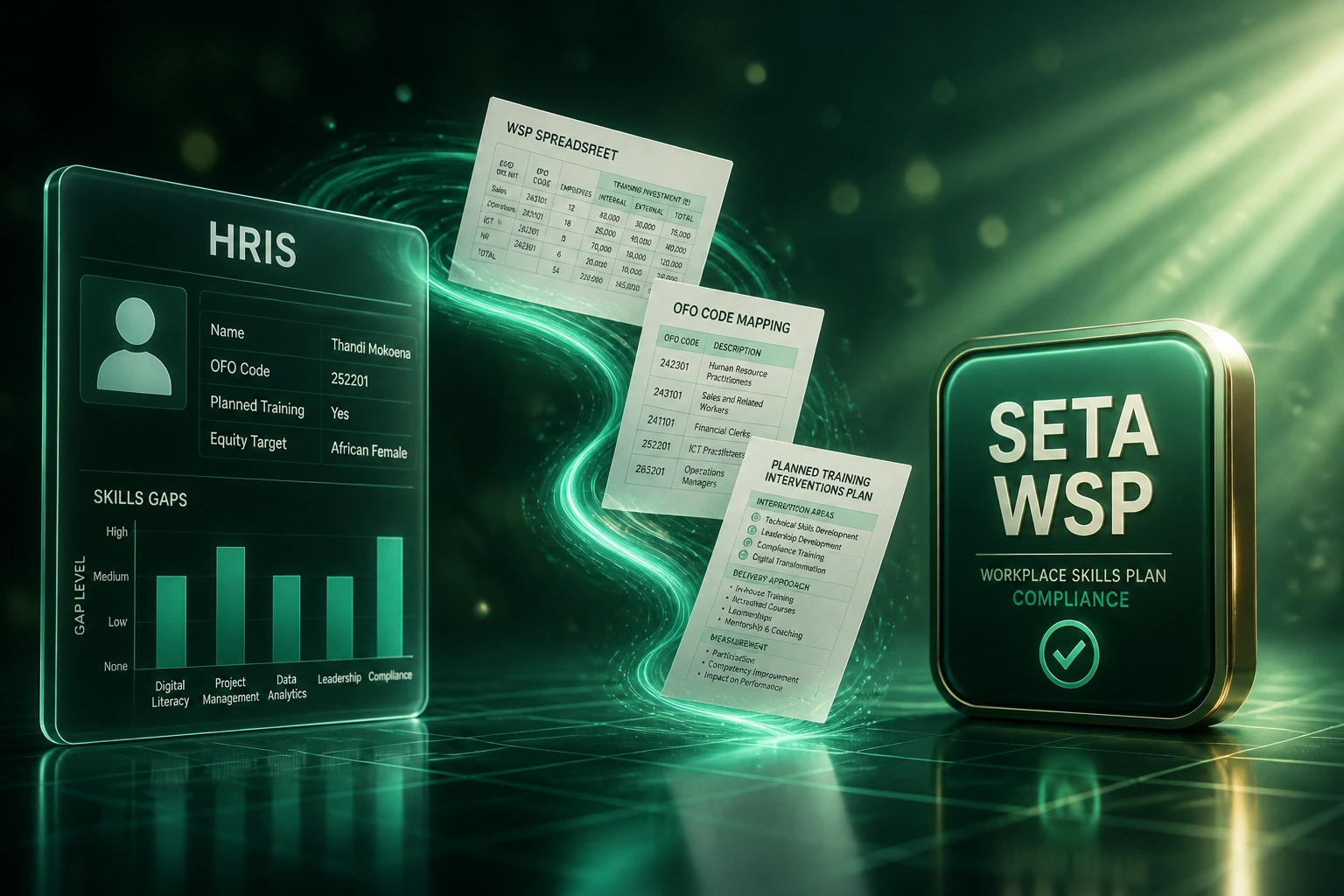
HRIS and LMS data in → OFO-mapped Workplace Skills Plan out. Your SDF reviews and submits, instead of retyping every row.
Pull Live Workforce Data
Headcount, demographics, and job titles sync from your HRIS on a controlled schedule
Map OFO & Equity
Titles resolve to OFO codes; planned learners align to equity targets before export
Attach Planned Training
LMS and L&D plans become PIVOTAL and non-PIVOTAL interventions with Rand budgets
Export SETA-Ready Pack
SDF reviews, signs off, and uploads to your SETA portal with days to spare
Everything You Need for Reliable Skills Development Reporting
HRIS Headcount Pull
Employee profiles, demographics, and occupation fields sync from your HRIS so the WSP starts from live headcount, not a stale March extract.
OFO Code Mapping
Internal job titles map to the OFO version your SETA requires (including OFO 2021 where mandated), with exceptions flagged for SDF review.
Planned Intervention Builder
Planned training from your LMS or L&D plan lands as PIVOTAL and non-PIVOTAL interventions with target groups, volumes, and estimated Rand spend.
Equity Target Alignment
Race, gender, and disability breakdowns for planned learners stay aligned to your employment equity targets before the portal rejects the row.
SETA-Ready Export
Exports match the employee-profile and intervention templates used by MICT SETA, Services SETA, BANKSETA, merSETA, HWSETA, and peer portals.
Deadline Control Tower
SDF sign-off, labour SDF countersign where required, and submission readiness are visible weeks before 30 April, not the night before midnight.
Systems We've Connected for SETA WSP Packs
From Three Weeks of Spreadsheets to a Two-Day Review
How a 180-person Services SETA employer protected an R80,000 mandatory grant and stopped rebuilding their Workplace Skills Plan from scratch every March.
The Manual Process
- HR exported payroll headcount; L&D emailed planned courses in separate workbooks
- SDF spent evenings remapping titles to OFO codes and fixing equity columns the portal rejected
- Training managers changed plans late, forcing last-minute WSP row rewrites
- Submission landed in the final week of April with no buffer for portal errors
- Finance treated the R80,000 mandatory grant as uncertain until SETA approval landed
The Automated Process
- Nightly HRIS sync keeps employee and equity fields current for the WSP draft
- OFO map resolves most titles automatically; exceptions queue for SDF review
- Planned interventions pull from the LMS catalogue with Rand cost estimates attached
- SETA template export ready two weeks before 30 April for committee sign-off
- Mandatory grant treated as expected cash, not a hope-and-pray outcome
Before vs After SETA WSP Automation
How It Works
From first conversation to a live Workplace Skills Plan pack in 3–5 weeks.
Tell Us Your Setup
Which SETA you report to, which HRIS and LMS hold people and planned training, and where OFO mapping breaks every year.
Free Scoping Call
30-minute call to map WSP fields, equity targets, PIVOTAL interventions, and the portal format your SDF must upload.
Build & Test
We wire the pulls, map OFO and intervention codes, and run a parallel dry-run against last year’s accepted pack until the SDF signs off.
Go Live & Monitor
Switch off the annual spreadsheet rebuild. Monitoring keeps planned-training and headcount feeds current ahead of the next 30 April window.
Frequently Asked Questions
What is SETA WSP automation, and how is it different from ATR work?
A Workplace Skills Plan is the forward-looking document: headcount, OFO occupations, skills gaps, equity targets, and the training you plan for the year ahead. Automation pulls that planning data from your HRIS and LMS into SETA-ready formats. An Annual Training Report covers actual training already delivered; that is a related sibling process, not what this build replaces.
Which SETAs and portals can you support?
We have shaped exports and workflows for levy-paying employers reporting to MICT SETA, Services SETA, BANKSETA, merSETA, HWSETA, ETDP SETA, and similar portals that take employee-profile and intervention templates. If your SDF uploads via LMIS, NSDMS, AIMS, or a peer system, we adapt the field map to that SETA’s current template.
How does this protect our mandatory grant?
Compliant WSP (with ATR where required) submitted by 30 April unlocks the 20% mandatory grant on your Skills Development Levy. Miss the window and that 20% is typically forfeited for the year, with unclaimed mandatory grant funding swept to discretionary pools by mid-August. BANKSETA and peer SETAs also treat an approved WSP as the gateway to discretionary grant applications.
Will this replace our Skills Development Facilitator?
No. Your SDF still owns consultation, sign-off, and the portal submission. We remove the weeks spent extracting headcount, remapping OFO codes, and reformatting planned interventions so the SDF reviews a SETA-ready pack instead of rebuilding it from scratch.
How do you handle OFO code mapping pain?
Internal titles rarely match the Organising Framework for Occupations one-to-one. We maintain a mapping table from your job catalogue to the OFO version your SETA specifies, flag ambiguous roles for human review, and refresh when DHET or your SETA updates the active code list.
How much does SETA WSP reporting automation cost?
A focused one-way pull from HRIS into a SETA-ready WSP pack typically starts from around R25,000. Builds with LMS planned-intervention sync, equity-target checks, multi-entity consolidations, and deadline dashboards usually sit in the R40,000–R75,000 range. On a R20 million payroll, the mandatory grant alone is about R40,000 a year; protecting that grant plus discretionary eligibility often pays for the build inside one submission cycle.
Stop Rebuilding Your Workplace Skills Plan by Hand
If your SDF is still stitching HRIS exports and OFO sheets into a SETA template every autumn, you are spending staff time and putting mandatory grant cash at risk on a problem that systems integration already solves.
Tell us which SETA you report to, which HRIS and LMS hold your people and planned training, and where last year’s WSP hurt most. We will show you how automated skills development reporting would look for your levy year.